Mirabell Palace has a colorful and romantic history. In 1606, it was built by Prince-Archbishop Wolf von Raitenau for his mistress Salome Alt, whom he could not marry because of his ecclesiastical rank. Nevertheless, Salome bore the prince 15 children and remained his loyal companion until he was overthrown by his own nephew Markus von Hohenems.
Hohenems drove Salome and her children out of the palace, moved in himself, and gave the palace a new name – Mirabell, from the Italian mirabile – “beautiful.” The palace and the park surrounding it are indeed considered among the finest examples of architectural and landscape art.
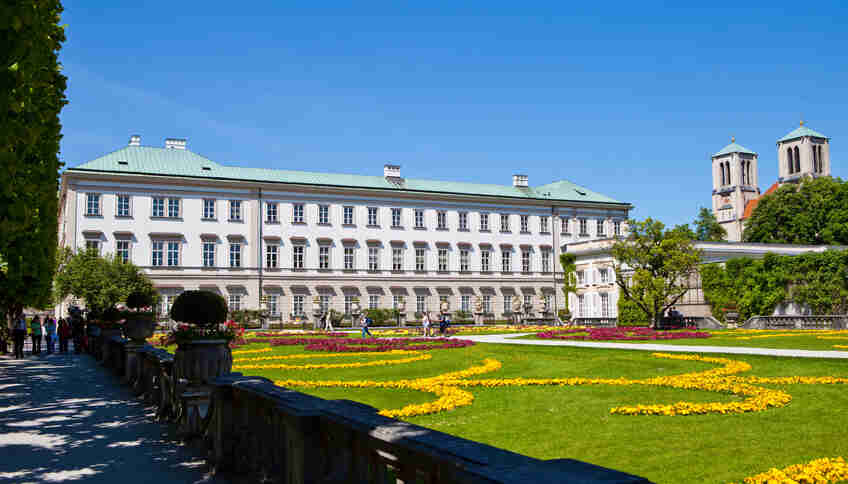
Mirabell Palace underwent several reconstructions, including a complete rebuilding under the direction of Peter de Nobile after a fire in the 19th century. Having acquired a neoclassical appearance, the palace retained the Marble Hall and the staircase from the early 17th century. The splendor of white marble, gold, and crystal makes the Marble Hall a true work of art. In the hall, where the opulence and luxury of the Baroque reign, wedding ceremonies and chamber music concerts are held.
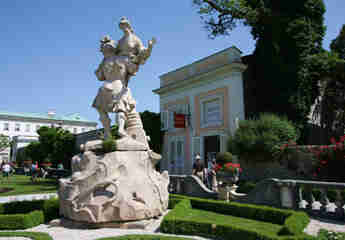
For all the beauty of the palace, which now houses the mayor's offices, the main jewel of Mirabell is considered to be not the building, but the adjoining park. The geometric Baroque-style park was created in 1690 by Fischer von Erlach. Perfect flowerbeds, elaborately trimmed box hedges, marble fountains, and exquisite sculptures place the Mirabell Gardens alongside the famous parks of Paris and Vienna. In addition to the classical statues of Greek gods and heroes, the park is known for the unusual Dwarf Garden – a group of 28 statues of dwarfs depicting the everyday activities of burghers.