
Van Gogh's works occupy the top spots on the list of the world's most expensive paintings. Many of them have been sold at auction for more than 100 million dollars! And the artist himself has already become surrounded by the most incredible legends. That is why visiting the Van Gogh Museum in Amsterdam will be interesting even for those who are far from Post-Impressionism, and for true connoisseurs even more so.
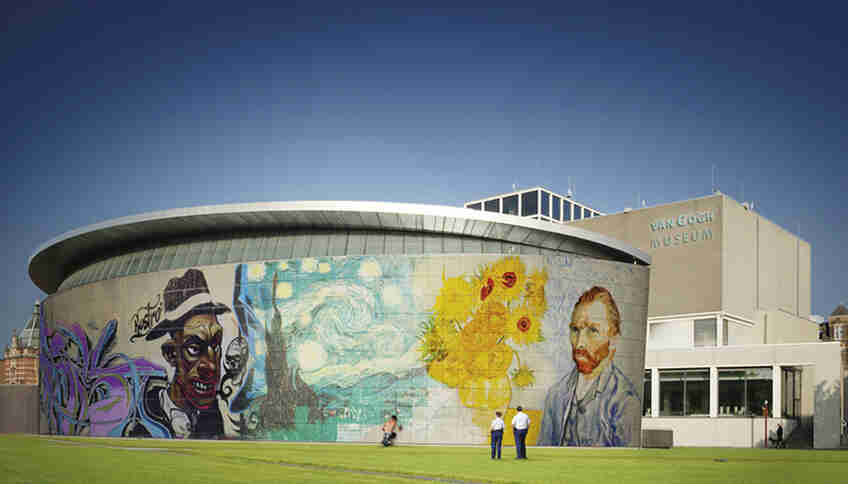
The building housing the collection is located on Museumplein in Amsterdam. Under its roof is housed a unique and, most importantly, the most complete collection of works by Van Gogh and other famous artists, such as Picasso, Gauguin, Monet, etc.
The core of the exhibition consists of paintings created during different periods of Vincent Van Gogh's life. They are conventionally divided into five sections: early paintings, works from the Paris period, life in Arles, the stay in Saint-Remy, and the Auvers-sur-Oise period. And all of this in just 10 years! That is exactly how long Van Gogh's creative life lasted, because he began painting when he was 27, and at 37 he took his own life. However, the artist left behind a very rich “legacy”: 864 paintings and almost 1200 drawings and prints.
The largest collection of his works - more than 200 paintings, about 440 drawings, and 31 prints - is now kept at the Van Gogh Museum in Amsterdam. Many of his other canvases can be found in the Kroller-Muller Museum in the Netherlands and the Orsay Museum in France. The rest of his works are represented by single pieces in various museums around the world and are also in private collections.
The Van Gogh Museum in Amsterdam was founded in 1973, and before that the master's paintings were kept first by his brother, Theo Van Gogh, and then by his wife. The fact is that Theo died literally the following year after Vincent's death, and then the entire “legacy” passed to his wife, and later to his nephew, Vincent Willem Van Gogh. It was he who transferred all the works still in his possession to the artist's museum.
Now not only Van Gogh's canvases are presented here, but also numerous letters that he wrote himself or received from his loved ones. Mostly, this is correspondence with his brother Theo. It is considered improper to read other people's letters, but in this case it is simply necessary in order to understand or at least imagine what the artist wanted to convey in one painting or another, what he was going through at that moment, what he was thinking about. These letters are like the diary of a genius, his thoughts, emotional torments, fears, and hopes.
In the museum you can see originals of Van Gogh's most famous works, including the paintings “The Potato Eaters,” “Bedroom in Arles,” as well as one of the three versions of “Sunflowers.” In 2002 the museum was robbed. The thieves took two Van Gogh paintings, “Congregation Leaving the Reformed Church in Nuenen” and “View of the Sea at Scheveningen.” And although the thieves were caught and sentenced to prison, the canvases themselves have still not been found. Their total value is estimated at 60 million dollars.
Unfortunately, this is not the only case of Van Gogh paintings being stolen. He is generally considered the most “frequently stolen” artist. Incidentally, as recently as 2013, another famous Van Gogh painting, “Poppies,” worth 50 million dollars, disappeared from an Egyptian museum.