
Oslo Manor has several other names: the traditional one – Oslo Ladegård and the descriptive one – the Old Bishop's Palace. The reason for so many names lies in the rich and complex history of this place, which began back in 1210.
At that time, the residence of the Catholic bishops in Oslo began to be built here, and it was more a well-fortified stone castle than a palace. In the Middle Ages, church and state were inseparably linked, and bishops took an active part in the political life of the country. It was in the bishop's castle that the union of Norway and Sweden was signed in 1319, after the death of the Norwegian king Haakon V.
The building of the Old Bishop's Palace was damaged during Swedish attacks in 1523 and almost destroyed during the Reformation in 1537. In 1579, a Renaissance-style building was erected on the same site, where the wedding of James I, king of Scotland and England, and Anne of Denmark took place in December 1589.
After the capital's fires of 1722, only the foundation of the castle remained, built to last from rough stone, and it was on this foundation that Oslo Manor was built in 1725.
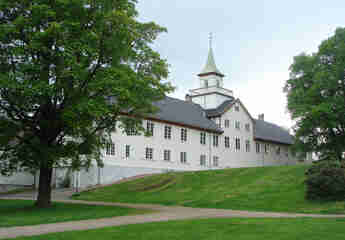
The building was erected in a simple and laconic style, with a gabled roof and white walls above a high ancient base. The manor is surrounded by a beautiful landscaped park, recreated from a map of the park dating from 1779. Shaped hedges, small fountains, and garden sculptures have become a worthy setting for one of Oslo's greatest historical treasures. Classical music concerts are often held in the manor itself, in its Baroque-style halls.