This historic district of Yaroslavl was formed as early as the 13th century. The gentle banks of the Volga turned out to be convenient for grazing and breeding cows, which is how the area got its name. In addition to dairy and meat production, fishing was practiced here for a long time. In 1584, this territory was incorporated into Yaroslavl.
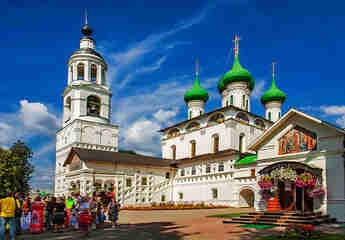
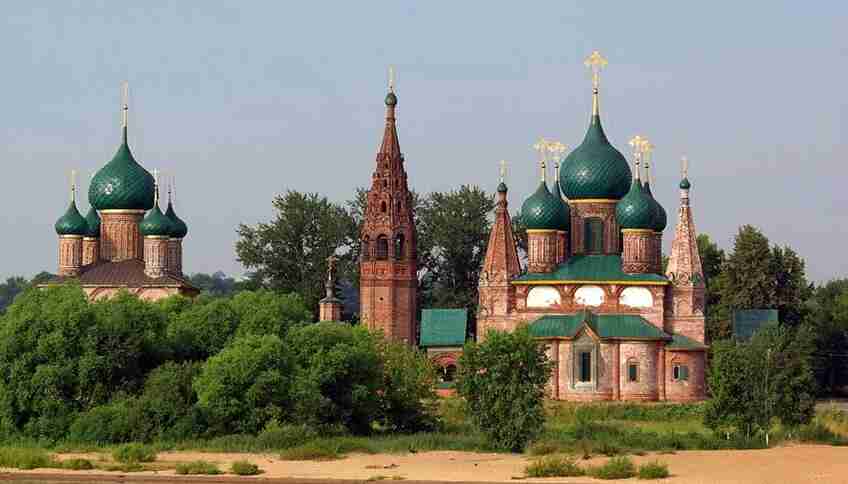
Today Korovnitskaya Sloboda is famous for its magnificent architectural ensemble, consisting of the Church of John Chrysostom and the Church of the Vladimir Icon of the Mother of God. Both churches are rightly considered fine examples of Russian architecture, and each of them is unique in its own way.
The Church of John Chrysostom was built in 1649-1654. This red-brick church, generally atypical for Russia, was built mainly with funds from the wealthy local Nezhdanovsky family. Thanks to the colored tile friezes and carved brick ornaments, the church looks very elegant. Light enters the interior through 12 large windows. The five-tier iconostasis of the 18th century, decorated with Baroque carving, deserves special attention. The church has many old icons and wall paintings.
In 1669, the Church of the Vladimir Mother of God, intended for services during the winter season, was built next to it. Like the neighboring church, it is crowned with a striking five-domed composition. In 1680, an elegant, slender bell tower was erected between the churches.
Since 1992, reconstruction and restoration of the churches damaged in Soviet times has been underway. At present, they belong to the Yaroslavl-Kostroma Diocese of the Russian Orthodox Old-Rite Church.