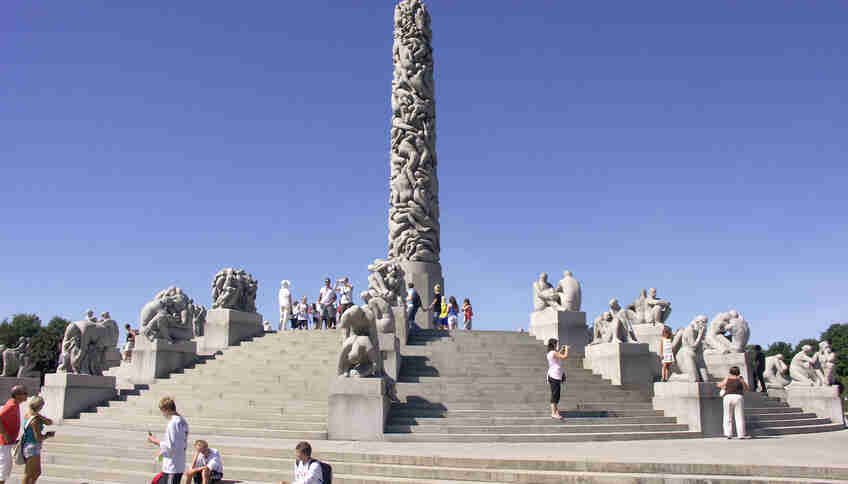
Updated for 2026: Vigeland Park remains one of Oslo's easiest year-round stops: open-air, spacious, and best enjoyed slowly, with time to wander beyond the Monolith itself.
Gustav Vigeland never pinned down a single meaning for his sculptures. He preferred to leave the interpretation to the viewer, which is why different people can stand in front of the same work and see completely different things.
Across the vast sculpture park inside Frogner Park, Vigeland spent decades creating what feels like a whole landscape of human emotion. Men, women, children, and older figures dance, laugh, grieve, cling to one another, and struggle. Some scenes are playful, some unsettling, and many work best not as a puzzle to solve but as something you simply feel.
At the heart of the ensemble stands the Monolith, a towering column of intertwined nude figures carved from a single block of granite. Vigeland saw in it a vision of human life and striving, with people supporting, carrying, and pushing one another upward. Others read it differently - as desire, ambition, faith, or the endless cycle of existence.