Bogoyavlensko-Anastasiin Convent

sobory.ru, Pavel and Elena Kallinikov
The Bogoyavlensko-Anastasiin (Bogoyavlensky) Monastery is a convent (formerly, until 1863, a monastery for men) located in Kostroma on Simanovskogo (Bogoyavlenskaya) Street. The Bogoyavlensky Cathedral houses the Feodorovskaya Icon of the Mother of God, a miracle-working icon of the Virgin venerated by the Russian Orthodox Church and known as one of the shrines of the House of Romanov. The monastery was founded by Venerable Nikita, a native of the Moscow region, disciple and relative of Venerable Sergius of Radonezh, former abbot of the Vysotsky Monastery in Serpukhov and later of the Vysoko-Pokrovsky Monastery in Borovsk. Initially all the buildings of the cloister were wooden. In the 16th century the monastery's wooden walls protected Kostroma on the approaches to the city. In 1559 construction began on the Bogoyavlensky Cathedral, the oldest surviving stone structure in the city of Kostroma.
Ioanno-Zlatoustovskaya Church

fotki.yandex.ru, Marina Saif
The Ioanno-Zlatoustovskaya Church (the church in the name of St. John Chrysostom, Archbishop of Constantinople) is an Orthodox church in the historic center of Kostroma. It was never closed in Soviet times and for more than 30 years served as the cathedral of the Kostroma diocese. The rector of the church is Archpriest Valery Bunteev. The first mention of the church dates back to 1628. At the beginning of the 17th century, this site was occupied by an ensemble of two wooden churches — the 'winter' one in the name of the holy martyrs Florus and Laurus (which gave its name to Lavrovskaya Street) and the 'summer' one in the name of John Chrysostom. The Kostroma cadastre book says: 'On Zlatoustenskaya Street in Kuznetsy there is a stipend-supported wooden cage church of the holy martyrs Florus and Laurus, and the church site of John Chrysostom.' The latter, at the time the cadastre book was compiled, had most likely burned down, leaving behind only a 'church site'.
Prospekt Mira

fotki.yandex.ru, olg92110357
Prospekt Mira is an avenue in Kostroma that runs from Susaninskaya Square to Prigorodnaya Street. Its length is 4 km 200 m.
A. N. Ostrovsky Kostroma State Drama Theater

Panoramio, Nikitin_Sergey
The A. N. Ostrovsky Kostroma State Drama Theater is a drama theater, one of the oldest theaters in Russia. The A. N. Ostrovsky Kostroma State Drama Theater was founded in 1808. In 1812, the Moscow Imperial Theatre was evacuated from Moscow to Kostroma, which had a tremendous influence on the city's culture and laid the foundation for its theatrical traditions. The theater building was constructed in 1863 and has survived to the present day almost unchanged. The building is a fine example of classical architecture, alongside such Kostroma buildings as the Fire Tower and the Borshchov House. Over many years, many famous actors took part in theater productions: Mikhail Shchepkin, Maria Yermolova, Valentina Fedotova. Beginning in 1854, plays by Alexander Ostrovsky were staged on the theater's stage for the first time in the provinces. Largely thanks to this theater, the name of the famous playwright was bestowed on it in 1923. All plays by A.N. have been staged in the theater.
Kostroma Historical, Architectural and Art Museum-Reserve

k156.ru
The Kostroma Historical, Architectural and Art Museum-Reserve is a state cultural institution, the largest museum in Kostroma and the Kostroma Region. The founding of the museum in Kostroma dates back to 1891 and is connected with the activities of the Kostroma Provincial Scholarly Archival Commission. In 1913 the commission was housed in the building of the Romanovsky Museum, built for the celebration of the 300th anniversary of the House of Romanov according to the design of the city architect . The new building at the beginning of Pavlovskaya Street (now Prospekt Mira) was opened in the presence of the imperial family. The museum's first collections were related to the history of the Romanov royal dynasty. Since 1913 the museum has been reorganized many times. Throughout the 20th century the museum collection was enriched with unique items: artworks and graphic works by E. V. Chestnyakov, the weapons collection of the Cherevin nobles, the Eastern collection of G. A. Ladyzhensky, and others.
Romanovsky Museum
livejournal.com, neferjournal
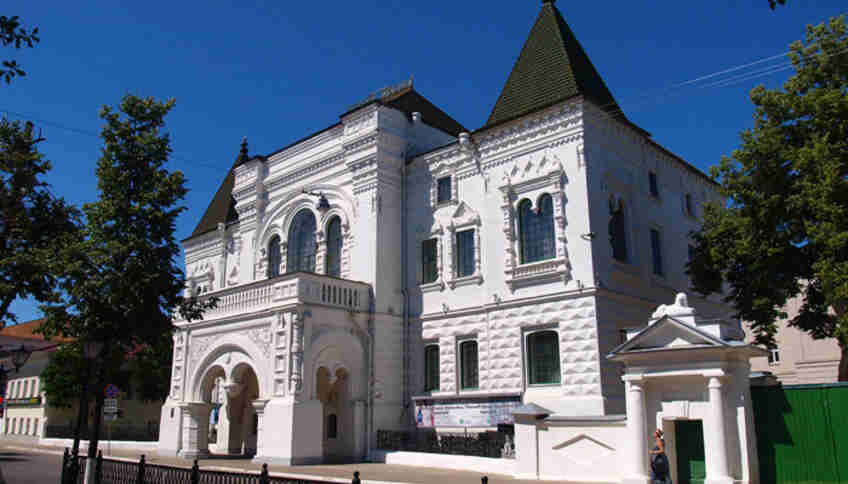
The Romanovsky Museum is a museum in Kostroma created in 1913 for the celebration of the 300th anniversary of the Romanov dynasty, one of the best-known buildings in provincial Russian cities constructed specifically for a museum. The forerunner of the Romanovsky Museum was the 'collection of antiquities' gathered by members of the Kostroma Provincial Scholarly Archival Commission (KSUAC) under the leadership of historian N. N. Selifontov (1835—1900). The provincial scholarly archival commission, established in July 1885, collected, researched, described, and published written sources while occupying several rooms in the Noble Assembly building on Pavlovskaya Street (now Prospekt Mira). It was here, in two rooms on the first floor, that the Kostroma Museum of Antiquities — the first museum institution in Kostroma Province — was opened in 1891. Soon the commission raised the question of the need to build a separate museum building, and the Kostroma nobility donated a small neighboring plot of land for construction.
Borshchov House

Panoramio, Alexander Khmelkov
The Borshchov House in Kostroma is an architectural monument of the age of classicism, one of the largest estates in the city from the first quarter of the 19th century, of exceptionally important urban-planning significance in the development of the center. Architect N. I. Metlin. In Kostroma, Lieutenant General S. S. Borshchov owned an old estate with wooden houses located on the central Yekaterinoslavskaya (now Susaninskaya) Square. After the general retired, construction of a stone wing began in 1819, and then in 1824, according to the project of provincial architect N. I. Metlin, a magnificent classical-style mansion was erected. It is known that Nicholas I stayed there, as did his son, heir to the throne Alexander II, with his tutor, the poet V. A. Zhukovsky, during a visit to Kostroma in 1834. In the fire of 1847 the house was badly damaged and was sold unfinished by the elder Borshchov's heir to the merchant A. A. Pervushin from Alexandrov.
Guardhouse

fotki.yandex.ru, palborum
The building of the former guardhouse in Kostroma is an architectural monument of the late classical (Empire) era, one of the city's landmarks, and part of the architectural ensemble of Susaninskaya Square. Architect P. I. Fursov. According to the 1781 general development plan of the city, a wooden guardhouse was built on the bank of the Volga near the Moscow outpost. A guardhouse is the main guard post, later in the Russian army a guard building, that is, a place to house the personnel of the main guard. Since the Middle Ages, Kostroma always had a strong garrison — streltsy, artillerymen, and arquebusiers, then, from the 18th century, the Old Ingermanland Musketeer Regiment, the Chernigov Musketeer Regiment, and others. Since the mounting of the main guard is a fascinating spectacle, guardhouses were placed on the main squares of cities, and famous architects were engaged in designing and constructing these buildings.
Fire Tower

Panoramio, Alexander Khmelkov
The Fire Tower in Kostroma is an outstanding architectural monument of the classical era, one of the city's landmarks and the main adornment of central Susaninskaya Square. Architect P. I. Fursov. The tower was built on the initiative of Governor K. I. Baumgarten (1768−1831), who issued an order: In November 1823, provincial architect P. I. Fursov drew up the design plans for the building and the construction estimate; in April 1824 they were reviewed and approved in St. Petersburg; on May 3, 1824, a contract for the construction of the tower was concluded. Construction of the tower was carried out in 1824—1825 by contractor A. Stepanov; finishing work was done according to Fursov's sketches by an artel of plasterers under the direction of A. P. Temnov and Yaroslavl stucco masters S. S. Povyrznev and S. F. Babakin 'and comrades' in 1825—1827.
Susaninskaya Square

Panoramio, Gordey44
Susaninskaya Square is the central square of the city of Kostroma. It arose according to the regular plan of Kostroma of 1781-1784. The development of the square is a complete architectural ensemble of the late 18th—19th centuries, exemplary in its kind. The square arose under the name Yekaterinoslavskaya according to the regular plan of Kostroma of 1781—1784. Before the fire of 1773, from 1619, its site was occupied by the territory of the New Town of the Kostroma Kremlin, and before that — the town posad. The square was built up in the late 18th century — first quarter of the 19th century. Initially the configuration of this square was conceived as semicircular, but in implementation it acquired a 'faceted' shape. In 1823 the square was paved, and in 1835 by decree of Nicholas I it was renamed from Yekaterinoslavskaya to Susaninskaya. P. I. Sumarokov wrote in 1838: In 1851 a monument to Tsar Mikhail Fyodorovich and the peasant Ivan Susanin (sculptor V. I. Demut-Malinovsky) was unveiled in the center of the square, and in 1900 a small garden was laid out around it.
Ivan Susanin Monument

fotki.yandex.ru, SVETLANA 51RUS
The monument to Tsar Mikhail Fyodorovich and the peasant Ivan Susanin is a monument erected in Kostroma in 1851 in honor of the legendary feat during the Time of Troubles. The author of the monument was sculptor V. I. Demut-Malinovsky. The monument stood in the city center, in the middle of Susaninskaya Square. It was destroyed in 1918—1928. In 1967, a monument to Ivan Susanin by sculptor N. A. Lavinsky was installed in Kostroma. The highest permission for the construction of the monument to Mikhail Fyodorovich and Ivan Susanin in Kostroma was granted on June 8, 1835, during Nicholas I's visit to the provincial city 'as testimony that noble descendants saw in Susanin's immortal feat — the saving of the life of the tsar newly chosen by the Russian land through the sacrifice of his own life — the salvation of the Orthodox faith and the Russian kingdom from foreign domination and enslavement'.
Trading Rows

fotki.yandex.ru, KAN
The Trading Rows are a trade and warehouse complex of the late 18th and early 19th centuries that occupies several blocks from Susaninskaya Square to the former kremlin in the very center of Kostroma. It is an exemplary monument of urban planning art from the time of Catherine's municipal reform. In the 17th century Kostroma reached its economic heyday and became one of the economically significant cities of Muscovite Russia. A large commercial center arose in Kostroma. At first trade was conducted in wooden stalls. But after the fire of 1773, when all the shops, warehouses, and houses were destroyed, a general reconstruction of Kostroma began. New trading rows were to be built of stone: work began in 1775. The basis was an 'exemplary' design of trading rows signed by the Vladimir provincial architect Karl von Kler. Architects S. A. Vorotilov, V. P. Stasov, P. I. Fursov, and N. I. Metlin also took part in the design and construction of the buildings.
Church of the Savior in the Rows

Panoramio, Sanchez Gaidabura
The Church of the Savior in the Rows is a five-domed Orthodox church of the mid-18th century that is part of the ensemble of the Trading Rows of the city of Kostroma. The first mention of the Church of the Savior dates to 1628, when the cadastre book for Kostroma mentions an empty church site in the market, and 'the church was of the All-Merciful Savior, the Procession of the Honorable Trees of the Life-Giving Cross.' And already in the sixties of the 18th century, through the care of merchant Stefan Semyonovich Belov, a stone Church of the Savior was erected in the traditions of pre-Petrine architecture — five-domed, pillarless, single-apse — and was consecrated in 1766. In 1787 the city magistrate decided, in accordance with the new general plan of 1781, to build a Gostiny Dvor, the design of which, indicating only general dimensions, was prepared by the chief architect of the viceroyalty, K. Kler.
Molochnaya Gora Street

fotki.yandex.ru, Salty Sea Dog
Molochnaya Gora is a street in the historic center of Kostroma. It connects Susaninskaya Square and 1 Maya Street, descending from the monument to Ivan Susanin to the embankment of the Volga River. It has largely preserved its historic buildings, which are of considerable interest. The street arose under the name 'Yekaterinoslavskaya' according to the regular plan of Kostroma of 1781—1784 to connect the central Yekaterinoslavskaya (now Susaninskaya) Square with the Volga embankment. The street, built up along the slope to the river with low, plastic buildings, was meant to 'open up' the square from the river side. The concept was also emphasized by the unity of the names of the square and the street. The name 'Molochnaya Gora' became attached to the street by the end of the 19th century thanks to the many women selling milk, cheese, and other dairy products from the settlements on the right bank — Gorodishche, Pantusovo, Selishche, and others — who crossed the Volga every morning and lined the slope along the street. At the same time, the official name — Yekaterinoslavskaya Street — never changed.
Chapel of St. Nicholas the Wonderworker

fotki.yandex.ru, Charleya57
The Chapel of St. Nicholas the Wonderworker on Molochnaya Gora is a miniature Orthodox church built in the 1840s according to a classical design by provincial architect P. I. Fursov on the site of the Bread Rows in Kostroma. The chapel originally had the shape of a rotunda, but later it was slightly rebuilt and lost its 'round' appearance. The chapel is decorated with columns framing the entrance and facade, but overall it is without architectural refinements. In Soviet years the chapel was closed, its premises were adapted for retail use, and the dome of the chapel was dismantled. In 1977—1979 the chapel building was restored. During the perestroika years the chapel was given over to the 'Instruments' store. In 1995 the Chapel of St. Nicholas the Wonderworker was given to the diocese. It became a metochion of the Trinity-Sypanov Pakhomievo-Nerekhtsky Monastery. Now the chapel has been fully restored: the cross has been restored, the domes have been gilded, and new interiors have appeared.

Yandex.Fotki, aroshektaev
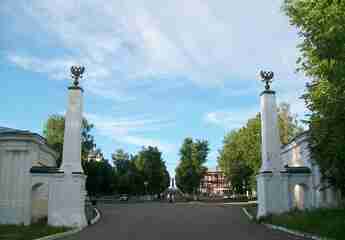
This gate in Kostroma has a rather indirect connection to Moscow. The obelisks were installed in 1823 for the visit of Emperor Alexander I, who at that time was traveling around Russia. Local architect P. I. Fursov was instructed to arrange the entrance to the city for the arrival of this important guest. Thus two four-sided obelisks topped with double-headed eagles were installed, with rusticated walls adjoining them.
At the beginning of the 20th century, the composition was slightly rebuilt in honor of the celebration of the 300th anniversary of the House of Romanov — two small buildings designed by architect N. I. Gorlitsyn appeared on both sides of the obelisks.
The double-headed eagles were dismantled during the October Revolution of 1917 for understandable reasons, but in 1993 they were restored to their former place.
Only the two obelisks have survived to the present day in their original form; the remaining elements of the ceremonial entrance were either rebuilt or abolished.
In the 20th century, the Moscow Gate lost its functional significance. Today it is an architectural landmark of Kostroma and an object of Cultural Heritage of the Russian Federation.
Monument in Honor of the 300th Anniversary of the House of Romanov

Yandex.Fotki, elena-oresh
The Monument in Honor of the 300th Anniversary of the House of Romanov is a monument laid in the Kostroma Kremlin in honor of the 300th anniversary of the House of Romanov. It was conceived as a 36 m structure with 26 sculptures of historical figures and bas-reliefs around the pedestal illustrating the most important events of Russian history. The sculptural ensemble in Kostroma was supposed to become the main monument to the 300th anniversary of the House of Romanov. In 1903, while preparing for the jubilee, the deputies of the Kostroma City Duma came up with the idea of creating a monument-temple in Kostroma in honor of this event. For several years work went on to organize an all-Russian fundraising campaign for the construction of the monument and to choose a place for its installation. A commission consisting of artists A. M. Opekushin, L. N. Benois, and V. A. Beklemishev also recommended choosing the high bank of the Volga on the territory of the Kostroma Kremlin for the monument, and L. N.

fotki.yandex.ru, Irsen
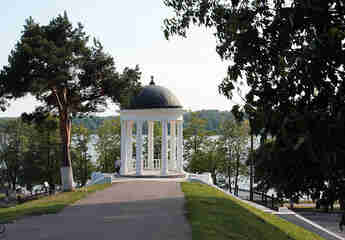
The great Russian playwright Alexander Nikolayevich Ostrovsky is connected with Kostroma by family roots. His father graduated from the Kostroma seminary, and the family owned the nearby estate of Shchelykovo, where Ostrovsky spent the last years of his life.
Alexander Nikolayevich often visited Kostroma and lived here for some time. Many themes in his plays were connected, one way or another, with the Kostroma Region. He loved walking along the picturesque banks of the Volga, contemplating the tranquil surface of the river and the mesmerizing landscapes.
In 1956 it was decided to install a gazebo on the high riverbank and name it after Ostrovsky as a tribute to the famous Russian writer. By the way, it was installed exactly on the spot where Ostrovsky most often spent time making sketches for his works. Earlier, the remains of the earthen fortifications of the Kostroma Kremlin were located here.
The structure looks very simple and elegant. The domed roof is supported by seven white columns. The architectural style is reminiscent of buildings that were popular in the 19th century on Russian noble estates.
After climbing the steps to the gazebo, you will be enchanted by the magnificent panorama of the Volga and the shoreline — it becomes clear where the genius of Russian drama drew his inspiration.
Church of the Resurrection on Debra

fotki.yandex.ru, -SHUM-
The Church of the Resurrection of Christ on Debra (Resurrection Cathedral) is an Orthodox church in Kostroma, on the bank of the Volga River. The Resurrection Church on Debra is the only surviving posad church of the 17th century in Kostroma. It was built in the mid-17th century, no later than 1652. Nizhnyaya Debrya is one of the ancient streets of Kostroma, running along the left bank of the Volga. The street name points to dense thickets by the river, a forest-overgrown lowland, a wilderness. This version is confirmed by the name of another ancient street running nearby — Lesnaya. However, already in the 17th century another name competed with Nizhnyaya Debrya — Nizhneberezhnyaya Street, and from the second half of the 19th century, Nizhnyaya Naberezhnaya Street. According to legend, the first church 'on the lower debra' was erected by the Kostroma prince Vasily Yaroslavich (1248—1276).

teremsnegurochki.ru
You should go to Kostroma to visit Snegurochka! Forget boring Lapland, because it is in Kostroma, on the Volga, that the heroine lives and warmly welcomes her guests. Even the famous playwright A.N. Ostrovsky, while living in Kostroma Province, wrote the fairy tale 'Snegurochka'.
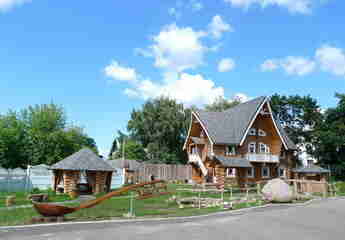
Grandfather Frost's granddaughter has her own home, and not just a home, but a real terem. This beautiful fairy-tale wooden building was built especially so that both children and adults could touch a miracle.
Snegurochka's Terem is located on Lagernaya Street and is surrounded by lush greenery, creating the feeling that you have entered a forest. Snegurochka is helped in greeting guests by Domovoy, Domovikha, and cat Bayun.
The interior of the main room is impressive: there is lots of light, decoration, and bright colors. So that Snegurochka does not accidentally melt, an Ice Room was made for her, where everything is made of ice, and guests are treated to drinks — children are served a miracle cocktail, and adults something stronger.
The entertainment program appeals to everyone — children are delighted by the games, songs, dances, jokes, and little sayings, and adults keep up and often join in the fun.
Snegurochka's Terem often also receives newlyweds; humorous contests are organized for them, they are told about Russian traditions, and an original photo session is held.