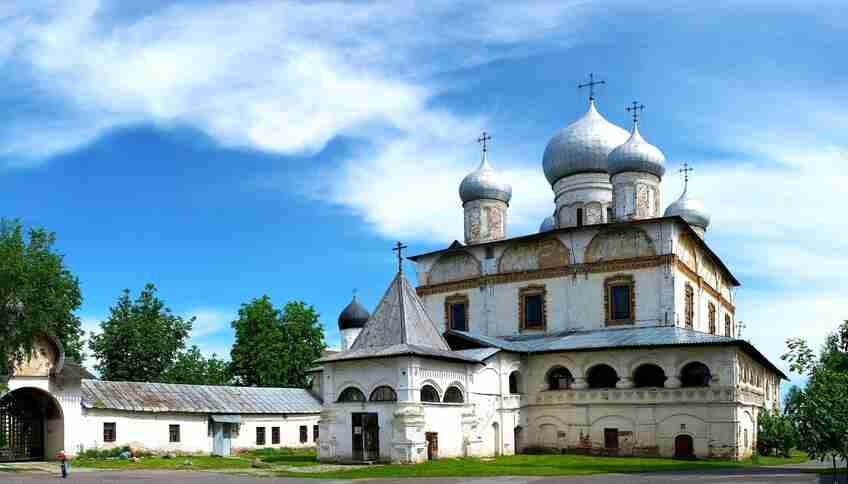
Desyatinny Monastery

ipetersburg.ru
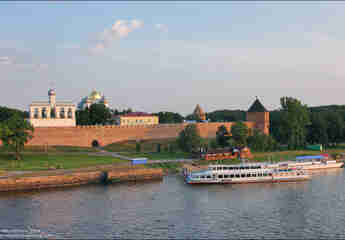
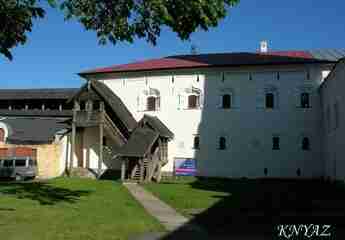
Desyatinny Monastery is a defunct former second-class convent of the Russian Orthodox Church in Veliky Novgorod. It is located in Lyudin End, south of Prusskaya Street. It adjoins the line of the rampart of the Okolny Gorod. There is still no single opinion as to why the monastery is called exactly that. Although it is known that the first stone church built in Kiev almost immediately after the Baptism of Rus was called the Church of the Tithes. Perhaps the name of the monastery is connected with the fact that it was built on princely land - a 'tithe.' The first mention of the monastery in the Novgorod chronicle dates back to 1327: 'Archbishop Moses built the Church of the Nativity of the Holy Mother of God in Desyatina.' In 1397, the Novgorod posadnik Isak Onkifov erected a new Church of the Nativity of the Mother of God. In 1413, Ivan Morozov erected another stone church in the monastery, that of John the Baptist. Other buildings gradually appeared - stone cell-walls, a chapel, a refectory, and a kvass brewery.
State Museum of Artistic Culture of the Novgorod Land

cirota.ru
The State Museum of Artistic Culture of the Novgorod Land is a state budgetary institution of culture and art in Veliky Novgorod. The museum is located on the grounds of Desyatinny Monastery, an architectural monument of the 14th-19th centuries, and is one of the cultural centers of Veliky Novgorod. Until 1994, the northern building of Desyatinny Monastery housed creative workshops where icon painters, woodcarvers, painters, and ceramic artists worked. In January 1994, the Regional Educational and Production Center of Artistic Creativity was opened here, which in 2002 received the status of the State Museum of Artistic Culture of the Novgorod Land. The initiator of the opening and the first director of the Museum of Artistic Culture of the Novgorod Land (1994-2008) was Galina Viktorovna Gavrilova, Honored Worker of Culture of the Russian Federation.

novgorodmuseum.ru
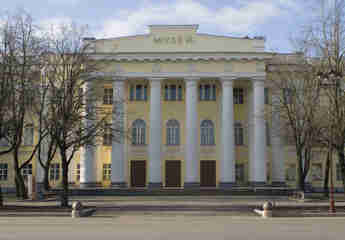
The museum, presenting Russian art of the 18th-20th centuries, is housed in a beautiful building in the style of classicism. This elegant mansion was built in 1851 as the Palace of the Deputies' Assembly, where meetings of the nobility and city and district authorities were held for more than 50 years. Concerts, balls, performances, and meetings of scholarly societies were also held here. And in 1862, Emperor Alexander II and his family were even received here.
In Soviet times the palace was radically rebuilt, and the pre-revolutionary facade decorations - district coats of arms, ornate pediments, and stucco - were removed. Now only 8 tall white columns remain of the decor.
The museum, whose collection includes canvases by Aivazovsky, Bryullov, Rokotov, Repin, and other great Russian artists, opened in 2001. In addition to painting, sculpture and graphic art are presented here. The selection of portrait miniatures is also very interesting, where you can see both celebrities and 'ordinary mortals,' whose images were painted by famous portraitists.
In addition, various themed exhibitions are constantly held on the third floor of the Museum of Fine Arts.
Kremlin Park
visitnovgorod.ru
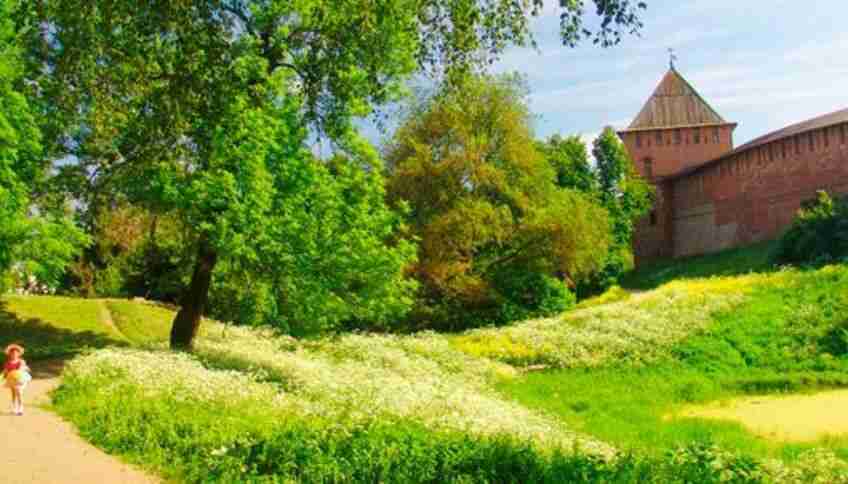
Kremlin Park is located on the Sofia Side in the historical center of Veliky Novgorod. On three sides it curves in a semicircle around the Novgorod Detinets. On the outer side it is bounded around the perimeter by the streets Rozvazha, Gazon, and Meretskova-Volosova. On the inner side it adjoins the defensive moat running along the walls of the Detinets. The area of the park is 25 hectares. The park arose on the site of the Small Earthen City, which surrounded the Detinets on three sides. In 1812, the earthworks were leveled. At the same time, a plan appeared according to which the freed space was supposed to be planted with trees and thus create the Summer Garden. The plan was carried out halfway - only in the northern part. The southern part was built up with houses. Originally, Kremlin Park was called the Summer Garden. Its area was 22 hectares. In 1885, a wooden city theater building was constructed in the Summer Garden on the grounds of the 'children's gymnastics' area.
Pedestrian Bridge

nemiga.info
The pedestrian bridge over the Volkhov River is located in Veliky Novgorod. It connects the Sofia and Trade sides in the area of the Novgorod Detinets and Yaroslav's Court. The first Novgorod bridge - the Great Bridge, which stood on this same spot - is mentioned in the chronicle in 1133. Although it was rebuilt many times, it was nevertheless actively used until 1944, when it was blown up by retreating Nazi troops.

boris-mavlyutov.livejournal.com
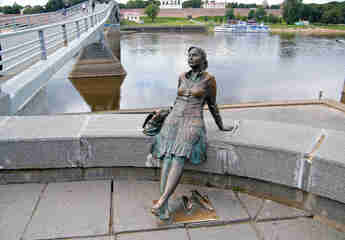
The Monument to the Tourist in Novgorod appeared not so long ago - on June 17, 2009, it was installed to mark the celebration of City Day. But in just a few years this charming sculpture became a favorite of residents and visitors alike. Everyone takes pictures near it; even Dmitry Medvedev, during his presidential visit to Veliky Novgorod, sat on the bridge parapet to take a photo.
The tourist is a young woman, our contemporary, in an ordinary blouse and skirt. She settled on the parapet by the Kremlin pedestrian bridge with her back to the river. The girl leans on her hands, reclining back and turning her face to the sun. Her handbag stands nearby on the parapet, and her shoes have been kicked off and lie next to her bare feet. It is a quite realistic scene from the life of any person who set out on a long walk through a big city, got tired, sat down to rest, and threw off annoying shoes. In the twilight or in the light of the evening lamps, this sculpture can even be mistaken for a living person, especially since the monument to the tourist is made exactly life-size. A local legend says that you must definitely leave a coin in one of the girl's discarded shoes, and then you will certainly return to Novgorod.
The author of the monument, Novgorod sculptor Vadim Borovykh, created the sculpture commissioned by publisher Nikolai Sumarokov, who wanted to give his native city an unusual and charming gift.

Flickr, kamenskiyan
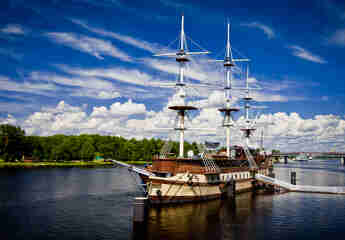
«Fregat Flagman» is, without a doubt, the most beautiful and original restaurant in Veliky Novgorod. It is housed in a grand copy of a 66-gun frigate of the 18th century that bore the name «Holy Apostle Peter».
Moored opposite the Novgorod Kremlin, the three-masted ship complements the traditional panorama of the city. Its exterior decor copies, and even embellishes, an old vessel of the imperial fleet. The interior of the restaurant halls is simply luxurious, and most of the rooms are designed in the style of the 18th-19th centuries.
The «Fregat Flagman» complex consists of five restaurants and bars. The «Europe» restaurant offers pizza and other Italian dishes, fine wines, and an impressive panoramic view of the river and the Kremlin. The «Admiralsky» banquet hall with its luxurious interior in white and gold tones provides the best service for an important celebration. In the «Japanese Courtyard» you can enjoy sushi and rolls prepared in front of you while sitting on cozy sofas separated from neighboring tables by screens. The grill bar has an extensive menu of dishes, alcoholic cocktails, and light decor in a pirate style - it makes you want to shout 'yo-ho-ho' and demand more rum!
On the two decks of the «Admiral» night club, parties are held; there is plenty of dancing space here, and the best DJs of the city and the country spin the music.
Znamensky Cathedral

fotki.yandex.ru, baranov.michael.2011
Znamensky Cathedral is located in Veliky Novgorod near the Church of the Transfiguration of the Savior on Ilyina Street. It was founded in 1682 on the site of a dismantled 14th-century church - the Church of the Sign of the Mother of God. Metropolitan Kornily acted as the initiator and organizer of the construction of the church to house Novgorod's cherished shrine - the icon of the Mother of God, which received the name «The Sign». The cathedral was built with funds from the House of Holy Sophia. Moscow streltsy took part in the stonework. Carpentry work was carried out by two artels of Novgorod carpenters. The cathedral was consecrated in 1688. In 1669, the church burned, after which it was repaired. In 1699, iconostases were installed in the main altar and side chapels. Their carved frames were executed in the technique of openwork ('flemmed') carving. The names of two carvers who took part in the work are known: Ivan Timofeev and Vasily Kobylinsky. Under Metropolitan Job, an ensemble of wall paintings was created in 1702.
Church of the Transfiguration of the Savior on Ilyina Street

fotki.yandex.ru, baranov.michael.2011
The Church of the Transfiguration of the Savior on Ilyina Street is a church in Veliky Novgorod, built in 1374 and famous for being the only place where frescoes by Feofan Grek have survived. The painting was done in 1378. The First Novgorod Chronicle contains a record of the creation of the church: 'In the year 6882 (1374 from the Nativity of Christ), a stone church of the Holy Savior on Ilyina Street was built and consecrated by Archbishop Alexei of Novgorod with the hegumens, priests, and choir singers of Holy Sophia (St. Sophia Cathedral).' The church was built by the residents of Ilyina Street - the main street in the Slavensky End of Novgorod (the Trade Side on the opposite bank of the Volkhov from the Detinets). It was preceded by a wooden church built by Bishop Nikita and known since the 12th century thanks to the processional icon of the Mother of God «The Sign», through which, according to legend, Novgorod was miraculously saved in 1169 from the Suzdalians besieging the city. A special chapel was arranged for the revered Novgorod shrine, which burned down in 1340.
Church of Fyodor Stratilat on the Brook

fotki.yandex.ru, baranov.michael.2011
The Church of Fyodor Stratilat on the Brook is a 14th-century church in Veliky Novgorod. It is located at the intersection of Andreevskaya Street and Fyodorovsky Ruchey. The church was founded in 1360 by order of the Novgorod posadnik Semyon Andreevich on the bank of the stream. The stream is mentioned in the chronicle under 6613 as Plotnitsky. Later it became Fyodorovsky. Construction was completed within a year. For several centuries the church was a parish church for Fyodorova Street of the Plotnitsky End. In 1954, during the laying of the Moscow-Leningrad road, Fyodorovsky Ruchey was filled in. Today the church is located on the left side of Fyodorovsky Ruchey Street.