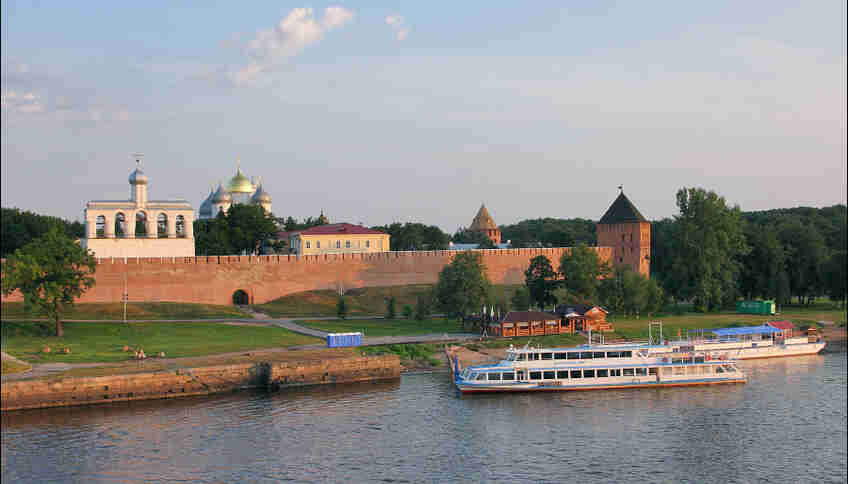
Novgorod Detinets

Flickr, Cartas para Elisa
Novgorod Detinets (also Novgorod Kremlin) is the fortress of Veliky Novgorod. The Detinets is located on the left bank of the Volkhov River. The first chronicle mention of it dates back to 1044. It is an architectural monument of federal significance and is protected by the state. Novgorod Detinets, as part of the historic center of Veliky Novgorod, is included on the UNESCO World Heritage List. The northern part of the modern Detinets once formed a delta created by a tributary of the Volkhov with two branches, whose territory was divided into two island-like sections. G. M. Shtender supposed that the very first fortress occupied the central part of the modern Detinets in the sector between the Vladimirskaya and Prechistenskaya towers (that is, the central islet). According to V. L. Yanin, the earliest Detinets was located in the northwestern part of the modern Kremlin in the area of the Vladychny Dvor (that is, on the northern islet). On the site of the Novgorod Detinets in the 10th—11th centuries there were residential estates of the Ludin End.
Memorial «Eternal Flame of Glory»

livejournal.com, ixicor
The memorial «Eternal Flame of Glory» in Veliky Novgorod is located on the grounds of the Novgorod Detinets between the Zlatoustovskaya Tower and the now non-existent Resurrection Tower (the entrance to the Detinets from the side of Sofia Square). The authors are the Leningrad artists and architects Ya. A. Svirsky, V. M. Skorokhodov, E. M. Rapoport, and P. Yu. Yushkantsev. Until 1965, there were two mass graves on the site of the modern memorial. One contained 6 people from among Soviet figures of the Novgorod Governorate who died in 1923—1937. In 1937, a monument in the form of a pink reinforced-concrete column was erected on their grave, with a marble plaque bearing the names attached to it. The second burial site was in close proximity to the first and appeared in 1944. Here 19 soldiers of the 59th Army who died in January—February 1944 were buried. In 1965, both burial sites were united in one place under a single gravestone. On May 8 of the same year, the memorial «Eternal Flame of Glory» was solemnly unveiled.
Monument «Millennium of Russia»

Flickr, Osdu
The monument «Millennium of Russia» is a monument erected in Veliky Novgorod in 1862 in honor of the thousand-year anniversary of the legendary calling of the Varangians to Rus. The authors of the monument project are the sculptors Mikhail Mikeshin, Ivan Schroeder, and the architect Viktor Hartmann. The monument is located in the Novgorod Detinets, opposite St. Sophia Cathedral and the former Government Offices building. The monument is a gigantic orb-of-state on a bell-shaped pedestal; the overall outline of the monument is bell-shaped (according to some assumptions, it was intended to «proclaim to descendants the heroic past of Russia»). Around the orb-of-state are six sculptural groups. The total height of the monument is 15.7 m (height of the pedestal — 6 m; height of the figures — 3.3 m; of the cross on the orb — 3 m). The diameter of the granite pedestal is 9 m; of the orb-of-state — 4 m; of the circumference of the high relief — 26.5 m.
Novgorod Museum-Reserve

Flickr, Tarakanov Dmitry
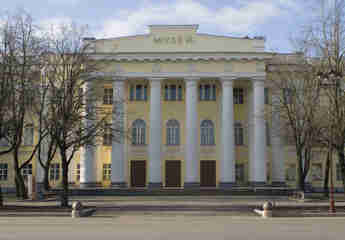
The Novgorod State United Museum-Reserve (NGOMZ) is a state museum covering the territory of Veliky Novgorod and the Novgorod Region, with its administration in the Novgorod Detinets. Director — Grigoryeva N. V. The first Novgorod museum was founded in 1865 and was originally called the «Novgorod Museum of Antiquities under the Provincial Statistical Committee». Its opening is connected with the celebration during that period of the 1000th anniversary of the Russian state. The initiator of the museum's creation was N. G. Bogoslovsky. A brief chronology of the main dates in the life of the museum: In the post-revolutionary period, the Novgorod museum collections were replenished mainly through the nationalization of church and estate property (the museum-estates «Marino», «Gruzino», and «Vybiti» were disbanded), as well as from the liquidated private museums of V. V. Peredolsky (Museum of Antiquities) and V. A. Molochnikov. From the beginning of the 1930s, additions began to come from the work of archaeological expeditions.

culture.natm.ru
Art, historical, and museum exhibitions, interactive tours, and educational games are held in this center on a regular basis.
In the musical and art salon, which is organized monthly, you can practice dancing, try playing different musical instruments, and show your talents in drawing. The works of participants in this educational activity are then shown as part of the «One-Day Exhibition», and all visitors continue socializing at a festive sweet table. This event can help a child decide on their hobbies and interests, choose whether they want to заниматься dancing, playing the violin, or painting.
Master classes in decorative and applied arts and traditional crafts are held in the center's classrooms. Perhaps your child will enjoy fashionable decoupage or quilling, or maybe they will be more attracted to good old woodburning, modeling, or embroidery.
The folklore program of the Children's Museum Center is aimed at studying Russian traditions, customs, and old games. For older schoolchildren, a Center of Military History has been created, where they can study the past of Russia and create models of fortresses and dioramas of famous battles, which will then be exhibited in competitions in museums.
Kokui Tower

Flickr, Tarakanov Dmitry
Kokui (Kukui, Watchtower, Kalanchovskaya) is a four-sided blind (non-passage) tower in the southwestern part of the Novgorod Detinets. The tower is rectangular in plan, 8.5 × 10.4 m. The height of the tower with the dome is 38.5 m, and the thickness of the walls at the level of the first tier is 2 m. The tower is crowned with a ten-meter tent roof. The tower is located in the southern part of the Kremlin and differs from the other towers in its distinctive shape and height.

visitnovgorod.ru
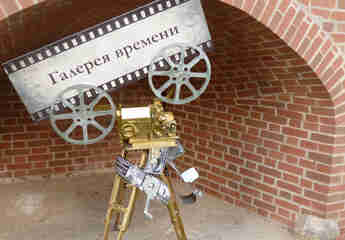
«Time Gallery» is an innovative project that includes an exhibition of historical objects and screenings of documentary and feature films.
Besides the unusual exhibition format, its location also makes it special. «Time Gallery» is located in the Kremlin wall, in the inner space of the fortress wall between two defensive towers. In 1991, this section of the fortifications collapsed; a few years later it was restored, leaving spacious rooms inside, which have served as exhibition halls since 2012.
It is worth noting that «Time Gallery» houses a unique collection of film equipment, including cameras that were used to shoot the most iconic events of the 20th century. Footage from old films — pre-revolutionary, documentary, and wartime — is projected directly onto the walls of the gallery.
In 2014, two cinemas opened here, each рассчитан for 14 people. In them you can watch documentary or feature films devoted to the themes of the exhibitions. Screenings take place every 30-60 minutes.
Church of Andrey Stratilat

strana.ru
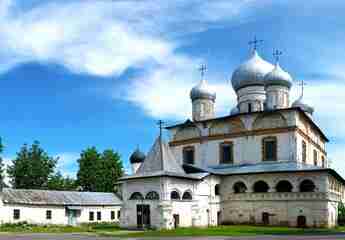
The Church of Andrey Stratilat is a small church of the 15th-17th centuries, located in the southeastern part of the Novgorod Detinets, rectangular in plan, with a single-span bell gable above the entrance. The church is crowned by a small cupola. Originally, on the site of the church in 1167 — 1173, the stone Church of Boris and Gleb was built — a majestic three-apse, six-pillar structure with a stair tower. In 1405, because of a fire that engulfed Ludin End, the church was badly damaged, and in 1441, by order of Archbishop Euthymius II, a new church was built on the old foundation. During construction, the stair tower was dismantled, and a separate chapel of Andrey Stratilat was built on its foundation. The Boris and Gleb Cathedral rebuilt in the 15th century is depicted on the icon «The Vision of Sexton Tarasius» of the late 16th century, decorated with a huge fresco-icon and crowned with two domes. One of them (the small one) symbolically indicates the existence of the chapel of Andrey Stratilat.
St. Sophia Bell Tower

Panoramio, Andrey Mazaev
The bell tower of St. Sophia Cathedral (St. Sophia Bell Tower) is an architectural monument of the 15th—18th centuries in the Novgorod Detinets. It is a multi-span wall-type bell structure. It is first mentioned in the chronicles in 1437, when information is given that during a flood the bell tower fell into the Volkhov together with the fortress wall. The bell tower is located on the inner side of the eastern wall of the Detinets, almost close to the wall, a few meters north of the arch built in the 19th century on the site of the Prechistenskaya Tower that collapsed in 1745. The length of the bell tower of St. Sophia Cathedral is 22.5 m, the width is 3.4 m. In 1439, by order of Novgorod Archbishop Euthymius II, they erected a «stone bell tower on the old place, on the city (that is, on the fortress wall)». There was also an assumption by such researchers as K. K. Romanova, D. A. Petrova, and others that the date of the restoration of the bell tower was different — 1455, at which time «Bishop Euthymius placed the stone bell tower at St.
St. Sophia Cathedral

fotki.yandex.ru, baranov.michael.2011
The Cathedral of Holy Sophia is the main Orthodox church of Veliky Novgorod, created in 1045—1050. It is the oldest surviving church on the territory of Russia built by the Slavs. In 1045, Grand Prince Yaroslav the Wise and Princess Irina (Ingigerd) headed to Novgorod from Kyiv to their son Vladimir for the laying of St. Sophia Cathedral by him. The cathedral was founded on the site of the Vladychny Dvor and was built approximately until 1050 in place of the 13-domed wooden church of 989 that had burned down before it, though not on the same spot, but farther north. According to different chronicles, the cathedral was consecrated in 1050 or 1052 by Bishop Luka. The church had five naves and three galleries, in which several additional altars were located. The northern gallery was rebuilt several times. Originally, the walls of the church were not whitewashed, except for the curvilinear apses and drums, which were covered with a layer of tsemianka. The inner sides of the walls were also exposed, while the vaults were initially coated with tsemianka and covered with frescoes.
Vladychnaya Chamber

regnum.ru
The Vladychnaya (or Faceted) Chamber is an architectural monument of the 15th century, built in the style of brick Gothic and located on the territory of the Novgorod Detinets. It is one of the oldest surviving civil buildings of Rus. The building is included in the UNESCO World Heritage list together with other historical structures of Veliky Novgorod. The chamber, as part of the Vladychny Dvor complex, was founded by order of Novgorod Archbishop Euthymius in 1433. As the Second Novgorod Chronicle reports, foreign masters took part in the construction, which is proved by the presence in the ceremonial hall of star-shaped rib vaults, pointed windows and arches, wimpergs, and some other details characteristic of Gothic architecture. In 1441, the monument was painted with frescoes.

discuss.ru, KNYAZ
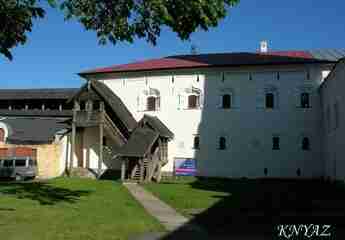
The Likhudov Building is a beautiful structure with a rich history, located in the oldest part of the Novgorod Kremlin, in the Vladychny Dvor. In this place there used to be the chambers of bishops and the houses of priests.
The Likhudov Building was erected in the 15th century and thoroughly rebuilt at the very beginning of the 18th century, for the opening of a new church school. The name of its architect disappeared in the intricacies of the numerous reworkings of the buildings of this courtyard. Almost every metropolitan considered it his duty to change the appearance of his possessions by adding to, rebuilding, or demolishing the buildings left by his predecessor.
But the chronicles preserved information about the Slavic-Greek school that opened in this building in 1706. Sophronius and Ioannikios Likhud, Greeks by origin, taught here. The brothers were outstanding teachers, translators, and writers; both received doctoral degrees from the University of Padua. Back in 1685, at the invitation of Tsar Fyodor III, they moved from Constantinople to Moscow to open the first Slavic-Greek-Latin Academy there. But 9 years later, as a result of the intrigues of local clerics who fabricated false accusations against them, the Likhuds were sent into exile.
Peter I freed them from imprisonment at the request of the Novgorod metropolitan, allowing the brothers to open a school in Novgorod. In memory of the teachers who had a huge influence on the development of education in the city, this building is still called the Likhudov Building.