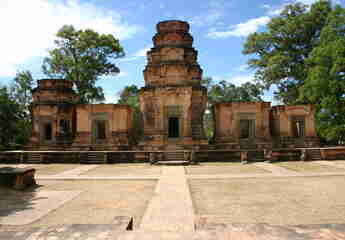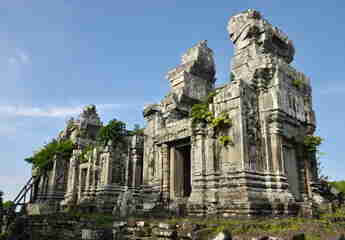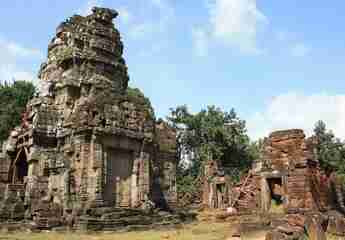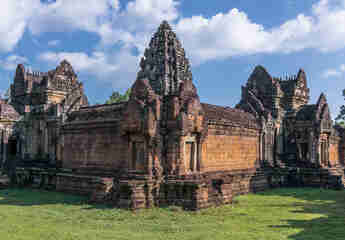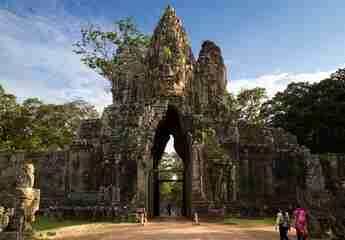
Tourists rarely stop by this temple, because it is located away from the road and is also surrounded by a dense curtain of greenery. The Buddhist temple, dedicated to the bodhisattva Avalokiteshvara, was built under Emperor Jayavarman VII in the late 12th and early 13th centuries.
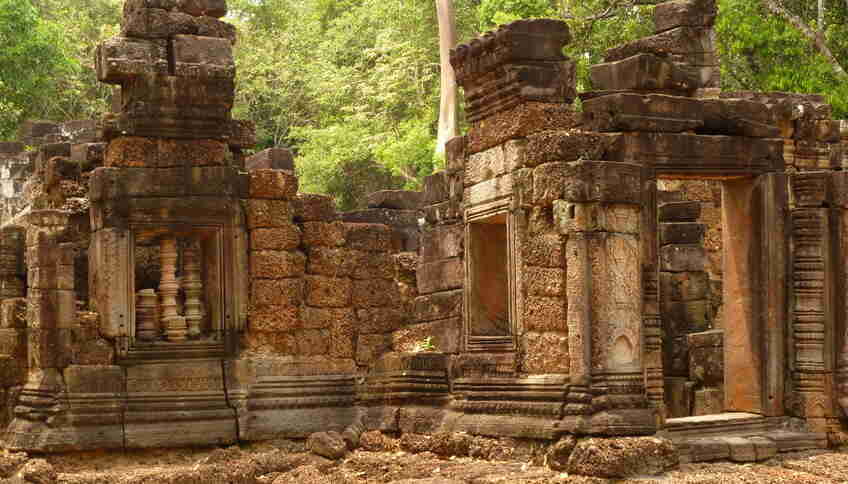
You can enter and leave the temple only from the eastern side, although it has several false entrances. It is surrounded by a double ring of laterite enclosure walls. Breaches in the walls are used as passageways through it. There is also a small moat with steps.
One of the temple pediments depicts Avalokiteshvara standing on a lotus flower surrounded by worshippers. Another pediment shows Krishna holding Mount Govardhana aloft in his hand, thus protecting the shepherds from bad weather.
On the terrace stands the central sanctuary, built in the shape of a cross. The inner courtyard is quite large – about 25*35 meters. To the left there is a library, which is also built of laterite and sandstone. Unlike the temple, it faces west.
On either side of the entrance to the central sanctuary there are false windows with balusters. This decorative element is found in almost all temples of that period. By the way, historians classify Krol Ko as belonging to the Bayon architectural style, whose main feature was the depiction of the face of Avalokiteshvara on the towers.