Lake Geneva

Flickr, PKirillov
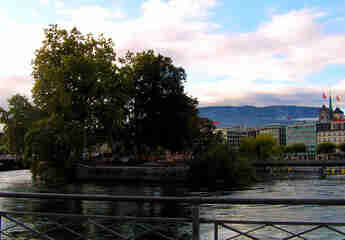
Lake Geneva, or Léman (Fr. Lac Léman, Le Léman, Lac de Genève), is the largest lake in the Alps and the second-largest (after Lake Balaton) freshwater lake in Central Europe. It lies within the borders of Switzerland and France. Lake Geneva lies in the floodplain of the Rhône and has the shape of a crescent bending near the village of Yvoire. This bend naturally divides Lake Geneva into the Large (Fr. Grand Lac) and Small Lakes (Fr. Petit Lac). The northern shore of the lake is dotted with fashionable resorts — the so-called Swiss Riviera. In these parts rises Chillon Castle, glorified by Lord Byron in his poem of the same name. The section of the coast between Geneva and Lausanne is called La Côte (Fr. La Côte), and the section between Lausanne and Vevey is called Lavaux (Fr. Lavaux). The earliest written name recorded for the lake was the Latin Lacus Lemannus, given back in the days of Roman rule. In the 4th century this name became the Latin Lacus Lausonius or the Latin Lacus Losanetes, and in the Middle Ages it became the Fr. Lac de Lausanne.
Geneva Fountain

mytourduglobe.com
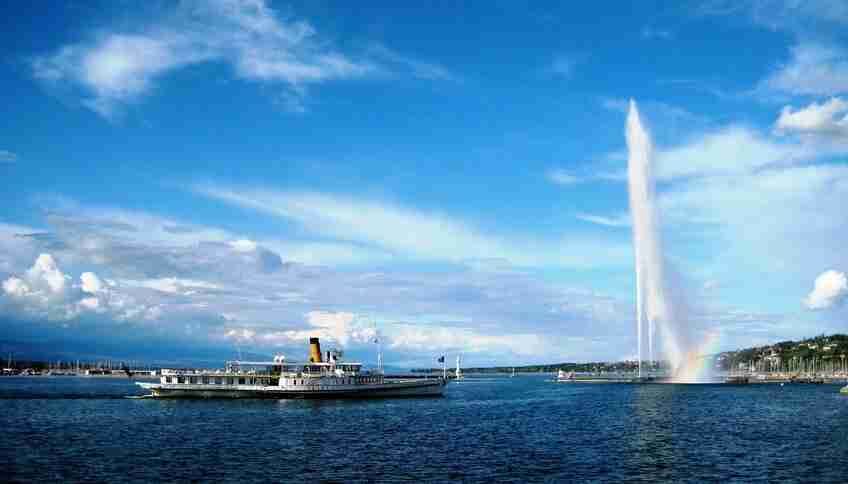
The Geneva Fountain (Fr. Jet d'eau de Genève, in many sources in other languages, including Russian, left untranslated: Jet d’Eau, Zhe d’O) is a fountain in Geneva (Switzerland), an important city landmark and one of the largest fountains in the world. The fountain is 140 m high. The flow rate is 500 liters per second. The power consumption of each of the 2 pumps operating from a 2400 V supply is 500 kW. The speed of the jet is 200 km/h. The fountain was first installed in 1886, slightly downstream from its current location. In 1891, in honor of the 600th anniversary of the Swiss Confederation, the fountain was installed in the city itself for everyone to see. At that time its maximum height was 90 meters. The fountain was installed in its current location in 1951 on a pumping station located in the lake beneath it, so that it would use water not from the water supply, as before, but from the lake itself. Since 2003, the fountain has operated daily.

Flickr, keepps
In the middle of Lake Geneva lies the reference point for the elevation of all places in Switzerland — two enormous boulders. Townspeople call them the Neptune Stones, while the official name of the larger one is “Repère Pierre du Niton.” It lies farther from the promenade and slightly higher than its twin brother. And it is precisely this one that serves as a kind of benchmark for measuring elevation. Repère Pierre du Niton itself rises 373.6 meters above another universal height reference — sea level.
You can view the Neptune Stones from the Gustave Ador promenade in the lake bay. These heirs of the Ice Age got their name from the god who, the Gauls believed, lived at the bottom of the lake. Apparently, he was greatly revered by the locals.
Historians suggest that in the Bronze Age these remnants of the Rhône glacier were of great importance and were a place for ritual ceremonies. This is how scholars explain the presence of strange square openings on the tops of the stones.
To get closer to these monumental creations of Swiss nature, you can board an excursion steamer.

Flickr, Leahmsy
Swiss watches are considered the best in the world. In Geneva they are everywhere: on the town hall, on many buildings, on lawns. And the most famous are in the English Garden. Their 5-meter dial is decorated with 6500 different flowers. Few tourists leave without a photo with them. In terms of the number of pictures, this attraction competes only with the legendary fountain of Lake Geneva. However, the clock wins in that by taking pictures with it at different times of the year and day, you will get completely different images ;)
The design of the Flower Clock changes four times a year. It also depends on the time of day: the plants are planted in such a way that even if there were no hands on the dial, they would still tell the time — each flower blooms at exactly its own hour!
To repair the mechanism of the huge clock, you need to go underground. But so far it has never malfunctioned. Swiss watchmakers live up to the reputation!
By the way, the second hand on the 5-meter dial is also a source of pride for the team of florists, designers, and watchmakers. Its length is 2.5 meters; at the moment it is the longest in the world.

panoramio.com, Flavius Patruti
Today it is hard to imagine that Geneva and Helvetia were once separate. Now they stand peacefully on a pedestal and embrace each other around the waist, while holding a shield and a sword in their hands.
The monument, installed in 1869, reminds the townspeople of the event of September 12, 1814, when the independent canton of Geneva joined Switzerland. The sculptor Robert Dorer, who was tasked with commemorating this event, chose female figures and placed two bronze women on a pedestal in such a way that their gazes were directed north toward Switzerland. The figures are the same height and stand in almost identical poses, which emphasizes the equality of the two administrative units.
Note: in the 17th century, the fashion for the allegory of the Swiss Confederation changed — it began to be depicted as a young woman, whereas earlier the image of a bull had been popular.
This beautiful monument is located at the center of a flower made of multicolored granite paving. You can admire the monument while walking along the promenade; the bronze Geneva and Helvetia gaze at the smooth lake waters not far from Mont Blanc Bridge.

Flickr, toddbyers1
Four bridges connect the two banks of the Rhône. But only Mont Blanc has gained truly worldwide fame. Probably because it offers the best view of Geneva's main attraction — the 140-meter fountain. Like a giant exclamation mark, it dominates the city, symbolizing one of Geneva's important qualities — always being on top.
Tourists often come here when choosing a good spot to photograph the rainbow that almost always plays in the fountain's spray. In any weather, the bridge offers a wonderful view of the chain of lakeside hotels and the summit of the French mountain Mont Blanc, to which the crossing owes its name.
Right beneath this bridge, the calm lake, turning into a whirlpool, runs away into the stone bed of the Rhône. Adjoining Mont Blanc, decorated with the flags of the 22 cantons of Switzerland, is the square of the same name. And quite nearby, excursion boats depart from the pier of the English Garden.

eco-turizm.net
Geneva has a huge number of interesting museums, so it is absolutely necessary to take breaks in your sightseeing schedule so that the abundance of information does not create chaos in your head. And the best place to retreat into nature is Rousseau Island, which lies in the middle of the Rhône, just below Mont Blanc Bridge.
It is amazing that in the center of the bustling life of a European city, such a corner of untouched nature has still survived. Curly willows hanging down to the water, wildflowers, and secluded spots by the water where you can feed wild ducks and swans...
There is always a place on the 70-meter stone bench for those wishing to sit in silence and enjoy an excellent view of the city. In the center of the island stands a monument to Jean-Jacques Rousseau. Historians claim that the famous writer loved to reflect while walking in this park. Therefore, in 1832, grateful compatriots decided to immortalize his name by renaming Ship Island.

Flickr, EastBayer
See Paris and die... in Geneva. And be buried right in its very center, rather than in a quiet suburban cemetery. This honor was granted to the Prussian duke Charles II of Brunswick. And all he had to do was leave his entire fortune to the city.
Having caused plenty of trouble for his state, fleeing to Paris with diamonds stolen from the country, by the end of his wanderings Charles II found himself in quiet Geneva, which gave him shelter but not peace. Contemporaries claimed that until the end of his life the Prussian duke suffered from paranoia and feared being poisoned and buried alive.
However, Charles II died a natural death during a game of chess, and his coffin can still be seen in the Alpine Garden on the shore of Lake Geneva. As many as 6 sculptors worked on this tomb, trying to take into account all the wishes of the deceased: the coffin with the silver sarcophagus is suspended at a height of 6 meters. This is an almost exact copy of the Scaliger Tombs in Verona. They say the eccentric duke spared no money on his funeral and memorialization, allocating as much as 20 million francs for it! His bronze equestrian statue still faces the Geneva bay.