Broken Chair

Flickr, rockstro
Broken Chair (English: Broken Chair) is a monumental sculpture in Geneva. The height of the wooden chair with a broken-off fourth leg is 12 meters, and 5,5 tons of wood were used to make it. The author of the work was sculptor Daniel Berset, while the piece itself was built by carpenter Louis Genève. The sculpture was installed on Geneva's Place des Nations, in front of the main entrance to the Palace of Nations (the UN European headquarters), in August 1997. It was supposed to remain there for three months, until the signing of the international convention banning anti-personnel mines and cluster bombs. Because the signing of this convention dragged on and encountered significant difficulties, the sculpture remained in place until 2005, was then dismantled due to the square's reconstruction, and returned to its original place in 2007.

tdg.ch, Pascal Frautschi
This compact and elegant building in Neo-Baroque and Neoclassical styles houses an extremely delicate collection known far beyond Geneva: 20 000 exhibits featuring magnificent examples of porcelain, ceramics, and glass from around the world. They reflect nearly 12 centuries of porcelain production and 7 centuries of glassmaking.
The building of the Ariana Museum of ceramics and glass was commissioned by the Swiss collector Gustave Revilliod specifically to house his personal collection, which he bequeathed to his beloved city a few years later. The museum was named after Gustave's mother, Ariana.
The value of the collection is confirmed not only by its size and history, but also by the fact that the International Academy of Ceramics is located here.
The exhibition will be interesting not only to collectors. The displayed pieces astonish with the exuberance of imagination applied to the making of seemingly quite ordinary things, from whimsical tableware to interior objects. A display of Russian porcelain holds a special place in the collection.
The symbolic fee for the tour will reward you with far more in terms of new impressions and knowledge. And the beautiful park on the lakeshore and the excellent rooftop cafe overlooking the UN building will provide a lovely finishing touch after your visit to the museum.
Palace of Nations

buytaert.net
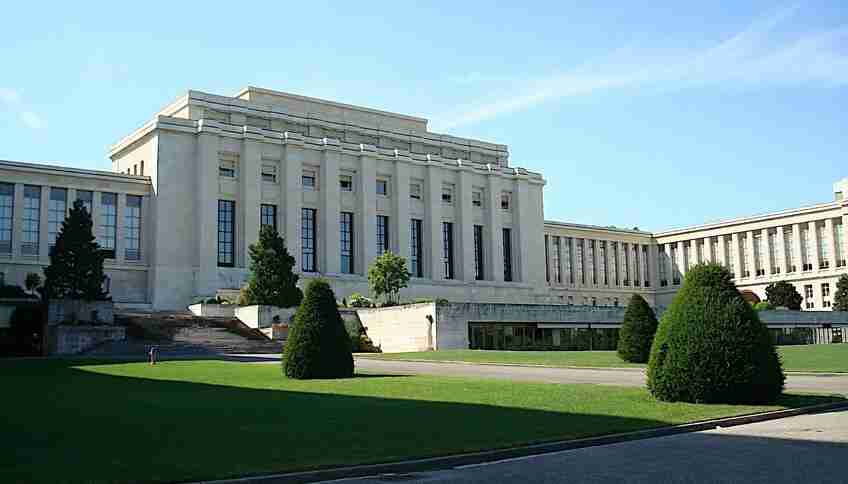
The Palace of Nations (French: Palais des Nations) is a complex of buildings constructed between 1929 and 1938 in Ariana Park in Geneva, Switzerland. The Palace of Nations served as the headquarters of the League of Nations until 1946. Since 1966, it has housed the United Nations Office at Geneva — the second most important UN seat in the world after New York. In addition, the Palace also houses the offices of the regional branches of the IAEA, UNESCO, UNCTAD, OCHA, the United Nations Industrial Development Organization, and the Food and Agriculture Organization of the United Nations (FAO). Every year, about 8000 meetings are held at the UN headquarters in Geneva, around 600 of which are major conferences. 100 thousand people visit the open halls of the Palace as tourists every year. After the League of Nations was established on January 10, 1920, an architectural competition was held in 1926 to choose the best design for the future complex.

Flickr, popmarta
If you do not know why a red cross is painted on ambulances, you should visit Geneva's Red Cross and Red Crescent Museum.
The idea of creating such an organization came to the young Swiss Henri Dunant in 1859, when he witnessed the Battle of Solferino, during which about 40 000 soldiers were killed or wounded on each side. Struck by the scale of human suffering, a few months after returning from the war he proposed a committee to help the wounded, and in 1863 founded the Red Cross.
This noble cause attracted volunteers not only in Switzerland but all over the world. At present, the organization has about 100 million members from 183 countries. Their large-scale activity is presented as fully as possible in the Red Cross and Red Crescent Museum. Here you can also trace the entire history of the movement through manuscripts, slides, photographs, and installations.
“We are all responsible for everything and for everyone” — these words by Dostoevsky are engraved in the main hall of the museum, the entire exhibition of which is devoted to the theme of human compassion.
So why did the Red Cross become the symbol of aid to victims? When creating the organization, Henri Dunant faced the task of making the emblem recognizable and associated with Switzerland. The simple solution — the inverted colors of the Swiss flag — gave the organization this logo. The crescent joined later. There is now a third equal symbol in this emblem — the red crystal. They will tell you what it means at the museum. By the way, the price of the admission ticket includes an audio guide in many languages of the world, including Russian. It is easy to get to the museum if you walk from the center toward the UN building.
Botanical Garden

Flickr, Chacal1233
The Botanical Garden and Conservatory of the City of Geneva (French: Conservatoire et Jardin botaniques de la ville de Genève) is a large botanical garden with a collection of more than 12 thousand plant species. Geneva's Botanical Garden was founded in 1817 with the assistance of the outstanding Swiss botanist Augustin Pyramus de Candolle on the site of today's Bastions Park (Parc des Bastions). In 1904, the garden moved to its present location near the UN office.