
Flickr, 10tis.com
Lak Muang is something like the zero kilometer marker, only much more symbolic. It is a 3-meter pillar installed when any city in Thailand is founded; it is its center and the beginning of all beginnings. But the column has an even more important function - to protect the population.
Lak Muang is the most important shrine in all the cities of Thailand. In Bangkok it is located across the road from the Grand Palace, and that is why many tourists fail to notice it. Of course, unfairly.
A shrine to guardian spirits has been built around the marker. Bangkok has five of them, and they are considered the true rulers of the capital. Thais turn to the spirits with all kinds of requests, but there is a belief that they are most willing to help couples who dream of having a baby.
Sometimes performances, dance evenings, and concerts are held here for the delight of the guardians. And on April 21 a large celebration is held in their honor, because it was on this day in 1782 that Lak Muang was installed. This happened by order of King Rama V, who decided to move the capital from Thonburi to Bangkok (the old name was Krung Thep). The city pillar was installed in accordance with all the rules: on the tenth day of the waxing moon of the sixth lunar month in the Year of the Tiger.

Flickr, Gerry Gantt Photography
The name of this temple has a hard-to-pronounce prefix, 'Yuwarajarangsarit Rajaworamahavihara,' and translates as 'great relic.' Only the most important monasteries in Thailand have such a status.
Wat Mahathat is the center of an entire temple complex. Like all especially important sites in former times, it was surrounded by a moat and defensive walls. Built in 1374, it went through destruction, fires, and several reconstructions. Many buildings are still in a semi-ruined state. Yet the scale of the complex is impressive: it has one main building for prayers, another for monastic rituals, 10 additional structures, and two hundred stupas - special structures for storing relics, for example, the remains of monks.
For a long time, an important shrine of Wat Mahathat was a Buddha statue made of gold, known for its miraculous power. However, three centuries ago it was moved to another temple. Today, the calling card of Wat Mahathat is considered to be a stone Buddha head in tree roots.
Among tourists, this place is especially valued because very high-quality, interesting, and affordable meditation lessons are held here.

Flickr, janahmiller
The largest collection of historical relics and works of art in all of Southeast Asia is housed in the Bangkok National Museum. The scale of the collection is truly astonishing: the whole of Thai history is presented here - from Stone Age artifacts to priceless exhibits of modern times.
Weapons, jewelry, and household items were collected during archaeological expeditions not only in Thailand but also in neighboring countries whose histories are closely intertwined. The culture of countries with which the Thai people are united by Buddhism is also represented here - India, China, Vietnam, Cambodia, and Indonesia.
The selection of exhibits, traditional for museums of this class, reveals the everyday life of ordinary people and the nobility, folk crafts, tools for labor and hunting, national costumes and ceremonial clothing, works of art, and religious objects. Visitors are especially drawn to the collection connected with Thai theater and the famous Khon masked dance - theatrical costumes and masks, musical instruments, and scenery.
The Bangkok National Museum is housed in the former palace of the vice king and consists of a complex of buildings, among them the famous Buddhaisawan Chapel with its unique Buddha statue. The palace ensemble is the same age as Bangkok: construction began in 1782, the same year the present capital was founded. The National Museum itself was established in 1874 by King Rama V on the basis of his father Rama IV's personal collection of valuables and antiquities.

Flickr, Joerg1975
Khaosan Road is probably the most famous street in Bangkok and certainly the liveliest and most colorful. Toward evening, tourists tired from daytime walks, museum visits, and other respectable activities gather here from all over the city. In this area, where life boils all night long, they look for informal socializing and entertainment at affordable prices.
Khaosan is paradise for those who like to travel on their own and with minimal expenses. Do not be alarmed by the status of a 'tourist ghetto' that some guidebooks have given this area. Students and young people actually like it very much here. In local hostels you can spend the night for as little as 3 dollars per person. You will not have to spend much on food either: the whole street is packed with cafes, restaurants, and stalls selling local fast food. In the evening all the bars turn on loud music, and vendors of fried insects and other exotic fare come out into the street.
Hundreds of little stores and stalls sell handmade souvenirs, paintings by local artists, clothes, books, and disks, as well as incense, natural cosmetics, and food products. Even if you are staying in another district of Bangkok, be sure to stroll along Khaosan to try the local exotic fare and stock up on inexpensive gifts.
Khaosan Road is also known for its large number of inexpensive travel agencies that can arrange a good-value excursion for you, both around Thailand and on a one- or two-day trip to neighboring countries.
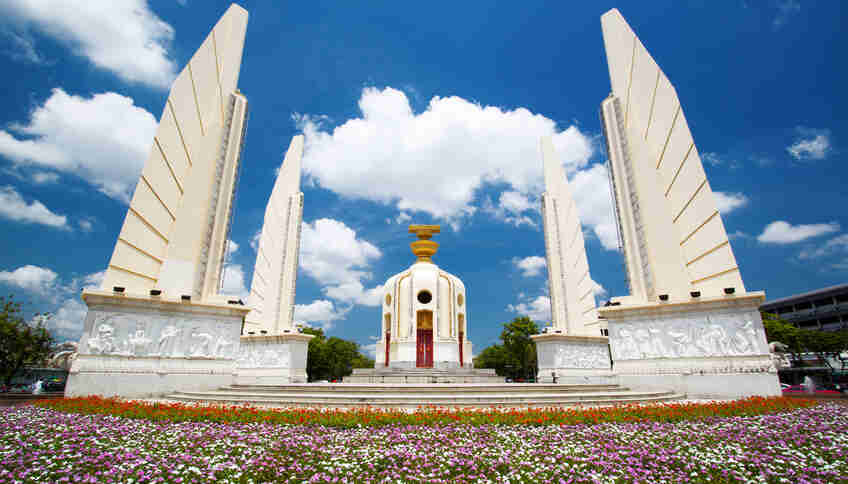
Democracy Monument

Flickr, noomplayboy
Democracy Monument - (Thai: อนุสาวรีย์ประชาธิปไตย Anusawari Prachathipatai), a monument in the center of Bangkok, the capital of Thailand. It forms a circular traffic junction on a broad boulevard: east to west Thanon Ratchadamnoen ถนนราชดำเนิน, at the intersection with Thanon Dinso. The monument was built in 1939 to commemorate the revolution in Siam in 1932, during which a constitutional monarchy was established in the Kingdom of Siam. The monument is oriented toward western Bangkok. In 2013 the monument became the center of unrest.[1]
Wat Ratchanadda

Flickr, aeydotme
Wat Ratchanadda (Thai: วัดราชนัดดาราม) is a wat (Buddhist temple) in Bangkok. It is located in the eastern part of the Old City (Phra Nakhon district), facing Ratchadamnoen Klang and Maha Chai roads. Construction began by order of King Rama III in 1846 and was completed in the 20th century. The temple's name means 'Granddaughter of the King' and was given in honor of Princess Somanas Wadhanavadi. The wat occupies an area surrounded by a fence and consists of several buildings. The most notable of them is Loha Prasat, built as a chedi and made of metal. This is the only metal temple building in Bangkok. Loha Prasat was built on the model of a now-lost Ceylonese temple from the 3rd century BC. Of the surviving prasat styles, it is closest to the Burmese one. Loha Prasat is 36 m high. It consists of four floors, each of which has metal spires. The total number of spires is 37, corresponding to the 37 virtues leading to enlightenment.
Wat Saket

Flickr, JRaptor
Wat Saket Ratcha Wora Maha Wihan - (Thai: วัดสระเกศราชวรมหาวิหาร), a Buddhist temple in Bangkok, Thailand. It is located in the eastern part of the Old City (Phra Nakhon district), opposite Wat Ratchanadda, facing Boriphat Road. The temple dates back to the Ayutthaya era, when it was called Wat Sakae. King Rama I renovated the temple and renamed it Wat Saket. During the reign of King Rama III, a gold-covered chedi was built on a high artificial hill, and because of this the temple was given the title Chedi Phu Khao Thong (Golden Mountain, ภูเขาทอง). The mountain represents one of the symbols of Buddhism, Mount Meru. However, the construction proved unsuccessful because of weak soil, and the mountain subsided. Repairs were carried out under King Rama V, after which the temple was renamed Suwannabanphot - the same as Golden Mountain, only in Sanskrit. This building became a popular attraction in Bangkok; however, the rest of the temple is visited less.

Flickr, notjustnut
In the 18th century there were probably no amusement parks in Thailand, and therefore the Thais invented entertainment for themselves. Moreover, they sometimes managed to combine entertainment with religion and get an explosive adrenaline mix. That is what happened, for example, with the Giant Swing.
It was built in 1784 in honor of Shiva, who stands firmly on his feet despite any trials sent to him by Brahma. The operating principle of the 42-meter structure is simple: a team of daredevils in a cradle swings back and forth and tries to snatch a bag of coins attached to a 25-meter pole with their teeth. Thrills are guaranteed for all participants. Some heroes tried so hard that they were injured and sometimes even died.
The swing structure was made of teak wood, but even it could not withstand the effects of the environment and deteriorated over time. The swing was rebuilt many times, and it was last seen in working condition in 1935. After several fatal accidents, it was decided to ban the popular amusement and leave the swing as a decorative attraction.
Do not forget to visit the Temple of the Giant Swing; it was built in 1807 and is located next to the swing. Nearby you can buy religious items and various souvenirs. The Bangkok Metropolitan Administration is also located there, on the square, where important city events are held.
Wat Ratchabophit

Flickr, Prahin | www.southeastasia-images.com
Ratchabophit (full name: Ratchabophit Sathit Maha Simaram Racha Wara Maha Wihan) is a Buddhist temple located in Atsadang, in Bangkok, Thailand, along the Khlong canal, not far from Wat Pho and the Grand Palace. The temple was built during the reign of Chulalongkorn. The temple has a unique layout: with its ubosot and wihan, it smoothly joins a circular courtyard in the center of which stands a gilded chedi covered with orange tiles (43 meters high). The tower is topped with a large golden sphere, inside which parts of the Buddha's relics are enclosed. The chedi was built in Sri Lankan style. The main hall of the temple has 10 door panels and 28 window panels, and each is decorated on the inside with black lacquer and gilding. The interior of the temple was designed by Italian architects; such an idea came to King Chulalongkorn after his visit to Italy. The entrance doors have tall 3-meter decorations with mother-of-pearl inlays that depict various medals and insignia.

Flickr, Back to Nothing
This museum tells, in a light and engaging way, everything connected with the national identity of the Thai people. Interactive exhibitions will tell you about the history of Thailand's formation as a state, the different stages in the development of Thai society, and the distinctive features of the culture and art of the country's inhabitants.
Museum of Siam opened in 2008 in a historic 19th-century building that had previously belonged to the Thai Ministry of Commerce. All exhibitions are organized according to the 'Play and Learn' principle, and the newest technologies were used in their creation - holograms, animation, sensors, and other interesting multimedia solutions. Both the general tour and the visit to each hall begin with a fascinating mini-film that vividly and clearly describes the concept of the exhibition you are about to explore.
The exhibits themselves are equipped with interactive elements: for example, you can fire a cannon at enemy ships or work as a cartographer, marking the borders of the state on a dynamic map with miniature villages and little figures. Another educational game presents a market with merchants from different countries. By choosing a merchant, you will learn what Burma, Laos, or Japan traded with Thailand many centuries ago and what role international trade played in the country's development.
Other aspects of the history and culture of ancient Thailand are presented in the same inventive playful form. According to reviews from tourists and local residents, Museum of Siam is the best and must-visit museum in the capital.

s-thai.ru
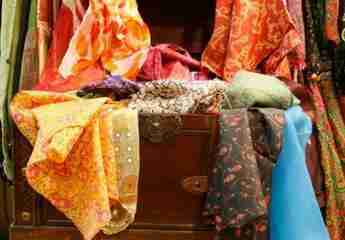
This bazaar smells of the intoxicating aroma of spices and dazzles with the bright colors of various fabrics. Snow-white cotton, caressing silk, and weightless batiste - we owe all this to immigrants from South India who, in search of a better life, spread across Asia and reached Thailand as well.
Phahurat Market is located in the area where Indian national minorities live, and that explains its distinctive character. Clothes, curtains, and sewing notions are sold here - and all of it at extremely low prices!
In the narrow, whimsical lanes you will also find household goods and silk bags. Just do not spend all your money at once; you still have spices to choose from, whose distinctive smell seems to have permeated all the merchandise. Nutmeg, vanilla sticks, turmeric, anise, peppers of all kinds - there are seasonings here even for true gourmets. Be sure to buy the traditionally Indian spice 'curry' - as is well known, it stimulates the immune system.
And the best way to remember your vacation in Thailand and your walk through Phahurat Market after you get home is to light a stick of incense - there is also a huge amount of it here, for every taste!
Flickr, shapeshift
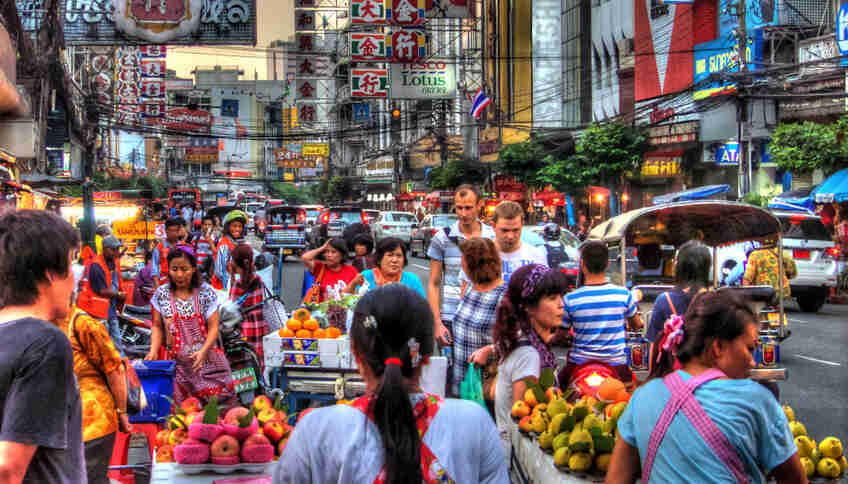
Thailand's main Chinatown is located in one of Bangkok's oldest quarters, on Yaowarat Road. The Chinese who live and trade here have long considered themselves Thai: they have assimilated well, and some have even partly forgotten their native language, yet they have preserved Chinese traditions and culture.
Yaowarat is the ideal place for those who like to buy souvenirs by the suitcase: prices are low and the atmosphere is lively. There are a great many shops here, and besides souvenirs you can buy jewelry, household appliances, antiques, used electronics, and much more, and, most importantly, very cheaply. We will tactfully keep silent about the quality of the goods and not expect too much from Chinatown. It is definitely better not to buy a 'real' iPhone for 1000 baht here, but you can (carefully) try plenty of local exotic delicacies.
During the celebration of Chinese New Year, traffic on Yaowarat Road is suspended. Colorful fairs, carnivals, and dances in the open air begin.
At first it may seem that chaos and disorder reign in Bangkok's Chinatown, but for the inhabitants of the Chinese quarter life in the style of Brownian motion suits them perfectly well; tourists just need a little time to get used to it.

Flickr, Bank Baray
According to official statistics, about half of Bangkok's residents are Chinese who have lived here since ancient times. Like in many other world capitals, they formed their own 'city within a city' - the Chinese quarter, or Chinatown.
The Thais call this district Yaowarat, after the street around which it sprang up. Life here bustles: its own temples and restaurants, bazaars and railway station - the social infrastructure creates the special color of a 'city within a city.'
'Wat Mangkon Kamalawat,' which literally translates as 'Temple of the Lotus and the Dragon,' is the largest and most important Chinese Buddhist temple in Bangkok. It is the center of all the major religious holidays, including the Vegetarian Festival and Chinese New Year.
Wat Mangkon Kamalawat is not a single building but an entire complex. Its buildings have a rather whimsical appearance: the tiled roofs are arranged in several tiers and decorated in traditional Chinese style.
Inside the main temple and other ritual rooms, Buddhist shrines are kept. And in the main square you can ask a fortune teller what fate has in store for you. However, to guarantee that happiness catches up with you, you need to release a bird from a cage. You can buy one right there on the spot.
Golden Buddha

Flickr, desomnis
Golden Buddha (Thai: พระพุทธมหาสุวรรณปฏิมากร; Phra Phuttha Maha Suwan Patimakon) is the largest solid gold statue in the world. It is located in Bangkok's Wat Traimit temple. The statue, depicting a seated Buddha, weighs five and a half tons[1] and was presumably made in the XIII century, during the time of the Sukhothai Kingdom. Its height is 15 feet 9 inches (including the base; without the base - about 3 meters), and it is 12 feet 9 inches in diameter[2]. During the war with Burma, the statue was covered with plaster, and only because of this was it able to survive the sack of Ayutthaya in 1767. It is believed that all the people who knew the statue's secret died during the war. During the reign of King Rama III, the statue was moved to Bangkok and installed in one of the temples (Wat Phrayakrai), abandoned in the early 1930s. Then the statue, still covered in plaster, was transferred to temporary storage. Until 1957, little attention was paid to the statue - until it was moved to a new location.