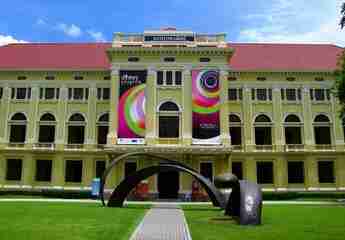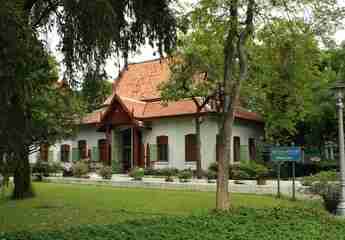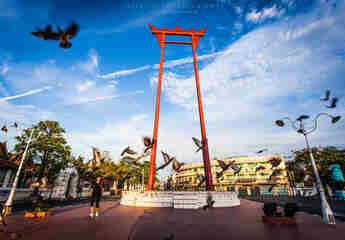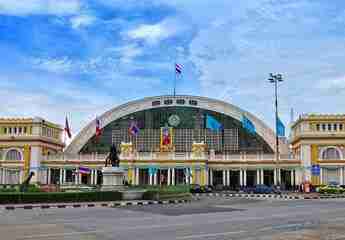

Flickr, Gerry Gantt Photography
"City of Angels" or "City Given by the Gods" is the literal translation of the name of Thailand's capital. It is therefore not surprising that there are more than 400 temples in Bangkok. Particularly outstanding among them is the Marble Temple, Wat Benchamabophit, or the "Temple of the Fifth King," built in 1900.
This sanctuary was built by order of King Rama V (Chulalongkorn), who in his youth, following the laws of Buddhism, lived for several months in a neighboring monastery and was delighted by the local beauty.
White marble, from which the monastery was built, does not occur in Thailand, so the building material had to be ordered all the way from Italy! The style of the sanctuary is eclectic and partly reflects European traditions, which is why Wat Benchamabophit is often called a symbol of the union of the worlds of East and West.
In the inner courtyard of the monastery there are 50 statues of Buddha, frozen in different poses - they embody styles of iconography and the development of the religion. This sanctuary is especially valuable because the ashes of Rama V are kept on its grounds.
Monument to King Rama V

Panaramio, Phadermchai Kraisora…
Chulalongkorn, also known as Rama V, Phrabat Momdet Phra Poramin Maha Chulalongkorn, Phra Chulachomklao Chaoyuhua 20 September 1853(18530920) — 23 October 1910) — was the King of Thailand, the fifth monarch of the Chakri dynasty. He was known to the Siamese of his time as Phra Buddhachao Luang (พระพุทธเจ้าหลวง — Royal Buddha). He is considered one of the greatest kings of Siam. His reign was characterized by the modernization of Siam, government reform, social reforms, and territorial resistance to the British Empire and French Indochina. Although Siam was threatened by Western expansion, Rama V, through his policies and actions, managed to save Siam from colonization, not without the help of the last emperor of the Russian Empire, Nicholas II. All of Rama V's reforms were dedicated to preserving Siam amid Western colonialism, so Chulalongkorn received the epithet Phra Piya Maharaj (พระปิยมหาราช — The Great Beloved King). Under him, the Thai solar calendar was introduced.

Flickr, I Prahin | www.southeastasia-images.com
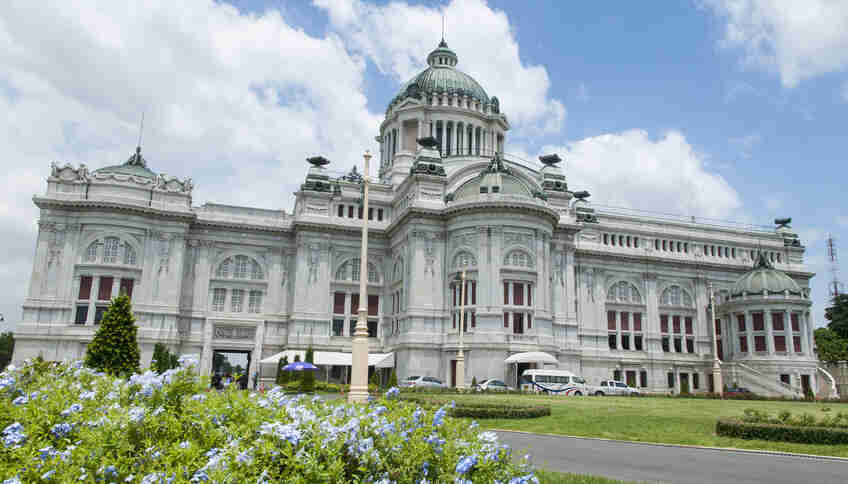
The small snow-white palace housing the throne hall looks rather unusual for Thailand - as if it had accidentally been transported here from Paris or Rome. Perfectly balanced proportions, precise lines, fine details, elegant sculptures and bas-reliefs made of Carrara white marble, considered one of the most valuable in the world — all this makes the building a true work of art, embodying the best traditions of the Italian Neo-Renaissance.
The palace, built by the Italian architects Tamagno and Rigotti in 1915, was intended for use as a royal reception hall. The central part is crowned by a dome 49.5 meters high, standing on an exquisite colonnade and surrounded by six smaller domes. Inside, the walls and domes are covered with incredibly beautiful frescoes depicting scenes from the lives of the monarchs of the Chakri dynasty.
Until the mid-1970s, the throne hall was used for its intended purpose: for ceremonial receptions and parliamentary meetings, after which it was decided to make it accessible to everyone. Now the throne hall is always open to tourists, with rare exceptions related to ceremonial events and parliamentary assemblies held several times a year.
At Ananta Samakhom, the public can also see the Arts of the Kingdom Exhibition — a collection of jewelry from the royal family and various decorative jewelry pieces. All exhibits are made of gold and decorated with genuine gemstones, - even the ship models or the royal elephant saddle.
A dress code is observed here, so do not wear shorts and tank tops on your visit to the palace.

Flickr, eson97
There is a beautiful legend: on the night before the birth of the Great Buddha, a white elephant appeared in a dream to his mother and presented her with a lotus — a symbol of purity and knowledge. Since those distant times, it has been considered good form among the rulers of Eastern countries to own these rare animals.
In Thailand, all white elephants automatically belong to the monarch: as soon as one is found, it is immediately taken to the royal elephant stables. A special naming and dedication ceremony is held for each of them into the "royal elephants," called Phraya Chang-ton or Nang Phraya Chang-ton, depending on the animal's sex.
The history of royal elephants and the colorful ceremonies involving them are what the National Museum of the Royal Elephant, or the Chang-ton Museum, is dedicated to. The museum presents two thematic collections: one is devoted to royal ceremonies and rituals associated with elephants, and the second describes the lives of white elephants themselves — how they are found and captured, how they live, and what they eat.
Interesting facts about these sacred animals are told separately. For example, in English the expression "white elephant" denotes an item that ruins its owner, or a deal whose costs exceed its returns. In ancient times, if an Eastern monarch wanted to spite someone, he would gift that person a white elephant. Sacred animals were never supposed to work, while their care and food required special treatment; thus, a person who had fallen out of favor with the king simply went bankrupt maintaining the exotic giant.

Flickr, tysonwilliams.com
The Dusit Palace complex, built in the late 19th and early 20th centuries under King Rama V, remains to this day the main unofficial residence of almost all the kings of Thailand. The complex covers 70 square kilometers, and there are many functional buildings on its grounds. One of them — the Abhisek Dusit Throne Hall — was built in 1904 to the east of Vimanmek Throne Hall.
Until the end of the 20th century, Abhisek Dusit was used for its intended purpose: for ceremonial events, for example receptions for important foreign ambassadors. In 1993, Queen Sirikit of Thailand decided to place a museum here dedicated to the national arts and crafts of her country.
After a major restoration, the throne hall became accessible to all visitors wishing to get a closer look at Thailand's traditional crafts. In this building, modest by royal standards, you can see examples of Thai decorative and applied arts - embroidery, silk goods, jewelry made of silver and gold, and other valuable things. In addition, with the assistance of Queen Sirikit, an exhibition of works of art created with the participation of members of the royal family is organized here.
Vimanmek Palace

Flickr, Shakil_Ahmad
Vimanmek Palace (Thai: วิมานเมฆ) — a former royal palace in Bangkok, Thailand. The largest teakwood building in the world. The name Vimanmek in Thai means "Home of the Devas"[1] or "Castle in the Clouds"[2]. It is located on the grounds of Dusit Palace, not far from Dusit Zoo in the Dusit District. In 1887, King Rama V of Thailand paid a visit to Europe and visited many different royal palaces there. Upon returning to Thailand, with his personal funds the king purchased a number of gardens and rice fields between the Padung Krungkasem and Samsen canals for the construction of a royal garden and named it Dusit Garden[3]. The first permanent residence in Dusit Garden was Vimanmek Palace, built in 1900 by order of King Rama V.
Dusit Zoo

Flickr, maryofelia
Dusit Zoo (Thai: สวนสัตว์ดุสิต) or Khao Din Park is Bangkok's city zoo, located in the Dusit District. It is the oldest zoo in Thailand. It covers an area of 188,800 m²[1] and is one of the most popular zoos in the country, with attendance of 2.5 million visitors per year[2]. It belongs to the state Zoological Park Organization of Thailand, which also includes Khao Kheow Zoo, Chiang Mai Zoo, Songkhla Zoo, and Nakhon Ratchasima Zoo[3]. The zoo also has an animal museum, an educational center, and an animal hospital. Dusit Zoo was originally a botanical garden and was called Khao Din Wana. King Rama V of Siam, frequently traveling abroad, was impressed by European gardens as places for people to relax and be entertained. In 1895, he ordered a garden to be built east of the Premprachakorn Canal, opposite the present-day Chitralada Royal Palace.