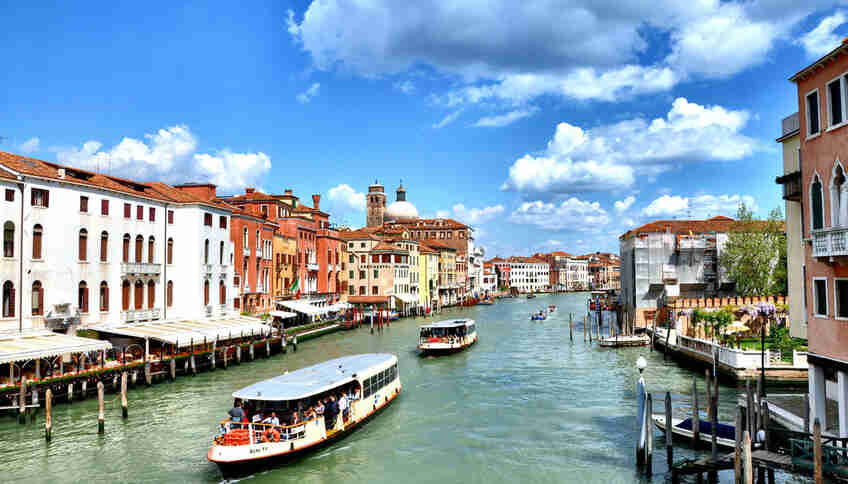

The vaporetto is the practical way to cover a lot of Venice without paying water-taxi prices. Gondolas are wonderful, but they are more about the classic Venice experience than getting from place to place. In practice, you move around Venice in just two ways: on foot or by water. And walking should still be your default. Every turn reveals something worth noticing - an old square, a narrow lane, another little bridge, another view that feels unmistakably Venetian.
Updated for 2026: Venice still works best as a mix of walking and vaporetto rides. Crowds, timetables, and fares can shift from season to season, so check the latest ACTV routes and ticket options before you travel.
Want more ideas for Venice? Download our mobile app - Travel Planner for iPhone and Android. Hundreds of attractions, ready-made routes, the ability to build your own walks, an offline map, and GPS. Everything you need for a more interesting trip.

Flickr, Kevin R Thornton
You will not get far without the vaporetto, the main public transport system in historic Venice. It is not cheap - few things in Venice are - but it is still much more practical than relying on private boats. Think of it as a water bus: fixed routes, fixed stops, and regular service. Because Venice's streets are canals, the bus happens to be a boat. The network connects the historic center with the lagoon islands, especially Murano, Burano, and Lido.
Everything you need to know before your trip to Venice - practical tips for independent travelers
Wherever you arrive - train, airport connection, or car park at the edge of the city - vaporetto links are never far away. Here is a quick guide to the lines visitors use most.

Venice vaporetto routes
Lines 1 and 2. These are the core routes along the Grand Canal, connecting Piazzale Roma and Santa Lucia station with Rialto, Accademia, San Marco, and beyond. If you arrive by car or coach, Piazzale Roma is your starting point. If you arrive by train, head to the Ferrovia stop just outside Santa Lucia. For many visitors, line 1 or 2 is the first boat they board in Venice - and often the one that gets them closest to their hotel. Line 1 is the slower, more scenic service, stopping all along the Grand Canal. Line 2 is the faster option, calling only at the main stops and often serving Giudecca and seasonal routes toward Lido.
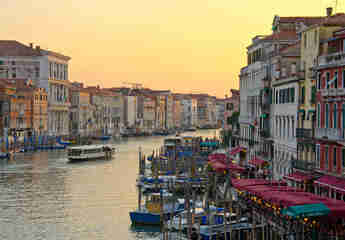
You do not have to use the vaporetto only as a way to get from A to B. It is also one of the best-value sightseeing rides in the city. Take it down the Grand Canal in the late afternoon or after dark and Venice feels completely different. A gondola or private boat can do the same, of course, but at a much higher price.

Flickr, marieclaire.lefbure
Top 10 attractions in Venice - what to see if you only have a day or two
Line 3. This line is mainly useful for Murano. It links Ferrovia and Piazzale Roma with Murano, and it has the advantage of skirting the most crowded stretch of the Grand Canal. If you are staying on Murano, it is often the simplest and most efficient option.
Lines 4.1 and 4.2 form a loop around the historic center and are useful for reaching San Michele cemetery island as well as Murano. Line 4.1 runs one way around the loop, while line 4.2 goes in the opposite direction. Together they connect key stops such as Fondamente Nove, Ferrovia, Piazzale Roma, Giudecca, San Zaccaria, and Murano, which makes them handy when you want to move around Venice without riding the full length of the Grand Canal.

Flickr, pe_ha45
Audio guide to Venice - an easy way to get to know the city without overplanning ;)
Line 12 is the classic route to Murano, Burano, and Torcello. It usually starts from Fondamente Nove. Murano is the quick first stop; Burano takes longer; Torcello is just a short hop from Burano. On the way you pass San Michele, Venice's cemetery island, where several notable artists and writers are buried.
To reach Fondamente Nove, you can either walk or use lines 4.1, 4.2, 5.1, or 5.2. Walking is a great choice if you want to see Cannaregio, one of Venice's calmer districts. Along the way you can explore the old Jewish Ghetto and the church of Santa Maria di Nazareth. It is a quieter, more everyday side of Venice, well away from the heaviest tourist traffic.

Flickr, invitojazz
Line 14 is the direct route from San Zaccaria to Lido and onward to Punta Sabbioni. It is the line to remember if you are heading for Lido's beaches or traveling in from the eastern side of the lagoon.
Vaporetto tickets and passes in Venice
Now for the practical part: tickets. Single vaporetto fares are high enough that they make sense only for one or two rides. If you plan to move around a lot - or you want to visit Murano, Burano, or Lido - a time-based travel pass is usually much better value. Ticket rules and prices do change, so it is always smart to check the latest ACTV fares before you buy.
- single tickets are best only for a one-off ride;
- 24-hour passes usually work best for a short stay;
- 48-hour passes are good for a weekend;
- 72-hour passes suit a classic city break;
- 7-day passes make sense for slower trips and island hopping;
- validate every ticket or pass before boarding.

Flickr, dmmaus
The more often you ride, the more sense a pass makes. It saves you from repeatedly buying tickets, standing in line, and wasting time at machines or kiosks. Just do not forget to validate your ticket or pass properly, because inspectors do check and fines are steep.
The vaporetto network can look confusing at first, but you will get used to it quickly. Major stops usually have route maps, and staff can often point you in the right direction. Keep an eye on the line number, the destination shown at the stop, and a current network map, and getting around Venice becomes much easier.
More Venice guides: