
Flickr, D&S McSpadden
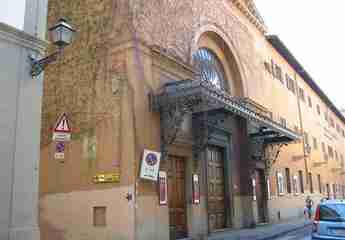
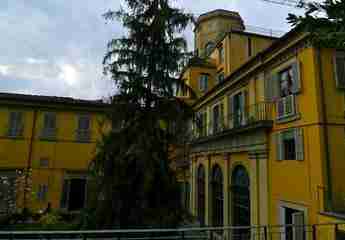
Millions of tourists from all over the world come to Florence to see with their own eyes the works of the greatest masters collected in the Accademia Gallery of Fine Arts. It was opened in 1784 specifically so that beginning sculptors and painters could study the details and learn the secrets by admiring genuine masterpieces.
Today, this is perhaps one of the most visited museums in Europe. It is famous, first and foremost, for Michelangelo's sculptures: four figures from the "Slaves" cycle, the unfinished marble sculpture of the Apostle Matthew, as well as the famous statue of David, which was specially moved here from Piazza della Signoria in 1873. A separate hall was even built for "David" - the Tribune. And a copy was installed on the square in 1910.
Important works of art are collected in the neighboring rooms, which had previously been part of two monasteries. Mostly, these are religious paintings by famous artists who worked in Florence from the 13th to the 16th centuries. Among them are such well-known names as Botticelli, Andrea del Sarto, Perugino, Bronzino, and others.
In one of the halls you can see Andrea Orcagna's polyptych and a series of panels telling about the life of Jesus Christ and Saint Francis, created by the Italian artist Taddeo Gaddi. In addition, the Gallery has a section of Russian icons painted in the 16th-18th centuries. Among the recent additions is the collection of antique musical instruments from the Cherubini Conservatory.
The Gallery is so popular with tourists that it is better to book a ticket here in advance, online. This way you will not have to waste time on tedious waiting in endless lines.
Medici Chapel

Flickr, SUFlorence
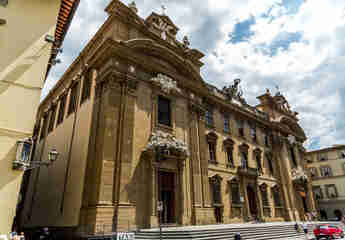
Medici Chapel is the memorial chapel of the Medici family at the Florentine church of San Lorenzo. Its sculptural decoration is among the grandest achievements of Michelangelo Buonarroti and the Late Renaissance as a whole. Michelangelo arrived in Florence in 1514 because Pope Leo X Medici offered him the task of creating a new facade for the local church of San Lorenzo, the family church of the influential Medici family. This facade was meant to become a "mirror of all Italy," the embodiment of the finest features of Italian artists' mastery and a witness to the power of the Medici family. But long months of deliberation, design decisions, and Michelangelo's own time in the marble quarries proved futile. There was not enough money to realize the grand facade, and the project faded away after the pope's death. To avoid alienating the ambitious artist from the family, Cardinal Giulio Medici instructed him not to finish the facade, but to create a chapel in the same church of San Lorenzo instead. Work on it began in 1519.
Basilica di San Lorenzo

matteorenzi.it
Basilica di San Lorenzo (eng. Basilica di San Lorenzo) is one of the largest and oldest churches in Florence, Italy, located in the central part of the city. The first church appeared here at the end of the 4th century, then it was rebuilt in the Romanesque style in the 11th century, and the modern Renaissance church building appeared in the 15th century thanks to the famous architect Filippo Brunelleschi. In addition, the church is the burial place of all the principal members of the Medici family, from Cosimo de' Medici the Elder to Cosimo III. Numerous works of art decorate the interior of the church. The church of San Lorenzo was founded in 393. In the 11th century the church was reconstructed in the Romanesque style. In the 15th century the basilica was reconstructed again. In particular, commissioned by Cosimo Medici, Brunelleschi added the Old Sacristy. Later, according to Michelangelo's design, the New Sacristy with the tombs of Lorenzo and Giuliano Medici was added on the other side of the transept, and the Laurentian Library was built.
Baptistery of San Giovanni

Panoramio, Junjun Guo
Baptistery of San Giovanni (Italian: Battistero di San Giovanni) is a medieval Romanesque baptistery on Piazza del Duomo and Piazza di San Giovanni, next to Santa Maria del Fiore Cathedral and Giotto's Campanile in Florence, one of the oldest buildings in the city. Like most baptisteries, it is dedicated to John the Baptist. The first baptistery was built in Florence no later than the 5th century. The current building was constructed from 1059 to 1129. Up until the 19th century, all natives of Florence were baptized here. Among them were Dante and the Medici. The semicircular apse was replaced with a rectangular one in the 13th century. The dome vault is decorated with Byzantine mosaics from the 13th-14th centuries. The central mosaic depicts the Last Judgment with the figure of Christ at the center. The baptistery also contains the tomb of Antipope John XXIII.
Santa Maria del Fiore Cathedral

itinera.serevo.it
Santa Maria del Fiore Cathedral (Italian: La Cattedrale di Santa Maria del Fiore) is the cathedral of Florence, the most famous of the architectural creations of the Florentine Quattrocento. It is located in the very heart of the city on Cathedral Square. Architecturally, particularly notable are the dome created to the design of Filippo Brunelleschi and the exterior wall cladding with polychrome marble panels in various shades of green (from Prato) and pink (from Maremma), edged in white (from Carrara). The Duomo (Italian: Duomo), also known as Santa Maria del Fiore Cathedral, was designed so that it could accommodate the entire population of the city (at the time of construction - 90000 people), that is, it was something like a huge covered square. The red dome of the cathedral, which has become a symbol of Florence, seems to hover over the whole city.

Flickr, Albert Photo
In ancient times, the Roman Forum stood on the site of Piazza della Repubblica; in the Middle Ages, the Old Market was located here, and now this place is a true site of tourist pilgrimage. One way or another, this has always been the center of city life.
In the 19th century, the square was rebuilt in the Piedmontese style, after which it became the way it can still be seen today. On the site of old houses and towers, an Arch was erected, named in honor of King Victor Emmanuel II.
In modern times, many cafes, boutiques, and open summer terraces have appeared here, where anyone can enjoy a cup of coffee. For children, a round carousel operates on the square, which at dusk turns into a glowing musical extravaganza.
When visiting Piazza della Repubblica for the first time, most tourists immediately look for the Column of Abundance. Back in ancient Roman times, it was the central point of the city. More precisely, not exactly it, because over many centuries the column itself changed more than once, but the place where it stands always remained unchanged. It was first replaced in the 15th century, but three centuries later the column fell, so another one was installed. Then there were several more copies, so the current Column of Abundance, alas, was not a contemporary of the ancient Romans.

Flickr, ScaniaTheKing87
"Piglet," or rather, "Little Piglet" - that is exactly what the locals affectionately and lovingly call this hero, which has become Florence's second symbol after the lily.
This sculpture is already more than 400 years old. Over the centuries it has noticeably darkened, except for the snout, which has been polished to a shine. There is a belief that you should make a wish while holding the snout and "treating" the little boar to a few coins, and then it will certainly come true.
The story of the appearance of "Porcellino" (translated from Italian as "piglet") goes back centuries. According to legend, a fierce boar burst into the city and frightened all the locals. They hid in their homes, afraid to go outside. And only one boy approached the animal, stretched out his hand, and stroked its wet snout. After that, the beast calmed down and left the city. And this story became yet another confirmation that tenderness and love can work miracles. A similar plot also appears in Hans Christian Andersen's fairy tale "The Bronze Boar."
The author of the sculpture is Pietro Tacca. Today, copies of his work have spread all over the world. Clones of "Porcellino" can be found in the USA, Canada, Australia, Denmark, France, Germany, and other countries.
Moreover, it has also "appeared" in the movies. For example, in one of the scenes of the film "Hannibal," the hero washes his hands in this very fountain. And Harry Potter fans solemnly assure everyone that they saw "Porcellino" in the final part of the famous film saga.
Piazza della Signoria

Flickr, Kathy Adams Clark
Piazza della Signoria (Italian: Piazza della Signoria) is an L-shaped square in front of Palazzo Vecchio in Florence. The square was the center of political life during the Florentine Republic. In the Roman period, there was a theater on the site of the square. Later, 36 towers were built, where the Uberti family, who were Ghibellines, settled. In 1260, after the victory of the Guelphs, all the buildings of the Uberti family were destroyed. After that, the square took shape. Over its history it changed several names: Priors' Square, Grand Duke's Square, and Nation Square. The government of the Florentine Republic (the signoria) was based in the square. Its residence was the Palazzo della Signoria, built by Arnolfo di Cambio in 1298-1310. This palace is also known as Palazzo Vecchio. The republic's government was headed by the Gonfalonier of Justice (Italian: Gonfaloniere della Giustizia). The government included 24 priors, elected for two months.
David

Flickr, Prof. Mortel
David is a marble statue by Michelangelo, first presented to the Florentine public on Piazza della Signoria on September 8, 1504. Since then, the five-meter sculpture has come to be seen as a symbol of the Florentine Republic and one of the pinnacles not only of Renaissance art, but of human genius as a whole. The original statue is currently housed in the Academy of Fine Arts in Florence. The statue, intended to be viewed from all sides, depicts a nude David focused on the coming battle with Goliath. This subject was an iconographic innovation, because Verrocchio, Donatello, and Michelangelo's other predecessors preferred to depict David at the moment of triumph after victory over the giant. The young man is preparing for battle with an enemy far stronger than he is. He is calm and focused, but his muscles are tense. His brows are menacingly furrowed, and there is something frightening in them. He has thrown a sling over his left shoulder, the lower end of which is held by his right hand.
Palazzo Vecchio

Flickr, Massimo Todisco
Palazzo Vecchio (Italian: Palazzo Vecchio, Old Palace) is one of the most famous buildings in Florence, located on Piazza della Signoria. It now serves as the town hall. This government building from 1299, where the priors met, was called the New Palace (Palagio novo). The former government building, the Bargello, became the Old Palace. In the 15th century, the rulers of the commune declared themselves signori, and the building itself became known as Palazzo della Signoria, thus giving its name to the square in front of the palace. Meanwhile, the building had already been renamed Palazzo Ducale (the duke's residence): Grand Duke of Tuscany Cosimo I moved here in 1540 from his private palace (today Palazzo Medici-Riccardi). But in 1565 he preferred to move his residence to Palazzo Pitti, which was expanded for this purpose, and the former New Palace ceased to be considered new and became the Old Palace (Palazzo Vecchio).
Loggia dei Lanzi

Flickr, roryrory
Loggia dei Lanzi (Italian: Loggia dei Lanzi) is a loggia, a structure on Piazza della Signoria in Florence, one of the city's landmarks. The arcade building was constructed between 1376 and 1382 under the direction of Benci di Cione and Simone di Francesco Talenti. The building was intended for assemblies and receptions of the Florentine Republic, and later in the 16th century it received its name thanks to the Landsknechts (Italian: Lanzichenecchi, in shortened form - Italian: Lanzi) of Grand Duke of Tuscany Cosimo I Medici who were stationed in the loggia. Today, Loggia dei Lanzi is an open-air museum displaying a collection of sculptures from the nearby Uffizi Gallery, including Benvenuto Cellini's "Perseus with the Head of Medusa," Giambologna's "The Rape of the Sabine Women" and "Hercules and the Centaur," an ancient Roman copy of the ancient Greek sculpture "Menelaus with the Body of Patroclus," Pio Fedi's "The Rape of Polyxena," as well as several antique female statues.
Uffizi Gallery

Flickr, Richard, enjoy my life!
Uffizi Gallery (Italian: Galleria degli Uffizi, literally "gallery of offices" (cf. English office)) is a palace in Florence, built in 1560-1581 and now one of the largest and most important museums of European fine art. In 2008, 1 553 951 people visited the Uffizi Gallery, making it the most visited art museum in Italy. The formation of the collection began in the middle of the 15th century, when the Medici house and, formally, Florence were headed by Cosimo the Elder. He patronized artists and bought examples of ancient art. His grandson Lorenzo the Magnificent became the next enlightener in the Medici family. He commissioned paintings from Andrea del Verrocchio and Sandro Botticelli, who created his 'Spring' and 'The Birth of Venus.' At the patron's request, Filippo Lippi painted 'Madonna and Child with Angels.'
Ponte Vecchio

Flickr, D. Scott Frey
Ponte Vecchio (Italian: Ponte Vecchio, old bridge) is the famous bridge over the Arno River in Florence, located at the narrowest point of the river, almost opposite the Uffizi Gallery. It is the oldest bridge in the city: it was built in 1345 by the architect Neri di Fioravanti[it] and has preserved its original appearance to this day. Originally, butchers' shops were located here; today there are jewelry stores and souvenir sellers. The bridges nearest to it are Santa Trinita Bridge and Ponte alle Grazie. Ponte Vecchio is the most ancient bridge in the city of Florence and the only one that has preserved its original appearance. The first bridge on this site was built back in ancient Roman times[1]. At that time the Cassia road passed over it; the piles were stone, and the superstructures were wooden. This bridge is first mentioned in documents from 996.
Palazzo Pitti

Flickr, The Web Ninja
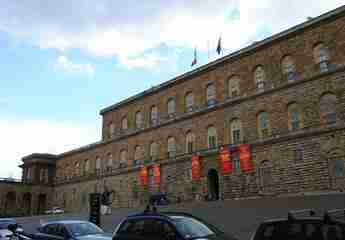
Palazzo Pitti (Italian: Palazzo Pitti) is the largest of the Florentine palazzi still in existence, one of Florence's most significant landmarks. It is located on the sloping Piazza Pitti; behind the building are the Boboli Gardens. The building served as a residence first for the Medici grand dukes, then for the Lorraine dukes, and finally for the Italian royal family. Today it is one of Florence's largest museum complexes. It houses the Palatine Gallery, the Gallery of Modern Art, the Silver Museum, the Porcelain Museum, the Carriages Museum, and the Costume Gallery - the largest collection in Italy devoted to the history of fashion. Construction of this austere and forbidding building was begun in 1458 by the Florentine banker Luca Pitti, the chief supporter and close friend of Cosimo Medici. The early history of the palace is a mixture of facts and fiction.

Flickr, Jurjen van Enter
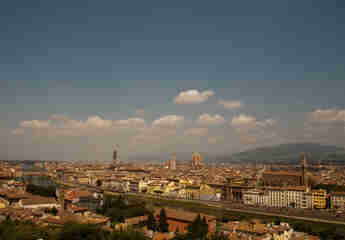
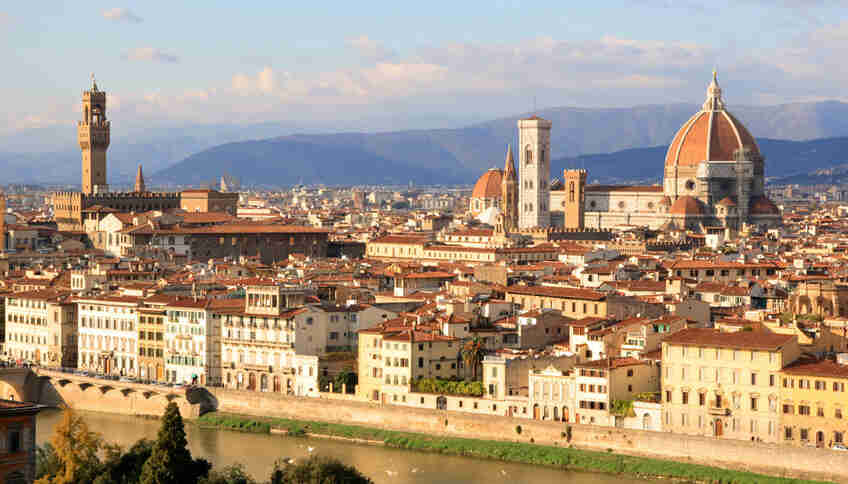
The most beautiful views of Florence open up from Piazzale Michelangelo! It is located on the Oltrarno hill, so the whole city can be seen from this height as if in the palm of your hand. This is exactly where street artists come to capture the beauty of their beloved city at different times of day.
Piazzale Michelangelo was laid out in 1865 according to the design of the Italian architect Giuseppe Poggi. He designed it as a terrace, on which sculptures of the famous Michelangelo later appeared.
As soon as another bus with tourists stops at the square, everyone immediately heads for the statue of David. This is perhaps the most photographed sculpture in Florence. After taking the main photo, visitors notice four more statues symbolizing the seasons. By the way, all of these are copies; the originals are kept in the Medici Chapel of the Basilica di San Lorenzo.
Time flies by unnoticed on Piazzale Michelangelo - gorgeous panoramic views delight the eye. From the square, Fort Belvedere, Santa Maria del Fiore Cathedral, and Ponte Vecchio are clearly visible.
It is also worth stepping into the Loggia created by Michelangelo. It was intended to house all his statues, but fate decided otherwise; now a famous restaurant with a rooftop panoramic terrace is located there. So guests of Florence can not only enjoy the beautiful views, but also sample Italian cuisine.