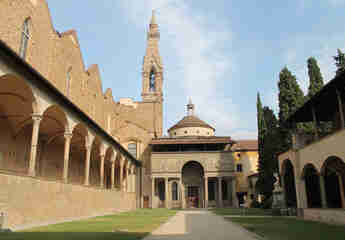
Tornabuoni Chapel

picsfromitaly.wordpress.com
Tornabuoni Chapel is a famous chapel in the Florentine church of Santa Maria Novella, decorated with frescoes by Domenico Ghirlandaio commissioned by Giovanni Tornabuoni, a relative of Lorenzo the Magnificent and head of the Medici bank branch in Rome. The artist, together with his large workshop, began painting the choir in the autumn of 1485 and completed it in December 1490. This cycle, covering about 580 sq. m., is the largest in 15th-century Florence. Iconographically, it does not go beyond a long-standing tradition. The side walls are devoted to the lives of Mary and John the Baptist and, as had been customary since the time of Giotto, are divided into 4 registers. The overly extended horizontals were divided into two compositions, each framed by painted pilasters, and therefore perceived as an independent picture. In the two lower registers they were designed as architectural interior scenes, where the main role was often given to portrait figures. Vasari lists those depicted and praises them for their lifelike quality.
Basilica of Santa Maria Novella

Flickr, ♥ Nadia ♥
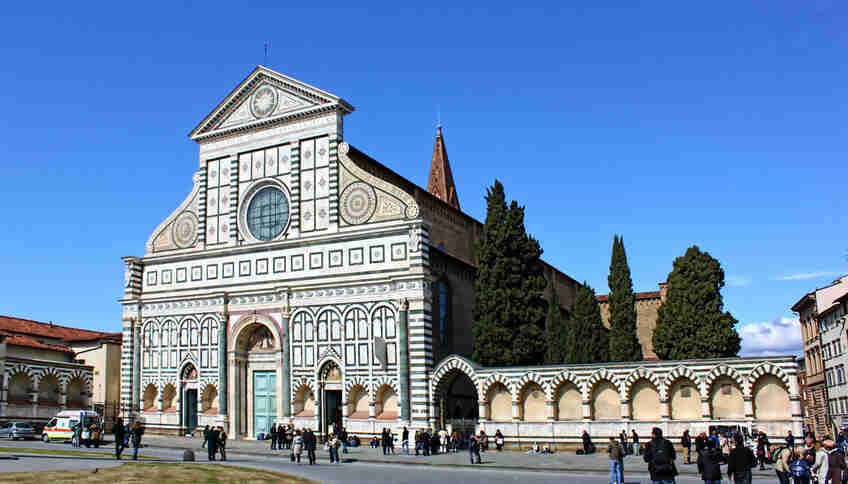
The Basilica of Santa Maria Novella (Italian: Bsilica di Santa Maria Novella) is a church in Florence, Italy, located on the square of the same name in immediate proximity to the city’s central railway station, which bears its name. It was built in the 14th-15th centuries, becoming the first basilica in Florence, and soon turned into the city’s main Dominican church. The church building combines elements of Gothic and early Renaissance architecture, and inside it is adorned with numerous frescoes and funerary monuments. The church of Santa Maria Novella owes its name to the 9th-century Dominican oratory of Santa Maria delle Vigne, originally located here. When this place was assigned to the Dominican order in 1221, the monks decided to build a new church and an adjoining monastery here. The construction plan was developed by two monks, Fra Sisto Fiorentino and Fra Ristoro Campi.
Medici Chapel

Flickr, SUFlorence
The Medici Chapel is the memorial chapel of the Medici family at the Florentine church of San Lorenzo. Its sculptural decoration is among the grandest achievements of Michelangelo Buonarroti and the Late Renaissance as a whole. Michelangelo arrived in Florence in 1514 because Pope Leo X de' Medici offered him the commission to create a new facade for the local church of San Lorenzo, the family church of the powerful Medici family. This facade was to become a “mirror of all Italy,” an embodiment of the finest qualities of Italian artists’ craftsmanship and a testimony to the power of the Medici family. But the long months of deliberation, design decisions, and Michelangelo’s own time spent in the marble quarries proved futile. There was not enough money to realize the grand facade, and the project came to nothing after the pope’s death. To avoid alienating the ambitious artist from the family, Cardinal Giulio de' Medici instructed him not to finish the facade, but to create a chapel in the same church of San Lorenzo. Work on it began in 1519.
Basilica of San Lorenzo

matteorenzi.it
The Basilica of San Lorenzo (English: Basilica di San Lorenzo) is one of the largest and oldest churches in Florence, Italy, located in the central part of the city. The first church appeared here at the end of the 4th century, then it was rebuilt in the Romanesque style in the 11th century, and the modern Renaissance church building appeared in the 15th century thanks to the famous architect Filippo Brunelleschi. In addition, the church is the burial place of all the main members of the Medici family, from Cosimo de' Medici the Elder to Cosimo III. Inside, the church is decorated with numerous works of art. The church of San Lorenzo was founded in 393. In the 11th century the church was reconstructed in the Romanesque style. In the 15th century the basilica was reconstructed again. In particular, by order of Cosimo de' Medici, Brunelleschi added the Old Sacristy. Later, on Michelangelo’s design, the New Sacristy with the tomb of Lorenzo and Giuliano de' Medici was added on the other side of the transept, and the Laurentian Library was built.
Laurentian Library

Flickr, Darren and Brad
The Medici Laurentian Library (shortened to Laurenziana, Latin: Biblioteca Medicea Laurenziana) is an Italian state library famous for its manuscripts, located in Florence. The library appeared during the rule of the Medici. The library received the name “Laurenziana” in honor of Lorenzo I de' Medici, who greatly enriched the holdings of his grandfather Cosimo de' Medici the Elder’s library. Cosimo de' Medici the Elder founded a home library in 1444 on the basis of his extensive collection of manuscripts. After the death of his friend Niccolo Niccoli in 1437, who was also passionate about ancient manuscripts, Cosimo inherited his collection, part of which he transferred to the monastery of San Marco. When the Medici were expelled from Florence in 1497, the library passed into the hands of the city and was sent to San Marco. After returning to Florence in 1512, the Medici not only regained power in the city, but also their collection of books.
Palazzo Medici Riccardi

Flickr, Mr.Dare
Palazzo Medici Riccardi (Italian: Palazzo Medici Riccardi) is the Medici family palace in the center of Florence, Italy, located on Via Cavour not far from the Basilica of San Lorenzo and the Cathedral of Santa Maria del Fiore. The first secular building of the early Renaissance in the city, it was built by Cosimo de' Medici’s favorite architect, Michelozzo. Today the palace houses the Riccardian Library. The floors of the building, made with different masonry, divide the facade of the palazzo into three tiers. The rough rustication of the ground floor gradually gives way to smoother slabs on the second and perfectly fitted slabs on the third floor. For the first time since antiquity, a cornice with consoles projecting far forward runs along the top of the building. In 1517 the open loggia on the south-eastern side was bricked up, and windows with pediments were cut into the sealed arches, the creation of which is attributed to Michelangelo. The first floor is made of rough, unpolished stone and, resembling fortress masonry, was meant to symbolize stability.
Cathedral of Santa Maria del Fiore

itinera.serevo.it
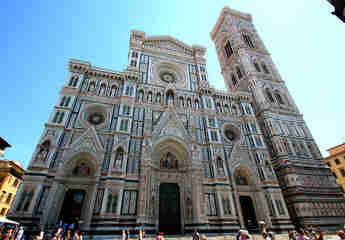
The Cathedral of Santa Maria del Fiore (Italian: La Cattedrale di Santa Maria del Fiore) is the cathedral in Florence, the most famous of the architectural monuments of the Florentine Quattrocento. It stands in the very heart of the city on Cathedral Square. Architecturally notable are the dome, created to the design of Filippo Brunelleschi, and the exterior wall cladding with polychrome marble panels in various shades of green (from Prato) and pink (from Maremma), edged with white (from Carrara). The Duomo (Italian: Duomo), also known as the Cathedral of Santa Maria del Fiore (Santa Maria del Fiore), was designed to hold the entire population of the city (at the time of construction — 90000 people), that is, it was something like a huge covered square. The cathedral’s red dome, which became a symbol of Florence, seems to float above the whole city.

Flickr, Albert Photo
In ancient times, the Roman Forum stood on the site of Piazza della Repubblica; in the Middle Ages, the Old Market was located here, and today this place is a true tourist pilgrimage site. One way or another, it has always been the center of city life.
In the 19th century, the square was rebuilt in the Piedmontese style, after which it became what it remains to this day. On the site of old houses and towers, an Arch was erected, named in honor of King Victor Emmanuel II.
In modern times, many cafes, boutiques, and open summer terraces have appeared here, where anyone can enjoy a cup of coffee. For children, a round carousel operates in the square, which at dusk turns into a glowing musical extravaganza.
When first arriving at Piazza della Repubblica, most tourists immediately look for the Column of Abundance. Back in ancient Roman times, it was the central point of the city. More precisely, not quite it itself, because over many centuries the column has changed more than once, but the place where it stands has always remained unchanged. It was first replaced in the 15th century, but three centuries later the column fell, so another one was installed. Then there were several more copies, so the current Column of Abundance, alas, was not a contemporary of the ancient Romans.

blog.hani.co.kr
Here, in the very heart of the medieval city, where documentary evidence says the Alighieri family house once stood, Dante was born around the end of May or the beginning of June 1265.
The Dante Alighieri House Museum is located in an old Florentine quarter, not far from the church of Santa Margherita. It is said that it was in this church that the poet admired his “secret” beloved, who became his muse — Beatrice Portinari. Dante’s platonic love for Beatrice is even the subject of a separate exhibition in the museum.
Unfortunately, none of Dante’s personal belongings have survived. But there are many paintings depicting the poet at different periods of his life. The museum also contains documents, photographs, and drawings from which one can form an approximate idea of the life of the famous poet, who was far from being immediately recognized by his contemporaries.
The culmination of the tour may be considered the screening of a shortened video version of the “Divine Comedy.” It is a sequence of illustrations to the work made by Gustave Dore, with brief plot commentary and quotations. The museum also has several sculptures and paintings depicting Dante himself and the hell described in his main work.
And in one of the rooms, historians tried to reconstruct the way of life of those times: here stands a bed on which lie red garments so familiar to us from portraits of Dante. And it creates the complete impression that the poet is among us, that he has simply stepped out of the bedroom for a minute and is about to return.
Church of Orsanmichele

Flickr, My Rome
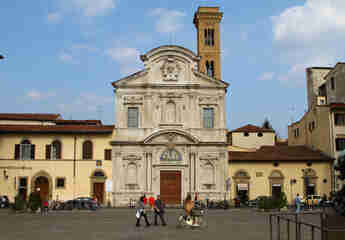
Orsanmichele (Italian: Orsanmichele, Or San Michele) is a church in Florence, a unique architectural structure in both form and significance. This palace served the dual function of city granary and temple. Orsanmichele was built between 1337 and 1350. The name of the church came from the name of an 8th-century women’s monastery that stood on this site and was called “San Michele in the Garden.” In 1240 a market appeared here, where grain was traded in an open loggia with pilasters that protected merchants from the rain. In memory of the church that had stood on this site, two images of St. Michael and the Virgin were placed on the walls. The latter was believed to have miraculous power. The outer arcades with richly decorated windows appeared only in 1367. The church began to play its role in art history only from 1348, when Europe was swept by the first wave of plague.

Flickr, jmpyankech
The Loggia del Mercato Nuovo was built right in the center of Florence back in the 16th century. It is a three-aisled stone shelter supported by columns. In the past, there was a market here where silk and gold goods had been traded since ancient times. Today you can buy leather bags, jackets, souvenirs, and various trinkets made by local craftsmen. As it did hundreds of years ago, this Loggia still shelters traders from rain, snow, and strong wind.
This place is also often called the Porcellino Market, because on its southern side there is a fountain with a monument to the Piglet (in other variations, a monument to a Boar or Wild Boar). This cute little boar (Porcellino) attracts hundreds of tourists who, following tradition, make a wish and rub its snout.
On the market grounds there is another attraction — the “wheel of shame” — a small circle made of different kinds of marble. Debtors used to be tied to it, to frighten others into always paying on time. Unfortunately, it is quite difficult to find and see it today, because there are stalls with goods all around.
The corners of the Loggia used to be decorated with niches containing statues. Now only some of the sculptures remain.

Flickr, ScaniaTheKing87
“Piglet,” or rather “Little Piglet” — that is exactly how the locals affectionately and lovingly call this hero, who has become Florence’s second symbol after the lily.
This sculpture is already more than 400 years old. Over the centuries it has noticeably darkened, except for the snout, which has been polished to a shine. There is a belief that you should make a wish while holding its snout and “treating” the little boar with a few coins, and then it will surely come true.
The story of the appearance of “Porcellino” (translated from Italian as “piglet”) goes back deep into the centuries. According to legend, a ferocious boar burst into the city and frightened all the local residents. They hid in their homes, afraid to go outside. And only one boy approached the animal, held out his hand, and stroked its wet snout. After that the beast calmed down and left the city. And this story became yet another confirmation that tenderness and love can work wonders. A similar plot also appears in Hans Christian Andersen’s fairy tale “The Bronze Boar.”
The author of the sculpture is Pietro Tacca. Today copies of his work have spread all over the world. Clones of the “Piglet” can be found in the USA, Canada, Australia, Denmark, France, Germany, and other countries.
Besides that, it has also “appeared” in cinema. For example, in one scene of the film “Hannibal,” the hero washes his hands in this very fountain. And Harry Potter fans solemnly assure everyone that they saw “Porcellino” in the final part of the famous film saga.
Piazza della Signoria

Flickr, Kathy Adams Clark
Piazza della Signoria (Italian: Piazza della Signoria) is an L-shaped square in front of Palazzo Vecchio in Florence. The square was the center of political life during the time of the Florentine Republic. In the Roman period, a theater stood on the site of the square. Later, 36 towers were built here, in which the Uberti family, who were Ghibellines, settled. In 1260, after the victory of the Guelphs, all the buildings of the Uberti family were destroyed. After that, the square was formed. In its history, it has had several names: Priors’ Square, Grand Duke’s Square, and Nation Square. The government of the Florentine Republic (the Signoria) was based in the square. Its residence was the Palace of the Signoria (Italian: Palazzo della Signoria), built by Arnolfo di Cambio in 1298—1310. This palace is also known as Palazzo Vecchio. The government of the republic was headed by the Gonfaloniere of Justice (Italian: Gonfaloniere della Giustizia). The government included 24 priors elected for two months.
Monument to Cosimo I de' Medici

Flickr, NikonDavid2007
Cosimo I de' Medici (Italian: Cosimo I de' Medici; 12 June 1519(15190612), Florence — 21 April 1574, Villa di Castello (Italian)Russian) was Grand Duke of Tuscany. He was the first representative of a cadet branch of the Medici to head Florence. The son of Giovanni dalle Bande Nere and Maria Salviati, the granddaughter of Lorenzo the Magnificent on her mother’s side. The senior Medici line descending from Cosimo, founder of the powerful dynasty, ended in 1537 with the death of Alessandro de' Medici, the 1st duke. Since Tuscany had been turned into a duchy at the wish of Emperor Charles V, the Florentines did not dare return to a republican form of government. The search for a candidate for the next duke led to Cosimo I. He represented the younger branch of the family descending from Cosimo’s brother named Lorenzo. At the time he assumed the title, Cosimo was 17 years old. Illegitimate children:

Flickr, Lance Griffin
On Florence’s main square — Piazza della Signoria — there stands a beautiful octagonal fountain decorated with a statue of Neptune in the center and mythical sea creatures at the edges. This is the famous “Neptune Fountain,” whose construction lasted a long 10 years. Work on its creation began in 1565 by order of Cosimo I de' Medici, and was completed just in time for the wedding of Francesco I de' Medici.
The fountain was worked on by the famous sculptor Bartolomeo Ammannati, who was directly responsible for the statue of Neptune, while the local master Giambologna assisted him, and the remaining sculptures are attributed to him. It should be noted that all these nymphs and satyrs turned out rather ornate, and their poses are unnatural. By the way, one of the satyrs was stolen in 1830. Neptune himself also suffered: vandals broke off the кисть of his right hand, but now the work of art looks as if nothing had happened.
Ammannati tried to make Neptune’s face resemble Cosimo I de' Medici in order, first, to express gratitude to his patron and, second, to emphasize the fact that Florence gained access to the sea with the conquest of Pisa and Livorno. In this way the master seems to liken Florence to the ruler of the seas.
David

Flickr, Prof. Mortel
David is a marble statue by Michelangelo, first presented to the Florentine public in Piazza della Signoria on 8 September 1504. Since then, the five-meter sculpture has come to be seen as a symbol of the Florentine Republic and one of the pinnacles not only of Renaissance art, but of human genius as a whole. Today the original statue is housed in the Academy of Fine Arts in Florence. Intended to be viewed from all sides, the statue depicts a nude David concentrated on the coming battle with Goliath. This subject represented an iconographic innovation, since Verrocchio, Donatello, and Michelangelo’s other predecessors preferred to depict David at the moment of triumph after defeating the giant. The youth prepares for battle with an enemy stronger than himself. He is calm and focused, but his muscles are tense. His brows are drawn together menacingly, and there is something intimidating in them. He has slung a sling over his left shoulder, the lower end of which is caught by his right hand.
Palazzo Vecchio

Flickr, Massimo Todisco
Palazzo Vecchio (Italian: Palazzo Vecchio, Old Palace) is one of Florence’s most famous buildings, located on Piazza della Signoria. It now serves as the town hall. This government building from 1299, where the priors sat, was called the New Palace (Palagio novo). The former government building, the Bargello, became the Old Palace. In the 15th century the rulers of the commune declared themselves signori, and the building itself came to be called Palazzo della Signoria, thus giving its name to the square in front of the palace. Meanwhile, the building had already been renamed Palazzo Ducale (the duke’s residence): Grand Duke of Tuscany Cosimo I moved here in 1540 from his private palace (today Palazzo Medici Riccardi). But in 1565 he preferred to move his residence to Palazzo Pitti, which was enlarged for this purpose, and the former New Palace ceased to be considered new and became the Old Palace (Palazzo Vecchio).
Loggia dei Lanzi

Flickr, roryrory
Loggia dei Lanzi (Italian: Loggia dei Lanzi) is a loggia, a structure on Piazza della Signoria in Florence, and one of the city’s sights. The arcaded building was constructed between 1376 and 1382 under the direction of Benci di Cione and Simone di Francesco Talenti. The building was intended for meetings and receptions of the Florentine Republic, and later in the 16th century received its name thanks to the Landsknechts (Italian: Lanzichenecchi, in shortened form — Italian: Lanzi) of Grand Duke of Tuscany Cosimo I de' Medici stationed in the loggia. Today the Loggia dei Lanzi is an open-air museum displaying a collection of sculptures from the nearby Uffizi Gallery, including: “Perseus with the Head of Medusa” by Benvenuto Cellini, “The Rape of the Sabine Women” and “Hercules and the Centaur” by Giambologna, an ancient Roman copy of the ancient Greek sculpture “Menelaus with the Body of Patroclus,” “The Rape of Polyxena” by Pio Fedi, as well as several antique female statues.
Statue of Dante Alighieri

Flickr, hburrussiii
Dante Alighieri (Italian: Dante Alighieri), full name Durante degli Alighieri (baptized 26 May 1265 — 13 or 14 September 1321), was an Italian poet, one of the founders of the literary Italian language. He was the creator of the “Comedy” (which later received the epithet “Divine,” introduced by Boccaccio), in which a synthesis of late medieval culture was given. According to family tradition, Dante’s ancestors came from the Roman Elisei family, who took part in the founding of Florence. Cacciaguida, Dante’s great-great-grandfather, took part in Conrad III’s crusade (1147—1149), was knighted by him, and died in battle against Muslims. Cacciaguida was married to a lady from the Lombard family of Aldighieri da Fontana. The name “Aldighieri” transformed into “Alighieri”; one of Cacciaguida’s sons was given that name. The son of this Alighieri, Bellincione, Dante’s grandfather, who was exiled from Florence during the struggle between the Guelphs and Ghibellines, returned to his native city in 1266, after the defeat of Manfred of Sicily at Benevento.
Basilica of Santa Croce

Flickr, Rich Jacques
The Basilica of Santa Croce (Italian: Basilica di Santa Croce — “Church of the Holy Cross”) is a basilica in the center of Florence. One of the city’s most popular tourist attractions. The largest Franciscan church in the world, famous for Giotto’s frescoes and the tombs of Italy’s great figures. Legend says that the church was founded by Saint Francis of Assisi himself. Francis of Assisi died in 1226 and was canonized just two years later. A mention of a church dedicated to him dates to 1229. Construction of the church on the site previously occupied by that building began on 12 May 1294 (possibly by Arnolfo di Cambio). The construction was financed by wealthy Florentine families. In 1442 the church was consecrated by Pope Eugene IV. The church’s windows are decorated with stained glass, enriching its interior. The church is built in the shape of an Egyptian T-shaped cross and is the largest Franciscan church in Italy.

Flickr, profanto90
The Pazzi Chapel is the best place to learn everything about majolica, the famous Italian artistic technique. Surely, when setting off for Florence, you have heard something about relief ceramics that appeared in the Renaissance era.
It was Italian masters who elevated this craft into an art form, and the Florentines became its trendsetters. One such master was the outstanding sculptor Luca della Robbia. His creations adorn the Pazzi Chapel, built in 1423 by the architect Brunelleschi in the courtyard of the church of Santa Croce.
The 13 medallions decorating the chapel’s wall spaces will give you a complete idea of colored relief majolica as a characteristic feature of the early Renaissance. A similar interior can also be found in the old sacristy of the church of San Lorenzo, but photography is prohibited there, so take the opportunity and capture images of genuine authentic majolica.
The architect Filippo Brunelleschi was the trendsetter of the architectural “fashion” of the early Renaissance. In particular, the chapel, which is the jewel of his work, established domed church and public building designs in Italian Renaissance architecture.
These two names — Brunelleschi and della Robbia — turned the chapel, once built as a private house of prayer for the aristocratic Pazzi family, into a work of art included in every architecture textbook.
Peruzzi Chapel

wikimedia.org
The Peruzzi Chapel (Italian: Cappella Peruzzi) is a chapel in the church of Santa Croce (Holy Cross) in Florence, famous for frescoes painted by Giotto. The chapel was commissioned by the wealthy merchant Peruzzi family in the Gothic style. It is the second chapel in the church of Santa Croce, located to the right of the entrance. The wall paintings were commissioned from the celebrated artist Giotto during the period when he had returned from the city of Padua, where he created the frescoes in the Scrovegni Chapel. The church of Santa Croce was used for its intended purpose and became a kind of pantheon of Florence’s illustrious sons. It is here that Michelangelo, Galileo, and Enrico Fermi are buried. There was also a burial in the Peruzzi Chapel itself, for the sake of which the frescoes in the lower part of the room were knocked off. In 1714 the old and, in the opinion of the believers of that time, worthless 14th-century frescoes were covered with chalk. The wall paintings lay buried under chalk for more than 100 years. They were uncovered in 1840 and slightly restored during the wave of growing interest in the national cultural heritage.
Michelangelo House Museum

Flickr, rfzappala
Casa Buonarroti (Italian: Casa Buonarroti) is the Tuscan name of the museum dedicated to the famous Italian sculptor Michelangelo. Michelangelo himself was not born in Florence and did not live here for years, although from time to time he returned here. He was born in the town of Caprese, in the province of Arezzo, and was brought here as a child. He was the second of six sons in the family of Lodovico di Leonardo di Buonarroti Simoni. The father’s income was modest, so the children were drawn into work early — most of the sons were involved in the production of silk cloth, for which Florence was famous. Michelangelo’s wet nurse was not his mother but a stonemason’s wife. As an adult, he joked that his passion for working stone came to him with his nurse’s milk. He first worked in the workshop of the painters Domenico and David Ghirlandaio, and a year later (in the spring of 1489) he moved to the art school in the Boboli Gardens. There he began studying sculpture. The family moved to Florence.