
Flickr, D&S McSpadden
Millions of tourists from all over the world come to Florence in order to see with their own eyes the works of the greatest masters gathered in the Galleria dell'Accademia. It was opened in 1784 specifically so that aspiring sculptors and painters could study details and grasp secrets while admiring authentic masterpieces.
Today it is perhaps one of the most visited museums in Europe. It is renowned above all for Michelangelo's sculptures: four figures from the "Prisoners" cycle, the unfinished marble sculpture of the Apostle Matthew, as well as the famous statue of David, which was specially moved here from Piazza della Signoria in 1873. A separate hall, the Tribuna, was even built for "David." And a copy was installed in the square in 1910.
In the neighboring rooms, which had previously been part of two monasteries, important works of art are displayed. These are mainly religious paintings by famous artists who worked in Florence from the 13th to the 16th centuries. Among them are such well-known names as Botticelli, Andrea del Sarto, Perugino, Bronzino, and others.
In one of the halls you can see Andrea Orcagna's polyptych and a series of panels telling about the life of Jesus Christ and Saint Francis, created by the Italian painter Taddeo Gaddi. In addition, the Gallery has a section of Russian icons painted in the 16th-18th centuries. Among the recent additions is a collection of antique musical instruments from the Cherubini Conservatory.
The Gallery is so popular with tourists that it is better to book a ticket here in advance online. That way you will not have to waste time on agonizing waits in endless lines.
Academy of Fine Arts

wikimedia.org
The Academy of Fine Arts in Florence (Italian: Accademia di belle arti di Firenze) is the first academy of painting in Europe. It was founded in 1561 with the support of Cosimo I, Grand Duke of Tuscany, by three well-known Mannerist artists: Giorgio Vasari, Agnolo Bronzino, and Bartolomeo Ammannati. Originally the Academy was located in the church of Santissima Annunziata. In 1784, by decree of Leopold, Grand Duke of Tuscany, all art schools of Florence were subordinated to the Academy. An art gallery was created at the Academy where students could familiarize themselves with the artistic legacy of the old masters. Music and art restoration were also counted among the fine arts; in 1849 the Florentine Conservatory was separated from the Academy. The halls of the Academy house such world-famous sculptural works as Michelangelo's "David" and "Prisoners," Giambologna's "Rape of the Sabine Women," as well as the finest examples of Florentine painting of the 15th-16th centuries.

Flickr, Oleg Dolya
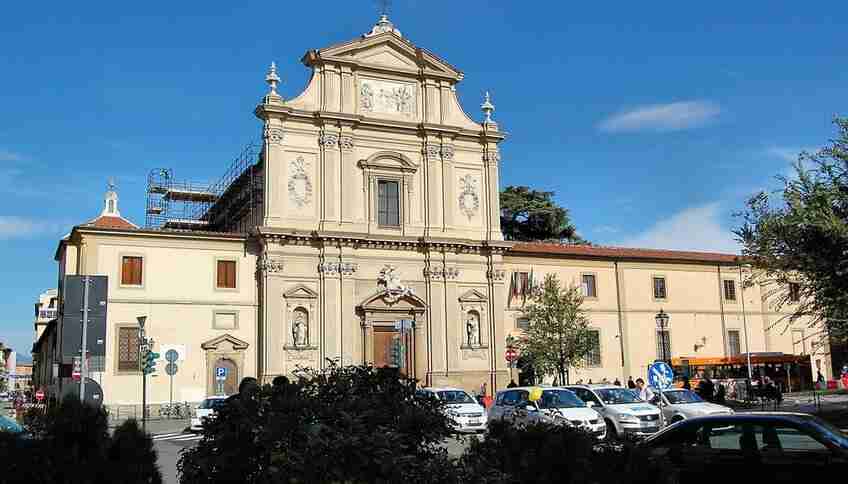
This square is named after the monastery of the same name, which was founded around the 13th century. Today it is an entire complex consisting of the church of San Marco and a convent housing the national museum.
In the 15th century, Cosimo de' Medici handed both the monastery and the church over to the Dominican monks, while indicating the need to reconstruct the buildings. He probably did this to show his respect for the church and at the same time strengthen his own authority, because during the renovation the symbols of the Medici dynasty appeared on many details of the facade and interior.
An interesting period in the life of the monastic complex, and of Florence as a whole, began at the end of the 15th century when the priest Girolamo Savonarola became prior. He himself strove, and urged everyone around him, to live more modestly, renounce luxury and wealth, and help the poor. Incidentally, it was he who secured the temporary expulsion of the Medici from Florence. Savonarola later suffered for his convictions, but nevertheless remained in the memory of the Florentines for a long time.
Also on Piazza San Marco is the Academy of Fine Arts, where you can see genuine masterpieces, including Michelangelo's famous David. And in the center of the square stands a monument to the Italian Risorgimento general Manfredo Fanti.
San Marco

Flickr, saucemania
San Marco (Italian: San Marco) is the general name for a complex consisting of the Basilica of Saint Mark (Italian: Basilica di San Marco) and a convent, now turned into a museum (Italian: Museo Nazionale di San Marco). It is located on Piazza San Marco (Italian: Piazza di San Marco) in Florence. The monastery of San Marco was apparently founded in the 13th century. It is known that from 1299 there was a Sylvestrine monastery here. In 1437, the Florentine merchant Cosimo de' Medici the Elder handed the church and monastery over to the Dominican monks and commissioned the architect Michelozzo di Bartolomeo to reconstruct it. The reasons for his act are not known exactly, but there is evidence both that he was guided by Christian piety[1] and that by this he strengthened his authority (the Medici coats of arms and other symbols on churches built to his order[2]). The rebuilding was largely completed in 1442, although some work continued later.

Flickr, Angela
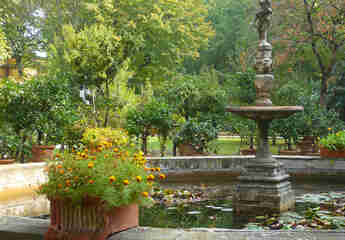
The Botanical Garden in Florence is considered one of the three oldest gardens in Italy; the other two are located in Pisa and Padua. All of them are still operating, and many of their plants are already well over a hundred years old. 1545 is considered the founding date of "Giardino dei Semplici".
This botanical garden owes its appearance to Luca Ghini. This Italian botanist appealed to Cosimo I de' Medici for money to set up a plant nursery for young physicians. The students studied medicinal herbs there and used them to create healing ointments and balms.
"Giardino dei Semplici" translates as "garden of simplicity." If you look at it from a bird's-eye view, you can understand that it really was laid out very simply: irregularly shaped squares connected by paths. But in the 18th century the garden was redesigned, so the original layout has not survived. However, the fountain "Boy with a Dolphin" and the central alleys have survived to this day.
The area of the botanical garden is almost 2.5 hectares. Rare plant specimens coexist on this territory that in the wild would hardly ever have met. A visit to the garden is especially recommended during the flowering period: the air here is filled with a unique fragrance, and the eye delights in the bright colors of the flowers. The orchid, fern, and azalea collections are of greatest interest.
Basilica della Santissima Annunziata

Flickr, Mr.Dare
Santissima Annunziata (Italian: Santissima Annunziata) is a basilica in Florence. It was built in 1250 by the Servite order. The church was rebuilt in 1444-1477 thanks to the efforts of Michelozzo and Leon Battista Alberti. The enclosed inner cloister dates from this period. In 1601 the sculptor and architect Giovanni Battista Caccini[en] added to the old basilica a loggia with an arcade on columns, in imitation of two similar loggias: the Ospedale degli Innocenti, a work of Filippo Brunelleschi, and the Loggia dei Servi de Maria[it], built by Antonio da Sangallo and others. Thus the symmetrical composition of the square named after the basilica was completed. In the arched gallery of the cloister, covered by a glass roof, there is a small painting museum called the "Cloister of Vows." This scenographically designed space is decorated with lunettes containing frescoes by Rosso Fiorentino, Pontormo, and Andrea del Sarto. To the right of the entrance is Rosso Fiorentino's fresco "Assumption of the Madonna."
Piazza della Santissima Annunziata

Flickr, Simone Ramella
Piazza della Santissima Annunziata (Italian: Piazza della Santissima Annunziata), or the Square of the Most Holy Annunciation, is one of the squares of Florence, Italy, lined with beautifully harmonious buildings in the style of the Italian Renaissance. The facades of the following buildings face the square: On the square itself are located: From the southwest the square is adjoined by Via dei Servi, which leads directly to the Cathedral of Santa Maria del Fiore.
Foundling Hospital

Flickr, Prof. Mortel
Ospedale degli Innocenti (Italian: Ospedale degli Innocenti - Hospital of the Innocents), or the Foundling Hospital, is one of the landmarks of the city of Florence, Italy, located on the Square of the Most Holy Annunciation next to the basilica of the same name. A former shelter for homeless children, it was built in the first half of the 15th century by the architect Filippo Brunelleschi[1]. One of the first Renaissance buildings[2], it exerted an enormous influence on the development of Italian and world architecture. The institution was created as part of an extensive program of charitable initiatives by the Florentine oligarchy aimed at improving citizens' living conditions and the sanitary situation. In 1419 the construction of the shelter was entrusted to the architect Filippo Brunelleschi by the Florentine silk guild Arte della Seta[fr]. The site chosen for the construction of the foundling hospital was the monastery garden of the nearby church of Santissima Annunziata.

Flickr, Pam Watt
In the center of Florence stands the oldest theater in Italy - the Pergola. It was built in 1656 and for more than 350 years has been considered a symbol of the city's artistic life.
"Pergola" is translated from Italian as "an arbor entwined with grapevines." If you look at the theater building, it immediately becomes clear where such a name came from. Greenery decorates this house with its own unique adornment. And once upon a time there was a cloth factory here...
In 1600 a new genre, opera, was invented in Florence, but no one yet knew what a building for such performances should look like. The Pergola theater later became the model for all the others. Inside appeared tiers separated by partitions into individual boxes. Nowadays no one is surprised by this, but for the 17th century it was a great innovation. The same was true of the underground passages beneath the stage, as well as the special mechanisms for lifting and changing the scenery.
The Pergola theater takes particular pride in its unique acoustics: even the slightest rustle from the stage can be heard here. That is why many directors dreamed of getting onto this theatrical stage. Incidentally, it was here that the premiere of "Macbeth" - Giuseppe Verdi's famous opera - took place.
Today the theater mostly hosts regular performances, but when the season ends, the festival "Florentine Musical May" begins. At this time opera lovers can enjoy the best productions by the greatest masters of operatic art.