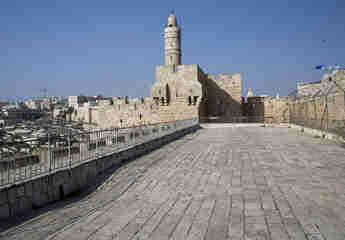

View of Jerusalem from the roof of Shechem Gate
We will begin this self-guided tour at Jaffa Gate, climb up onto the walls, and walk along the Christian Quarter, the Latin Patriarchate, and the Church of the Most Holy Name of Jesus. Then we will admire the views outside the city, and there is plenty to see there, because Jerusalem has its very own Notre-Dame. We will pass over Shechem Gate, find out where Column Square used to be, walk past the sleepwalkers' cemetery, and descend at Lions' Gate. This unhurried walk will take a little over an hour, but we're in no rush ;)

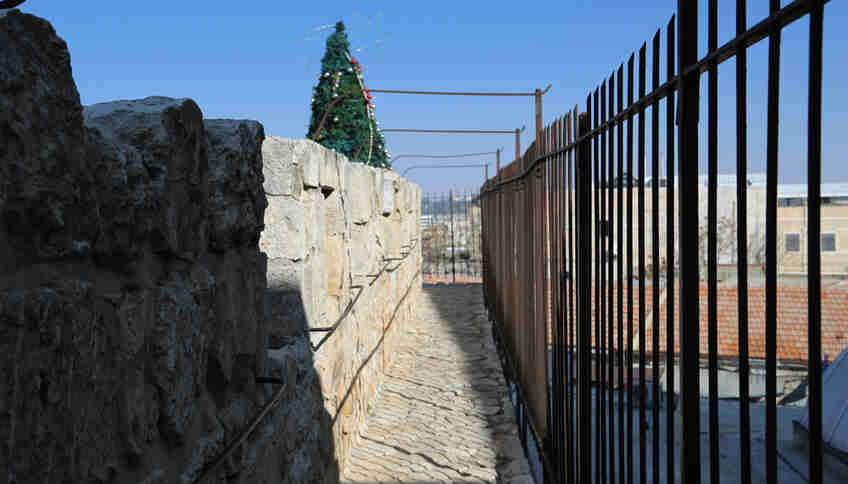
Our walk will follow such a narrow parapet. Comfortable shoes are a must-have accessory.
By the way, it's very convenient to take self-guided walks around Jerusalem by downloading our smartphone audio guide. With it, you will literally free up your hands and be able to immerse yourself 100% in the atmosphere of the city while listening to audio stories about its main attractions.
At the beginning of the 16th century, the Jerusalem walls lay in ruins. Sultan Suleiman the Magnificent built the walls in 1536-1541 in order to protect the city from the Crusaders. They once encircled the city on all sides, but at present only the northern and southern sections of the walls have survived. Our first walk will take place along the longer, northern stretch of the Jerusalem wall.
You can buy tickets to the wall at the information center by Jaffa Gate (as soon as you enter the city, look for it on your left). The pleasure costs 16 shekels per adult. The entrance is here as well, nearby, but you may not find it on your own, so ask the people selling the tickets.
Walk along the northern wall of Jerusalem on a larger map
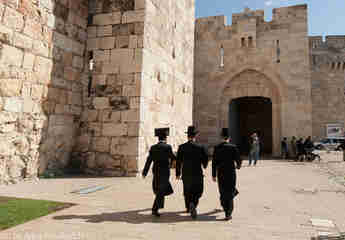
The walk begins on the roof of Jaffa Gate. From here there is an excellent view of the square and the Tower of David. It has nothing to do with King David, whom you probably thought of, since it was built in the Ottoman period by Suleiman the Magnificent.

View from the roof of Jaffa Gate toward the opening in the wall created especially for the arrival of Kaiser Wilhelm. Today it is one of the entrances to the city.
Jaffa Gate

View from the roof of Jaffa Gate toward Jaffa Road.
450 years ago, the Ottoman Sultan Suleiman the Magnificent initiated the construction of walls around the Old City. Incidentally, Tel Aviv did not yet exist then, but Jaffa did. The road connecting Jaffa and Jerusalem was called Jaffa Road, as was the gate leading into the city.
Did you notice that the entrance to Jaffa Gate is shaped like the Cyrillic letter “Г”, and this is no accident - such a form prevented troops from being brought in quickly.
In 1898, while preparing for the visit of German Kaiser Wilhelm II, a breach was made in the wall to the right of the gate, and the deep moat around the Tower of David was partially filled with earth, creating a ramp leading into the city. Today it has turned into an ordinary roadway.
Interestingly, General Allenby, who commanded the British troops that captured Palestine in 1917, dismounted as he approached the gate and entered the city on foot.
After the War of Independence in 1948, this part of the city remained under Palestinian control, and the opening in the wall was sealed with stones. However, after the Six-Day War it was dismantled.
The walls are 4.2 kilometers long and include 35 towers, half of which were never completed.
Christian Quarter

Moving on from Jaffa Gate, you skirt the Christian Quarter from the west; it will remain on your right. You won't get breathtaking views from here, but that's not why we climbed up here. Here you can “peek” at the backstage side of Jerusalem, and that is exactly what makes it interesting.
In the 19th century, Christians actively began buying land in the Holy Land. The buildings you will encounter on your way belong to the Latin Patriarchate - the center of Roman Catholicism in Jerusalem.
The nearby Cathedral of the Most Holy Name of Jesus, despite its seemingly ancient appearance, was built in the mid-19th century.

Since there is very little space in the Old City, rooftops are yet another effective way to use space.
Notre-Dame de France

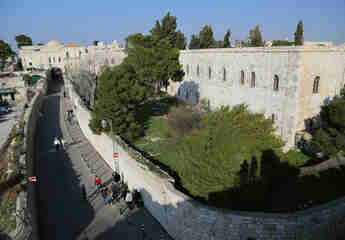
As soon as you feel the turn to the north - look over the walls. Directly opposite you there will be a view of the street... and Notre-Dame de France. Despite its Renaissance appearance, this building was constructed in 1904. The first French pilgrims making mass pilgrimages appeared by the city walls in 1882. They set up their camp right here. And after some time, a decision was made to buy the land by the walls of the Old City and establish a hotel for believers.
From the 19th century onward, thousands of Christian pilgrims began flocking to Jerusalem, and they had to be housed somewhere. So the French pilgrims built the largest building in the city, one that could accommodate more than a thousand souls each night.
By the completion of construction in 1904, it was the tallest structure in the city, U-shaped, with a luxurious staircase and a statue of the Madonna and Child.
In 1967, after the Six-Day War, the hospice passed to the Vatican.
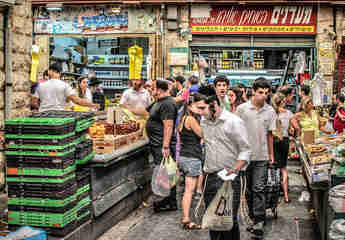
Next, along the walkway past Jerusalem courtyards, underwear drying in the sun, garbage, and inner patios, we come to Shechem Gate.
Damascus or Shechem Gate

Along with Jaffa Gate, these were once among the most important gates and led from Jerusalem to Nablus. In Hebrew, these gates are called Shechem Gate. In the Byzantine period they were called St. Stephen's Gate, in memory of the martyr struck down by arrows. In the Ottoman period, the tradition of marking St. Stephen's Day gradually “moved” to the other gate where we will end our walk - for some time Lions' Gate was named after the holy martyr.

Since the 10th century, Arabs have called the gate Bab al-Amud, or Gate of the Column. It is said that in front of it, inside the city, there was already in the Byzantine period a square called “Column Square,” where, apparently, a colossal column once stood, later lost.
The commercial street A-Gai, by the way, is depicted on the famous “Madaba Mosaic.” It led through these gates, crossed Jerusalem from north to south, and passed exactly between two Jerusalem hills - the Temple Mount to the east and Mount Zion to the west.
Note that on the mosaic from Madaba, a square and a large column in the center are indeed depicted by the gate, which was later irretrievably lost.
Flower Gate or Herod's Gate

And we pass the noisy market street and move north. The next stop is Herod's Gate. In Arabic, this gate is called Bab al-Zahara, which according to one version comes from “bab al-sahira” - “those who do not sleep at night,” or more simply, sleepwalkers. Al-Sahira is an Arab cemetery, which we will come to very soon. And these gates were probably called Flower Gate because of the stone rosettes stylized as flowers.
Mount of Olives or Olivet
Winding along the wall, soon after Herod's Gate you will feel another turn - the perfect time to stop, look over the wall, and examine the Mount of Olives in detail. There, farther to the left, in the distance, lies Mount Scopus, on whose summit the Jerusalem University has spread its buildings.

A little closer, where the high bell tower rises, stands the Lutheran Center and the operating Augusta Victoria Hospital, named after the Austrian empress.

Closer to us and slightly to the right you can see the Franciscan monastery with the Garden of Gethsemane and the Basilica of All Nations, and a little higher above it - the Orthodox convent of Mary Magdalene.
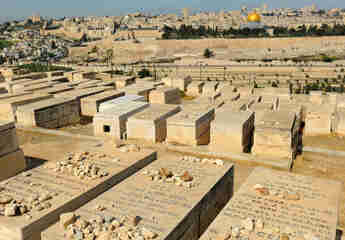
Far to the right is the old Jewish cemetery, which has existed for more than one thousand years and holds more than 150 thousand saints and sinners.

Lions' Gate

Lions' Gate, as is well known, was built by Suleiman the Magnificent. According to legend, he had a prophetic dream that lions would tear him apart if he did not surround the Old City with a wall. The wall was built, and stone lions were embedded into it.
Today these are the only gates leading into the city from the east. For some time Christians called them St. Stephen's Gate, mistakenly believing that the saint was killed right here, although in fact it happened at Shechem Gate.
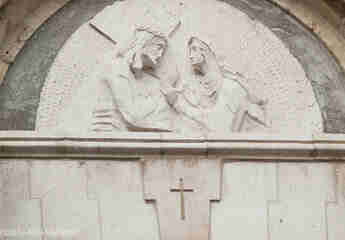
This is where the walk along the northern part of the wall ends. We go down and come out onto Via Dolorosa or the Sorrowful Way - Christ's final path before the execution. Here you have the opportunity to walk along Via Dolorosa and, after returning to Jaffa Gate, begin the second part of the walk - along the southern Jerusalem wall. Or, leaving the city, you can climb the Mount of Olives to an excellent observation point.
Your guide was Alina Kovalevich