Water Puppet Theater

Flickr, inerich
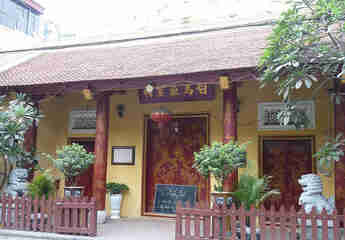
Water puppet theater is a Vietnamese tradition dating back to the XI century AD and originating in villages in the Hong Ha River delta in northern Vietnam. In the old days, peasants used this form of entertainment during floods[1].The puppets for this theater are made of wood and then lacquered. The performance is held in a shallow pool. The marionette is supported by a large rod located under the water and controlled by the puppeteer, who is usually hidden behind a screen. In this way, the puppets move over the water. Performances are often accompanied by national music[2].

Flickr, Sergey Emelyanov
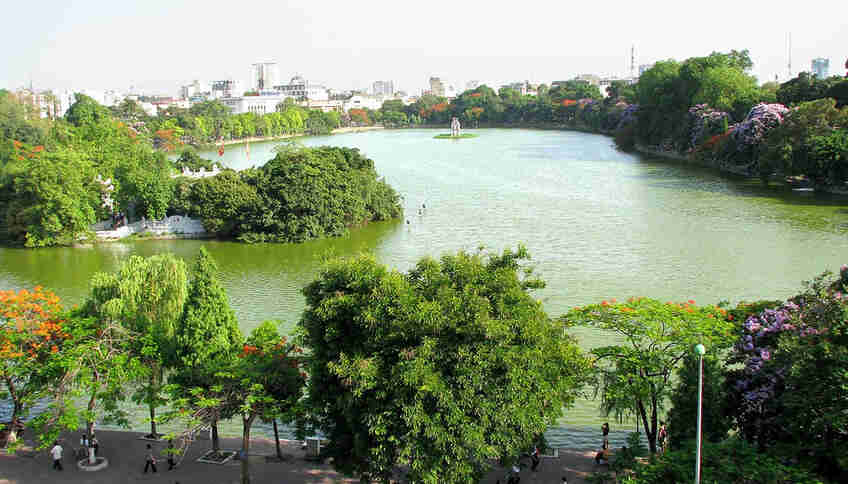
All Vietnamese love and revere Hoan Kiem Lake. Besides, this is probably the most charming place in Hanoi. The calm mirror-like waters with green plantings along the banks look very picturesque!
In addition to its natural beauty, the lake is famous for the legend of how, in ancient times during the war with China, the national hero of Vietnam Le Loi was granted a sword with which he defeated all the invaders. According to the tale, the weapon was given to Le Loi by a turtle living in the lake. Later, however, when the hero returned to the lake in gratitude, the sword fell from his hands, returning to the depths of the water.
Such an interesting and patriotic story about the turtle prompted the Vietnamese to rename the lake from “Green Water” to “Lake of the Returned Sword.” The original name, however, is more practical, since the water in it is indeed green all the time. And about the turtles, it is said that a very rare species of these amphibians really lives here, though they do not show the magic sword to anyone ;)
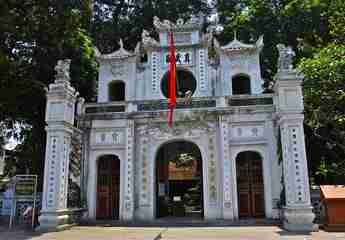
There is a small island in the middle of the lake. You can get to it by a bridge that will lead you to Ngoc Son Temple, built in the XIX century in honor of important figures in the history of Vietnam. These are Van Suong, a famous scholar and man of letters, and Huang Dao, who became renowned in the fight against the invaders of the Yuan dynasty. The temple has several interesting sculptures, as well as hieroglyphic inscriptions. This place is literally permeated with symbolism and the spirit of traditional Vietnamese culture.
Hoan Kiem Lake

Flickr, One for the Road: Brendan Caffrey Photography
Hoan Kiem Lake (Vietnamese Hồ Hoàn Kiếm, chu nom 湖還劍, ho hoan kiem), also “the lake of the returned sword” and “the lake of green water,” is a body of water located in the center of Hanoi. Hoan Kiem Lake is considered a historical and cultural landmark of Vietnam.The lake was formed on the site of an old bed of the Red River, which flows somewhat farther north. Hoan Kiem is located between the old streets of Hang Ngang (Hàng Ngang), Hang Dao (Hàng Đào), Cau Go (Cầu Gỗ), Luong Van Can (Lương Văn Can), Lo Su (Vietnamese Lò Sũ).

Flickr, paulvo
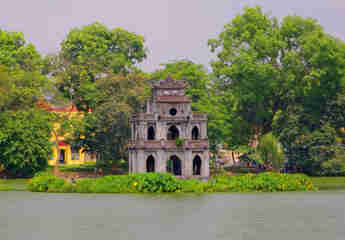
In the middle of Hoan Kiem Lake in Hanoi there is a small island where a beautiful temple stands – Turtle Tower, which is connected with a city legend.
In the XV century, the national hero of Vietnam Le Loi received a magic sword from a turtle living precisely in this lake. Later, after defeating the invaders, when Le Loi returned to the turtle with gratitude, the sword – whether by accident or on purpose – fell from the hero's hands and returned to the lake. That is why it was nicknamed Hoan Kiem, which translates as “Lake of the Returned Sword.”
It is believed that a rather rare species of large freshwater turtles really does live here, and they are one of the symbols of Hanoi. Perhaps this is what gave rise to the beautiful myth about the turtle.
The tower on the island was built in 1886. In style it is close to traditional Vietnamese architecture, but the noticeable influence of European style is also felt, which is not surprising, since the country was a colony of France for a long time.
Long ago, another ancient structure stood on this site, destroyed back in the XVIII-XIX centuries, so Turtle Tower, although it looks rather archaic, is a newcomer to Hoan Kiem Lake.
Ly Thai To Monument

hanoilocalguide.com
Ly Thai To (Vietnamese Lý Thái Tổ; simplified Chinese 李太祖, pinyin: Li Taizu), taboo name — Cong Uan (Vietnamese Công Uẩn; simplified Chinese 公蘊, pinyin: Gongyun) 974—1028) — Vietnamese emperor (from 1009), founder of the Later Ly dynasty.Ly Thai To was born in the district of Cophap, in Bac Giang (now Dinh Bang commune, Tu Son district, Bac Ninh province). His mother came from the Pham clan, and the future emperor was an illegitimate child — there were several legends about his birth. According to the official version, his mother, while walking near the Tieu Son monastery, met a spirit in human form, from whom she conceived a child. One temple version claimed that the mother of Ly Cong Uan conceived from the seed of a white monkey; another said that she lived in Thientam monastery, whose elderly abbot accidentally bumped into her in the dark, and thus the maiden Pham became pregnant.

thongtan.net
The Museum of Revolution in Hanoi was opened in 1959, and since then its collection has expanded significantly, with exhibits representing the history of the last several decades being added.
By “revolution” in Vietnam they mean practically the entire century-long history, from the struggle against the French colonizers to the period of economic growth in the 80s of the last century. The Vietnamese really defended their independence for a very long time, constantly fighting both external aggressors and internal enemies, so the revolutionary period of the country covered almost a century.
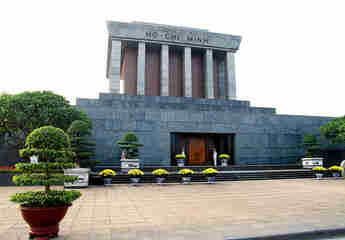
The exhibitions of the Museum of the Vietnamese Revolution are divided into three large groups of exhibits, each of which describes a certain era. The first is the struggle for independence in 1858-1945, the second is the resistance war in 1945-1975, and the third is the period up to the present day. In total, the museum's collection contains several tens of thousands of items and carefully collected artifacts. A separate hall is devoted to the legendary Ho Chi Minh, his personal belongings and the story of his life.

Panoramio, Grafikol.com
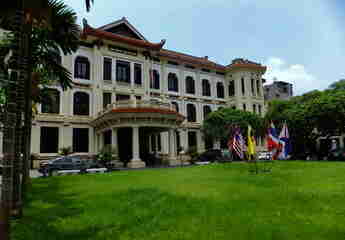
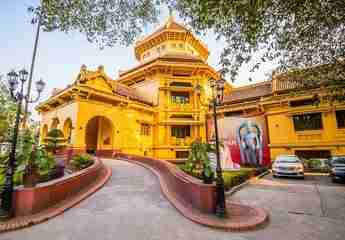
You can learn the history of Vietnam from ancient times to the present most fully by visiting the National Museum of Vietnamese History, opened in 1958 not far from Hoan Kiem Lake.
The museum building is a fine example of colonial architecture, combining the charm of local exoticism and the progressive (for the end of the XIX century) European style.
The exhibition introduces visitors in chronological order to the history of the Vietnamese people, beginning with the emergence of culture and statehood. 7 thousand exhibits are displayed here at the same time. However, there are even more in storage — about 100 thousand items. Therefore, the exhibitions change quite dynamically; in addition, work is constantly carried out to replenish the collection and improve the exhibition halls.
In the museum you can see ancient artifacts and works of art relating to the rule of the great dynasties in the Middle Ages. You will also become acquainted with items connected with Vietnam's struggle for independence, including even original documents signed by Ho Chi Minh himself.
Hanoi Opera House

blogspot.com, alpaj75
The Hanoi Opera House (Vietnamese Nhà hát lớn Hà Nội) — an opera house in the center of Hanoi, the capital of Vietnam. It was built in the period from 1901 to 1911, during the rule of the French colonial administration.When drafting the construction project for the Hanoi Opera House, the building of the French Garnier Opera was taken as a model.On the site intended for the opera, there was a large pond adjacent to the city gates. Construction encountered many difficulties, since the foundation had to be placed on unstable soil. Before laying the foundation, almost 1 meter thick, it was necessary to drain the pond and install 30 000 bamboo piles.The architectural style of the Hanoi opera is similar to the style of the Paris opera - with typical Gothic and mosaic decorations on the arches and stained-glass windows. Some architects believe that, since the Hanoi opera was built 300 years later than its French counterpart, this made it possible to avoid an abundance of unnecessary elements[1].