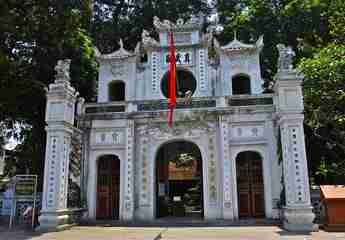

In the old city quarter, at the end of Hang Chieu street, you will see an arch through which Vietnamese people keep darting back and forth on bicycles and motor scooters. This arch, crowned with a lookout tower with a pavilion resembling a pagoda, is Quan Chuong, or the Old City Gate of Hanoi. It consists of a large arch three meters high and two small side arches for pedestrians.
This gate is the only one to have survived of the 16 gates of the 17th-century city wall. It was built during the time of the Later Le Dynasty - rulers who decided to strengthen the city, founded back in the 13th century, with a fortress wall with watchtowers above the gates. Back then, each of them bore the name of the village or area it opened onto, and Quan Chuong was called Dong Ha, after the neighboring village.
That was the case from the moment the gate was built in 1749 until 1873, when French troops destroyed all of the city's fortifications, including the gates. But at the one before you, a mandarin named Chuong took up the defense - he and his soldiers held the gate to the last drop of blood and the last breath. In memory of such heroism, the French decided not to destroy the Dong Ha Gate. Later, the townspeople began calling it by the name of the legendary mandarin - Quan Chuong.