City Hall

Flickr, Stoffs
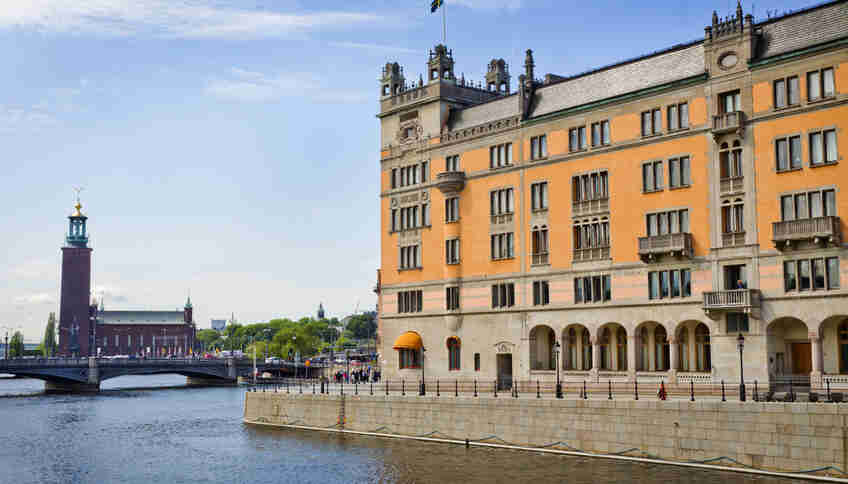
Stockholm City Hall (Swed. Stockholms stadshus) is one of Stockholm's main tourist attractions, a symbol of the Swedish capital. The building was constructed at the tip of Kungsholm island in 1911—1923 according to the design of Ragnar Östberg (Swed. Ragnar Östberg). Meetings of the city authorities are held in City Hall, important political negotiations take place there, and in the Golden (1930, 1933-1973) and Blue halls (since 1974) of City Hall a banquet is held every year on December 10 after the presentation of the Nobel Prizes. The Golden Hall is decorated with a mosaic of more than 18 million gilded tiles depicting scenes from the history of Sweden. The courtyard of City Hall is open to visitors, while tours of the halls are possible only with a guide. Tours in Swedish and English are conducted daily, and tours in Russian can also be booked.[1] From the observation deck of the 106-meter tower of City Hall, a magnificent panorama of Stockholm opens up.
Stockholm Central Station

Flickr, hugh llewelyn
Stockholm Central Station (Swed. Stockholms centralstation) is the largest railway station in Sweden. It is located in the Norrmalm district by Central Square and Vasagatan street. It is bounded by Vattugatan street to the south and Kungsbron to the north. The station was opened on July 18, 1871 (the Southern Station was opened on February 10, 1860). Today it is the largest railway station in Scandinavia and the second-largest passenger hub with about 200 000 visitors daily. Together with the T-Centralen metro station, Stockholm Central Station is the largest in Scandinavia with 450 000 passengers per day. The station building was constructed between 1867 and 1871 and was opened on July 15, 1871. The architect was Adolf W. Edelsvärd. All station property is owned and managed by Jernhusen. The facade of the station on the Vasagatan side is adorned with statues of Svea and Göta on each side of the small national coat of arms, crowned with a royal crown, by the artist Oskar Berg.

sergeybond.livejournal.com
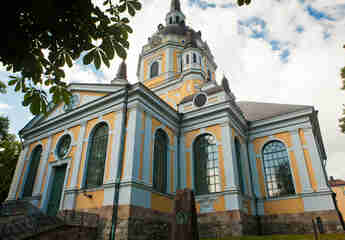
An ancient church in the very center of Stockholm has survived many reconstructions and even risen from the ashes.
Its history began almost 750 years ago, when King Magnus Ladulås ordered a women's monastery and a church to be built here in honor of Clara, a saint greatly revered in Europe, who founded the Order of the Poor Clares.
The monastery functioned for about 250 years, but in the 16th century it was demolished together with the church by order of King Gustav Vasa. However, his heir soon ascended the throne and ordered the church to be rebuilt. Thus began a new stage in the existence of the temple, which lasted about 200 years.
Then a severe fire occurred, destroying all the interior decoration as well as the tower in the western part of the building. The restoration of the church continued for almost an entire century, and only in 1886 was a new tower built. Its height reached 116 meters – it was the tallest building in the capital of Sweden. At the very top of the tower spire appeared a gilded rooster, which served as a reminder that the church watches over the faithful.
One of the facades of the church is overgrown with shrubs, which makes it seem even more ancient and a little mysterious. The interior decoration of the temple is very rich: a marble floor, stained-glass windows, sculptures of angels, a carved pulpit, and most importantly, a stunning organ that still works to this day.

Flickr, marte.ks
Drottninggatan, or 'Queen Street,' is Stockholm's most important pedestrian street. It begins not far from the Gamla Stan district (Old Town) and stretches for 1,5 km.
At the very beginning of Drottninggatan, on the corner of Strömgatan street, you can see a beggar fox — this is how the British sculptor Laura Ford decided to draw the attention of passersby to the problem of homeless animals suffering because of our actions.
The city's main pedestrian street is crowned by a park with an observatory that has been granted the status of a historical museum.
In addition, Drottninggatan is home to the city's oldest pharmacy called 'The Owl.' It is said that its address has not changed since 1798, while 'The Owl' itself was opened back in 1761.
Along the pavement throughout the entire street runs a long inscription — quotations from the works of the classic writer Johan August Strindberg, the founder of Swedish theater and literature. He lived on Drottninggatan, in house number 85, where the writer's museum is located today.
Royal Academy of Fine Arts

wikimedia.org
The Royal Academy of Fine Arts (Swed. Kungliga Akademien för de fria konsterna) is a Swedish art academy in Stockholm. The academy was founded in 1735 by Carl Gustaf Tessin and the architect Carl Hårleman under the name Royal Academy of Drawing (Kongl. ritakademien). Among the main subjects taught, among others, was drawing from the nude. In 1768 the first meeting of the members of the academy took place under the leadership of the architect Carl Fredrik Adelcrantz. In 1773, by order of King Gustav III, its first charter was written, modeled on the Paris Royal Academy. In addition to drawing, architecture, anatomy, technical drawing, art history, and artistic perspective began to be taught here, as a result of which the initially small Academy of Drawing grew and turned into the Royal Academy of Painting and Sculpture (Kongl. målare- och bildhuggareakademien).

Flickr, imagea.org
This beautiful architectural complex looks quite austere – its facades are made of ordinary limestone. And yet, this is where the state and administrative offices of the Ministry of Justice and the Ministry of Foreign Affairs are located, as well as the offices of the Government of Sweden. In addition, this building also serves as the home of the country's prime minister. Every day press conferences, meetings, and high-level sessions involving many influential statesmen are held here.
The architectural complex of Rosenbad was built in central Stockholm back in the second half of the 17th century and originally functioned as public baths. From the end of the 18th century the building was owned by the Bonde family. At present, a restaurant of the same name is open on the first floor of the building.
Riksdag

Flickr, IamRedOctober
Riksdag[1] (Swed. riksdag, from Swed. riks — state, and Swed. dag — day) is the unicameral parliament of Sweden, consisting of 349 members elected under a proportional system for a term of four years. The Riksdag is headed by the speaker — the talman. It is the highest representative and legislative body of Sweden. The Riksdag building is located in central Stockholm on the island of Helgeandsholmen.
Medieval Museum

Flickr, Ingvald R Ingebretsen
The Medieval Museum (Swed. Medeltidsmuseum) is located on the island of Helgeandsholmen under the Norrbro bridge in Stockholm. The Medieval Museum (Medeltidsmuseum) appeared after a major archaeological study in 1978-80, which took place on the eve of the restoration of the old Riksdag building. Among the excavated finds were parts of the city wall erected by Gustav Vasa in the 1530s, as well as the medieval cemetery of Helgeandshuset (House of the Holy Spirit), which originally gave the island its name. For the most part the museum is located below ground level; the entrance is from the Strömparterre terrace under the Norrbro bridge. Annual ticket 100 kronor, also valid for the Stockholm City Museum[1]. Tue.- Sat.: 12 to 17, Sun.: 12 to 19, Monday – closed.
Royal Opera

Flickr, s_poc
The Royal Opera in Stockholm is an opera house in Stockholm, the capital of Sweden, founded in 1782. The theater building is located in central Stockholm, on the eastern side of Adolf Gustav Square (Swed. Gustav Adolfs torg). Today the theater's repertoire includes opera performances and ballets, with ballets accounting for about 40 percent. The opera has its own symphony orchestra that performs concerts[1]. * The troupe of the Swedish Royal Opera toured the USSR in 1975[1]. The first opera troupe in Sweden was created by King Gustav III. The first performance (the opera Thetis and Phelée by the German composer Johann Gottlieb Naumann) was given on January 18, 1773, but the opera theater itself was not established until 1782. In 1775 construction of a building for the theater began. The author of the building project was the architect Carl Fredrik Adelcrantz. The client of the construction was Gustav III, a supporter of the ideals of enlightened absolutism and a patron of the arts.

Flickr, http://www.henriksundholm.com/
The Church of Saint Jacob, compared with many famous buildings of Stockholm, does not look very impressive. That is why many tourists strolling along the embankment do not notice it. And yet, this is one of the oldest surviving structures in the capital of Sweden!
This church was erected in the last quarter of the 16th century on the site of an even older church with an almost 300-year history. In the Middle Ages this small chapel stood on the site of the modern royal park. It was dedicated to Saint Jacob, the patron saint of sailors and travelers, and together with another modest church it was demolished under Gustav Vasa.
His son Johan III, on the contrary, decided to build two new churches in Stockholm. Thus in 1580 work began on the construction of the churches of Saint Jacob and Saint Clara.
In those times stone replaced the wood traditional for Sweden, and the new church became a real adornment of this part of the capital. Later it was reconstructed, but that does not take away from the building its status as one of the oldest in the entire city.
Several unique artifacts have survived in the church to this day, including a 17th-century baptismal font, church silverware, and porticoes made by the master stonemasons Henrik Blom and Hans Hebel.
Royal Dramatic Theatre

Flickr, Rain_S
The Royal Dramatic Theatre, Dramaten (Swed. Kungliga Dramatiska Teatern) is the Swedish national theater. It was founded in Stockholm in 1788. The modern Art Nouveau building was erected in 1908 according to the design of the architect Fredrik Lilljekvist. The decoration of the theater was created by Carl Milles and Carl Olof Larsson. It opened on February 18, 1908 with a production of August Strindberg's historical drama 'Master Olof.' Among others, the theater was led by Olof Molander (1934-1938), Ragnar Josephson (1948-1951), Ingmar Bergman (1963- 1966), and Erland Josephson (1966-1975). Many famous directors and actors graduated from the Dramatic School at the theater, including Greta Garbo, Max von Sydow, Gunnar Björnstrand, Signe Hasso, Bibi Andersson, and Pernilla August.

imageocd.com, aviewoncities.com
This is one of the best museums in Sweden, and perhaps one of the best in the world devoted to this subject. Musical instruments of all historical eras and peoples are presented here. The collection, housed in the former royal bakery, a 17th-century building, occupies quite a large area, wandering through which is a real pleasure!
The nicest thing about the Music Museum is that you can try to 'play' some of the instruments. The museum uses the following symbols: a green square means you may play, a red circle means you may not. If an exhibit is behind glass and looks very fragile, headphones with a recording of how it sounds are attached to it. There are quite a lot of instruments with green squares, so there are practically never lines for them. There is also a huge globe record library here, with national music 'attached' to each point on it.
In addition to musical instruments, throughout the museum you can discover many very unusual exhibits. Somewhere they teach you to dance to certain music, somewhere they show marvelous video clips, and somewhere you can sit down at a drum kit and, putting on headphones, try to keep in time with the music.

Flickr, Richard J. Nemeth
The Museum of the Swedish Army in Stockholm is completely unlike similar museums in other countries. Across its three floors all milestones of history are presented, beginning with the ancient Scandinavian Vikings and up to the present time. At the entrance visitors are greeted by a monument to those who fell at Poltava. The facade of the museum is decorated with greened antique cannons, and in the cozy courtyard a tank stands next to a pair of armored cars.
Inside the building there is an exhibition of historical edged weapons, antique pistols, muskets, and arquebuses. Curiously, each exhibit has a plaque containing information about the exact films in which this weapon became famous.
Instead of a tragic chronicle of fierce battles, the Museum of the Swedish Army mostly presents exhibitions with a vivid social message. The exhibitions tell about the horrors of war, the history of battles, the psychology of conflict, and hygienic problems at the front. Wax figures of nobles, soldiers, peasants, and even animals complete the picture.
State Historical Museum

shmm.se, Christer Åhlin
The State Historical Museum (Swed. Statens historiska museum, Historiska museet) is a museum in Stockholm. The museum's exhibition covers the cultural history of Sweden from the Stone Age to the 16th century. (A later period is represented in the Nordic Museum). The main museum building was designed in 1935—1940 by the architects Bengt Romare and Georg Scherman. A highlight of the museum is the so-called 'Gold Room' (Guldrummet), created by the architect Leif Blomberg, where a large number of gold jewelry items are displayed. The museum also houses a collection of exhibits representing the Viking period.