
Chenghuangmiao

Flickr, Alex T_SF
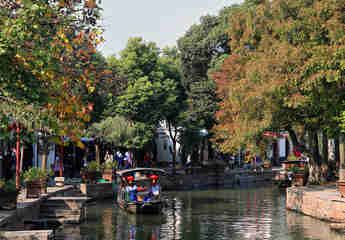
Chenghuangmiao (City God Temple) is a Taoist temple in Shanghai connected to the Yu Yuan gardens. It is located in the center of old Shanghai. People pray here, worshipping Chenghuang, the Taoist god and guardian of the city. Today, Shanghainese also use this name for the shopping district around the temple. There are more than a hundred buildings here, most of which are already more than a hundred years old. These buildings now house shops, restaurants, department stores, and cafes selling local cuisine. Chenghuangmiao was built in 1403. The temple was originally located on Fangbin Zhonglu Street. Throughout its existence, Chenghuangmiao was destroyed many times, but each time it was rebuilt. During the Qing dynasty, the temple's popularity grew. The current version was built in 1926. Merchants around Chenghuangmiao began gathering only after Shanghai became an open port. Thanks to them, a large market formed around the Taoist temple, later becoming a lively center of trade.
Yu Yuan Garden

Flickr, Thainlin Tay
Yu Yuan Garden (simplified Chinese: 豫园, pinyin: Yùyuán) in Shanghai is a private classical Chinese garden. It is located in the very heart of the old city of Nanshi. Its name means “Garden of Joy” or “Garden of Leisurely Rest,” and today it truly is a pastoral world inside a super-modern and restless metropolis. The first owner of Yu Yuan Garden in Shanghai, Pan Yunduan, who served as provincial treasurer during the Ming dynasty, decided to build a garden resembling the imperial garden in Beijing to delight his parents in their old age. Construction, begun in 1559, was repeatedly halted and resumed due to lack of money, but it was still not completed within 20 years. Yunduan's father, the former Minister of Punishments Pan Enm, did not live to see the garden finished. Moreover, the garden's owner himself went bankrupt, and his descendants wanted to sell his creation. Merchants were found who readily bought Yu Yuan at a low price. Later, the garden was incorporated into the City God Temple complex.
St. Joseph's Church

Flickr, Huan!
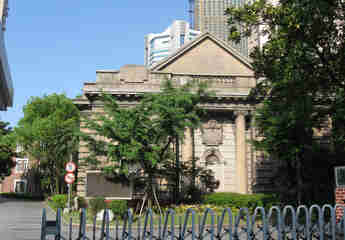
St. Joseph's Church (Chinese: 洋泾浜圣若瑟堂) is a Catholic church located in Huangpu District of Shanghai, China. St. Joseph's Church was built in Romanesque style in 1860—1861. It is believed that Napoleon III financed the construction of the church. In 1862, the church was consecrated in honor of St. Joseph, the betrothed of the Virgin Mary.
French Quarter

shanghaihighlights.com
The Shanghai French Concession (French: La concession française de Shanghai, simplified Chinese: 上海法租界, pinyin: Shànghǎi Fǎ Zūjiè) was a territory of Shanghai administered by France from 1849 to 1946. The Shanghai French Concession was established on April 6, 1849, when the French consul in Shanghai, Charles de Montigny, received a document from the Shanghai daotai under which part of the territory was allocated for the French settlement. This plot of land, where the modern Shanghai districts of Xuhui and Luwan are located, occupied the center, south, and west of the urban part of Shanghai. To the southeast of the French Concession was the walled Chinese City, and to the north was the British Concession (later incorporated into the Shanghai International Settlement). The border between the British and French quarters ran along Yangjingbang Creek, which flowed into the Huangpu River; later the creek was filled in, and Edward VII Avenue was laid along its former channel (modern Yan'an Street).
Shanghai Museum

Flickr, Kenneth Moore Photography
The Shanghai Museum is a museum of ancient Chinese art in Shanghai. It was founded in 1952. The museum houses about 120,000 items. The most valuable are the collections of bronze ware, ceramics, calligraphy, furniture, jade figurines, antique coins, paintings, seals, and sculptures. There are 11 permanent galleries and 3 special exhibition halls. The Shanghai Museum holds items of national significance, including one of the three surviving examples of “transparent” bronze mirrors from the Han dynasty.
People's Square

Flickr, Michael Jentsch
People's Square (traditional Chinese: 人民廣場, simplified Chinese: 人民广场, pinyin: Rénmín Guǎngchǎng) is a large city square adjacent to Nanjing Road in Huangpu District in Shanghai, China. People's Square is the seat of the Shanghai municipal authorities and is used as the starting point for measuring distances in the city of Shanghai. Before the establishment of the People's Republic of China in 1949, People's Square was part of the Shanghai Racecourse. After gambling and horse racing were banned by the CCP government, part of the racecourse became People's Square. The racetrack and grandstands were integrated into it and are now used during parades. In the 1990s, the square acquired its modern appearance. The Shanghai municipal government moved here, and the Shanghai Museum was also placed here. Later, the Grand Theatre and the Urban Planning Exhibition Hall appeared here. Other parts of the racecourse have also survived.

Flickr, LIU XIAOXUE*
Behind this boring, at first glance, name lies a very interesting exhibition — here you can see what Shanghai's urban planning policy is striving toward.
However, similar exhibitions exist in many capitals of the world. You wouldn't call such a place a traditional “museum,” since the word itself is associated with objects of antiquity. And if there are old exhibits here, they are meant only to show the path of technological progress. Thus, on the lower floors of the museum there are teahouses, cafes, and shops styled like Shanghai streets of the 1930s.
And what is Shanghai striving toward? It lays claim to the status of the world's leading business center! “Catch up with and surpass Hong Kong” seems to be the unofficial slogan of this city. The main exhibition of the future is Shanghai in 2020. You will be able to see what “hovering” transport might look like in the future, for example, a metro operating on magnetic levitation. What is especially interesting is that not only ordinary exhibits are presented here, but interactive ones as well. In short, it will be interesting not only for urbanists, but for all other visitors too.
Shanghai Art Museum

Flickr, fotojamie2012
31.232615, 121.466209 Shanghai Art Museum (traditional Chinese: 上海美術館, simplified Chinese: 上海美术馆, pinyin: Shànghǎi měishù guǎn) is an art museum and exhibition venue in central Shanghai in the PRC. The museum's historic building is known for its iconic clock tower and exhibitions of contemporary art, including the Shanghai Biennale. The permanent exhibition is devoted mainly to traditional Chinese art. The museum occupies 2 200 sq. m. The museum is located in the building of the former Race Club on the edge of People's Square (formerly the Shanghai Racecourse) in Huangpu District at 325 Nanjing Road. Above the museum halls is the city's well-known restaurant “Kathleen’s 5” (Kathleen’s 5). The Race Club building was built in 1933 in the English neoclassical style. At that time horse racing brought the city its third-largest source of income. In 1937 the city was occupied by the Japanese, and the building was expropriated by the military.

capaworld.capa.org, Colin Speakman
You can't keep up with the stars. To attend concerts by all your favorite idols, you need a lot of free time and money. And politicians do not tour at all; they have more important things to do! But thanks to the genius of Marie Tussaud, we can appreciate the appearance even of talented people who have passed away, whose names have forever entered history.
Did you know, for example, that American president Barack Obama's height is 187 centimeters? And can you imagine what the sculptor Madame Tussaud herself looked like? By the way, the famous German woman made her own wax figure 8 years before her death, at the age of 80. And the first person Tussaud cast in wax was the French writer and thinker François-Marie Arouet de Voltaire.
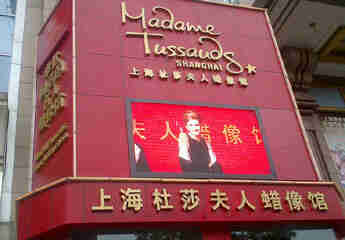
The exhibition founded by this modest-looking woman has branches all over the world, including in Shanghai. This unique museum will interest absolutely everyone, because it features not only performers, but also athletes, scientists, and cosmonauts — that is, representatives of completely different fields of activity.
The number of museums where world celebrities are “locked up” is steadily approaching 20. In 2006, the “wax stars” also appeared in Shanghai. Agree, it would be unfair if such an important attraction were absent from the cultural and economic center of China.
The museum is located in the very center of the city, on People's Square, on the 10th floor of a huge complex from which you can also admire the beauty of the city from a bird's-eye view. The uniqueness of the Shanghai branch lies in the fact that stars of China are represented here. Especially numerous among them are athletes shown with props: balls, gymnastic rings, or golf clubs.
Nanjing Road

Flickr, Michael Jentsch
Nanjing Road (simplified Chinese: 南京路, pinyin: Nánjīng Lù; English: Nanjing Road) is Shanghai's main shopping street and one of the busiest shopping streets in the world. Its eastern part from the Bund waterfront to People's Square is pedestrian for most of its length, and along this stretch there are many different shops and cafes. In the western part of the street are luxury shops and boutiques. From the numbering standpoint, it is divided into three streets: West Nanjing Road (Chinese: 南京西路 pinyin nánjīng xīlù English West Nanjing Road) from Yan'an Street to Tibet Street, the pedestrian zone “Nanjing Road” (Chinese: 南京路步行街 pinyin nánjīnglù bùxíng jiē English East Nanjing Road) from Tibet Street to Henan Street, and East Nanjing Road (Chinese: 南京东路 pinyin nánjīng dōnglù English East Nanjing Road) from Henan Street to the Bund.
The Bund

Flickr, joegwolf
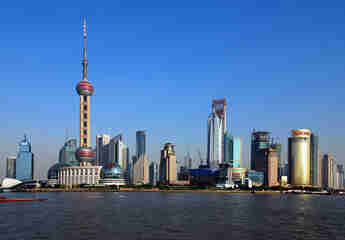
The Bund (simplified Chinese: 外灘, pinyin: Wàitān; English: The Bund; other names: Bund, Band, Shanghai Embankment, Waterfront) is a section of Sun Yat-sen Road (simplified Chinese: 中山路, pinyin: Zhongshan Lu, English: Zhongshan Road) in Shanghai, China. It is located within the boundaries of the former International Settlement along the Huangpu River in the eastern part of Huangpu District. Usually, this name also includes the buildings and piers along this street and the adjacent territories. Opposite the embankment, across the river, lies Shanghai's new business district, Pudong. In Chinese, “waitan” literally means “outer shore.” The English word bund means “embankment” or “pier” (usually in Asian countries). It most likely entered English from Hindi, in which it means “bank” or “shoal.” In India, China, and Japan there are a number of places that bear this name in English, but the proper name the Bund almost always refers to this section of waterfront in Shanghai.