
Flickr, Azizul Ameir
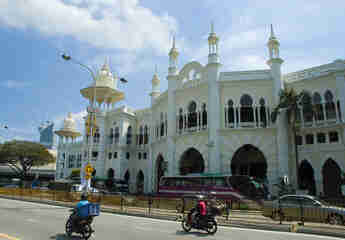
One of the most attractive sights in Kuala Lumpur is the railway station, left to the city as a reminder of the colonial era. It was built by the British, who tried to imbue all their structures in Asian countries with a characteristic Eastern flavor. As a result, the station building turned out, on the one hand, monumental in a European way, and on the other, graceful in an Eastern way, like a carved casket.
Magnificent arches, airy turrets, outlandish balconies... Looking at all this beauty, it is hard to believe that railway platforms are located inside this 'fairy-tale castle.' Until 2001, it was the main transport hub of the Malaysian capital! Then a modern station was built nearby and the main traffic was moved there, leaving the 'old-timer' only suburban rail service.
But for tourists this is actually convenient: you can come here calmly to admire all the details of the unusual architecture without jostling in the crowds of arriving and departing passengers. In addition, the Railway Transport Museum is now open inside, and the old station hotel is still operating. It has been restored and turned into a luxurious hotel while preserving its historic ambiance.

hazuism.blogspot.ru
The main museum of Malaysia is located near Lake Gardens. You can begin your visit without even stepping inside, because the museum building is already impressive from the outside. It was built in the 'rumah gadang' style - the traditional way of building houses among the Minangkabau people. The three-story building is decorated across its facade with bright Italian mosaics. The museum opened on the anniversary of Malaysia's Independence Day, August 31, 1963.
Its collection occupies four large galleries, each representing a particular historical era. This is where the largest number of exhibits devoted to the ethnography and history of Malaysia is gathered, from the most ancient times to modern history.
In the first gallery you will see the results of archaeological excavations of the earliest settlements, household items, and other interesting artifacts. In the second gallery you will be greeted by brilliance and luxury - this part of the exhibition is devoted to the Malay kingdom, and features jewelry, clothing, and installations telling about the lives of the sultans of Malacca. The third hall is Malaysia's colonial legacy; it mainly displays weapons, ship models, and military uniforms. In the fourth hall you can learn about the history of Malaysia gaining independence in the 20th century.

Flickr, zhaffsky
One of the most interesting places in Kuala Lumpur, the National Planetarium, is located in a building with an azure dome that resembles a toy palace.
An unusual colorful staircase with a waterfall flowing down the steps leads to the beautiful building. And the area around the planetarium offers excellent opportunities for photography, with one of the most unusual and beautiful views of the capital opening up from here.
The National Planetarium includes several exhibitions: a scientific space exhibition, a space theater, a park of ancient models of the starry sky, an observation gallery, and a reference center.
In the planetarium cinema, a huge 3D screen is placed under the dome of the ceiling, and while you watch an educational film about space, glowing comets and satellites will fly around you.
On the second floor there is an educational museum hall with interactive and game exhibits that explain how space works.
Those who wish can put themselves in the shoes of astronauts - the National Planetarium has an exact replica of a spacecraft restroom, and the passage into one of the halls is designed in such a way that you can even experience weightlessness for yourself.
And if you want to visit the future, you can order the Cosmic Sphere as your guide - this gyroscopic robot, the size of a human being, will give you an unforgettable tour.
National Mosque Negara

wikimedia.org
Negara (Malay: Masjid Negara) is Kuala Lumpur's national mosque, built in 1965. The mosque's main hall accommodates 8 thousand people and is especially full on Fridays. The mosque complex consists of a ribbed star-shaped dome and a minaret 73 m high. The dome's eighteen corners symbolize Malaysia's 13 states and the '5 pillars of Islam.' After Malaysia gained independence from Great Britain in 1957, the new government began actively implementing development programs in the fields of the economy, social policy, and architecture. These development programs were meant to demonstrate Malaysia's new progressive culture and the achievements of democracy. In 1957, the idea arose to build a national mosque that would become a symbol of the country's independence.

Flickr, Nigal Raymond
The Museum of Islamic Art is located in Lake Gardens in Kuala Lumpur, which is also home to the Orchid Garden, Deer Park, Butterfly Park, and Bird Park. This museum opened relatively recently, at the end of the last century, and is quite a large building with 4 levels. The exhibition is presented only on the two upper floors, while the two lower ones are occupied by a bookstore and souvenir shop, a restaurant, and cozy inner courtyards with fountains.
The exterior of the building looks very attractive thanks to the decorated domes and Iranian tiles. Precisely because of this, from a distance the Museum of Islamic Art can easily be mistaken for a mosque.
Several halls are located on the two floors, divided by thematic and geographic principle. One of them presents a stunning collection of manuscripts and the Quran. In another, you can see the 'Ottoman room' - rooms like these once existed in wealthy Syrian homes of the early XIX century. Household items are also presented here in their luxurious form. And one of the most interesting halls is the jewelry hall.
Bird Park

Panoramio.com, hazrul99
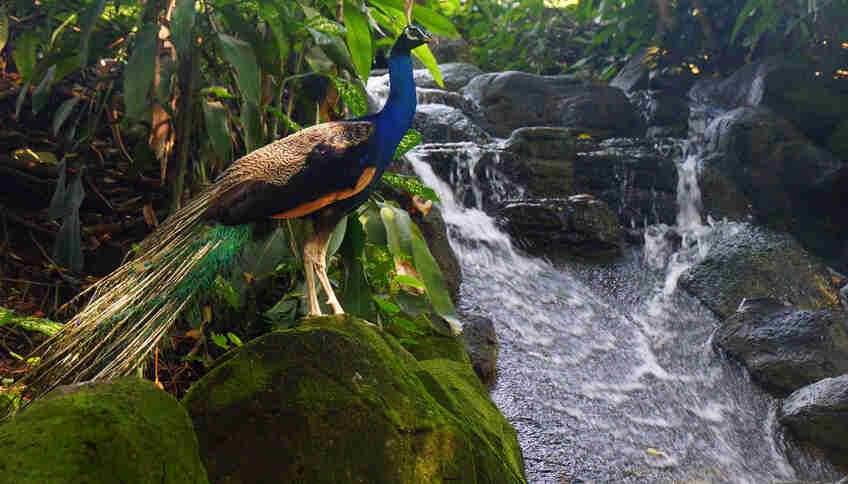
Kuala Lumpur Bird Park, founded in 1991, is located in the Lake Gardens area and is the largest open-air aviary in the world, covering more than 8 hectares (20,9 acres). The park is home to more than 2000 birds, some of which were donated by citizens and embassies of foreign countries such as Australia, New Guinea, Thailand, Tanzania, the Netherlands, and China. The park is one of Malaysia's best-known tourist attractions and is visited by about 200000 people every year. On December 5, 2008, the park was visited by former U.S. President Bill Clinton[1] (Eng.). The main distinguishing feature of the bird park is the concept of 'free flight,' meaning that most of the birds are kept outside cages and aviaries. The entire park is covered with mesh secured to poles. Visitors have the opportunity to closely observe the lives of more than 800 birds of 60 local and foreign species living together in an almost natural environment created by human hands.

boundfortwo.com
A wonderful oasis of coolness, greenery, and a kaleidoscope of colors awaits you in the Orchid and Hibiscus Park, which is part of Lake Gardens.
In the covered galleries you will find more than 800 species of noble orchids and 500 species of hibiscus, as well as other exotic Malaysian flora.
If in our latitudes shelters are built for flowers in botanical gardens and greenhouses to protect them from the cold and bad weather, here everything is the opposite. To protect delicate tropical flowers and lush ferns from the bright sun, canopies have been made above the paths, giving welcome shade to both plants and people. Comfortable benches and cozy gazebos are placed throughout Orchid Park, and fountains murmur everywhere, creating the necessary microclimate and bringing pleasant freshness.
Locals love coming here for dates, picnics, or simply to read a book surrounded by unearthly beauty.
Flower lovers will be interested in seeing all kinds of orchids, hibiscus of different colors and double blooms, unusual tropical ferns, and vines. Park specialists will gladly advise you on matters related to keeping and caring for orchids. By the way, some kinds of flowers can be bought here; the selection is simply шикарный and the prices are low.

Flickr, iamthewitch2
Butterfly Park is located on the grounds of the so-called Lake Gardens in Kuala Lumpur. Once there, moving around at first feels rather unusual because of the stretched nets that separate the butterflies from the outside world. But any inconvenience is quickly forgotten under the impression of the exotic surroundings.
The park where these winged beauties live cannot boast a huge territory; rather, it can be described as cozy, intimate mini-jungle. However, this is exactly what makes it possible to interact with the butterflies closely and directly: they often land on hands, clothes, and heads...
In total, about 20-30 species of butterflies live here, many of them simply enormous and incredibly beautiful. Azure blue, orange, bluish-black, violet - their range of colors is mesmerizing!
Besides butterflies, the park has small ponds with Chinese carp and catfish, and a couple of cages with pythons, rabbits, and lizards.

Flickr, Muhaimin Mohamad
Lake Gardens is the largest green area in Kuala Lumpur. It covers more than 90 hectares - almost like a small forest. Founded in 1880, this park has long been a favorite recreation spot for locals and tourists.
It is a large complex containing the Orchid Garden, Deer Park, Butterfly Park, and Bird Park. In the Orchid Garden, more than 800 species of magical exotic flowers will appear before you, and you can even buy seedlings or mature plants there. Nearby is the Hibiscus Garden with more than 500 varieties of these picturesque plants.
In Deer Park, several species roam freely, both ordinary deer and rare animals. For example, mouse deer, which are no bigger than a medium-sized dog, can rightfully be considered the signature animals of the park.
Once you enter Butterfly Park, you will find yourself in a real tropical forest, because a unique microclimate has been created for these fragile creatures with the help of 15 thousand different plants. The butterflies, of which there are 120 species here, breed in a special nursery.
Bird Park was opened in 1991 by the Queen of Malaysia herself. More than 3 thousand winged inhabitants representing different continents were settled here then. And the 3-hectare area was covered with netting so the birds would not fly away.
In addition to the biosphere parks, Lake Gardens has boat stations, a concert venue, a sports area, and children's playgrounds.

Flickr, mdkhai
Kuala Lumpur's most dramatic and patriotic monument is the National Monument, located next to the Malaysian Parliament building. The sculptural group depicts seven soldiers, one of whom holds the Malaysian flag. In subject matter, the monument echoes the famous U.S. Marine Corps Memorial in Washington, and that is no coincidence - it was created by the same author, Felix de Weldon.
The National Monument was installed in 1966 in honor of 11 thousand soldiers who died during three wars: World War I, World War II, and also the war of the Malayan Communist Party against the British Commonwealth in 1948-1960.
The seven soldier figures symbolize strength, courage, unity, leadership, vigilance, suffering, and self-sacrifice. Flowers always lie at the foot of the monument, and every year on Warriors' Day, July 31, wreaths are brought here in memory of the heroes.
The monument is 15 meters high, making it one of the tallest bronze sculptural compositions in the world. As a result of a terrorist attack in 1975, the monument was damaged, but in 1977 it was restored.
Not far from the National Monument there is a beautiful landscaped park, so you can combine the pleasant with the useful: learn a little more about the difficult history of Malaysia and relax in nature, in a green park with fountains.