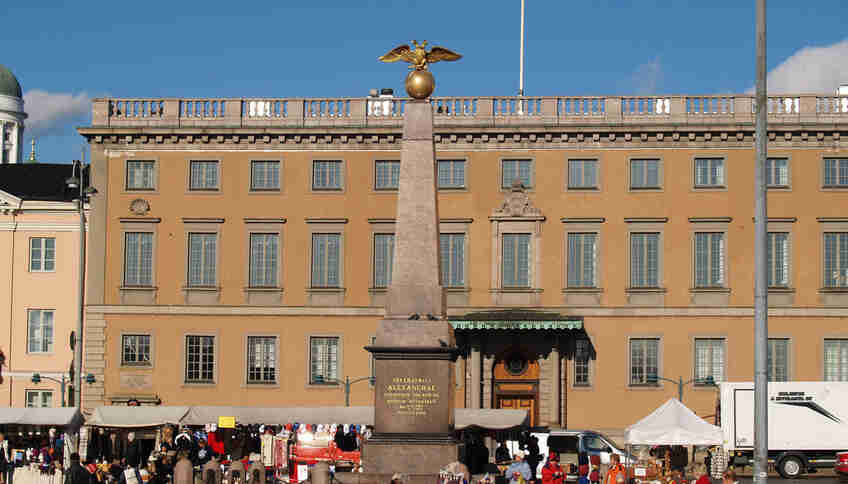
At the center of the bustling Market Square rises the first monument in Helsinki's history — a granite stele topped with a sphere on which a double-headed eagle sits. The obelisk, which in Finnish is called 'Keisarinnankiv' — "the empress's stone," was erected in 1835. Among Helsinki's urban legends, one of the most popular is precisely about the place and reason for the appearance of this monument.
Russian Empress Alexandra Feodorovna was the patroness of the city of Helsingfors, whose residents were extremely grateful to her for this. When the imperial couple first arrived in the city in 1833, there was still no embankment here, and boats moored at wooden landing stages. Empress Alexandra's boat could not come right up to the platform — it ran aground, and the distance was too great to get ashore. Emperor Nicholas I, dressed in full ceremonial uniform, jumped into the water himself, lifted his wife into his arms, and carried her to the landing stage without wetting a single flounce of her dress. It was exactly on the spot where Nicholas I set Empress Alexandra down that the obelisk was installed, marking the place where the foot of the city's patroness first stepped onto its territory.
After the October Revolution of 1917 and Finland's declaration of independence, the sphere and the double-headed eagle were removed from the granite obelisk and kept in a museum for a long time. In 1972, the citizens of Helsinki asked the municipal authorities to return the obelisk's finial to its place, to the obvious displeasure of all Soviet diplomats and delegates. Nevertheless, their wish was granted, and today the Empress's Obelisk is the only monument in the world bearing the symbols of the Russian Empire.