
Cathedral of the Virgin Mary

livejournal.com, town4you
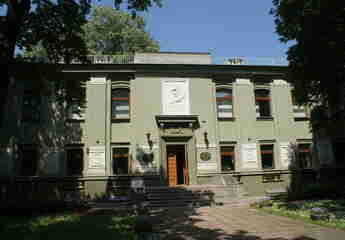
The Archcathedral of the Holy Name of the Blessed Virgin Mary (Belarusian: Архікафедральны касцёл Імя Найсвяцейшай Панны Марыі) is a Catholic cathedral in the Vilnius Baroque style, the main Catholic church in Minsk, Belarus. It is the cathedral of the Minsk-Mohilev Archdiocese. An architectural monument, it is included in the State List of Historical and Cultural Values of the Republic of Belarus (code 712Г000235)[1]. The church was built in 1700—1710[1][2][3] as a church at the Jesuit monastery, and is therefore also known as the «Jesuit church»[1]. Address: Freedom Sq., 9. The history of the Society of Jesus in Minsk begins in the middle of the 17th century, when the first members of the order arrived in the city. In 1683 construction of the monastery began, and on October 24, 1700, the stone monastic church was laid. Thanks to numerous donations, construction proceeded quickly, in 1708 the interior was completed, and on March 16, 1710, the Vilnius bishop Konstantin Kazimir Brzostowski (Eng.
Freedom Square

Flickr, hansbirger
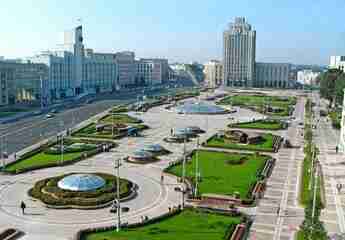
Freedom Square (Belarusian: Плошча Свабоды) is one of the central squares in Minsk, Belarus, formed at the beginning of the XVI century as the city's administrative, commercial, and cultural center. It is located on the elevated bank of the Svislach River.Until the 1860s it was called the Upper Market (Belarusian: Высокі Рынак), and until 1917 — Cathedral Square. From 1917 to 1933 it bore the name «Plyats Voli».Freedom Square was considered the central square, but during the Great Patriotic War it was heavily damaged and lost its significance.On the square stands the city hall, restored in 2004 according to the last design (it was built in 1582, then rebuilt several times and demolished in 1857), as well as the Archcathedral Church of the Blessed Virgin Mary (1700-1710).In the center of Freedom Square before the revolution stood a monument to the Russian Emperor Alexander II the Liberator, created through voluntary donations from Minsk residents.
Minsk Town Hall

blogspot.com, Dmitry Tichy
Minsk Town Hall is an administrative building in the central part of Minsk, on High Market, built in 1600.[1] There was a clock on the town hall tower, which was of great value at that time.Before the Russian authorities abolished Magdeburg rights for Minsk (May 14, 1795), meetings of the Minsk self-government body — the magistrate or council — were held in the town hall, and standards of units of weight and volume were kept in the building.The building housed the magistrate, court, archive, etc., and in the 1830s a music school. In 1884 it was adapted for a theater that operated in 1844—1851. Dramatic and musical performances in Russian, Polish, and Ukrainian were shown here by the permanent city theater companies of Ya. Khelmikovsky, V. Verzhbitsky, and V. Drozdovsky. In November 1848, N. Gogol's play «The Government Inspector» was staged here for the first time in Belarus. The theater's foyer, hall, and boxes were painted by city decorator I. Kuratkevich[2].In the square adjoining the town hall there once stood a monument to Alexander II, installed in January 1901.

Panoramio.com, Chapaevec
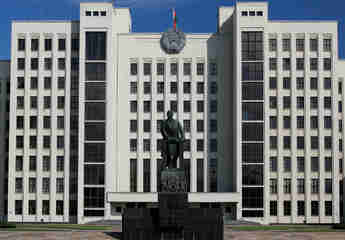
The full name of this monument is «Governor Zakhar Korneev's Coach». Its creator was the famous sculptor Vladimir Zhbanov, assisted in the work by his colleagues Alexander Tukhto, Yuri Polyakov, and Viktor Zavadsky.
«Coach» was ceremonially unveiled on September 8, 2007 — on Minsk City Day. The sculpture is located opposite the central entrance to the town hall, as if to suggest that Zakhar Korneev is about to come out of the building and get into the harness. The first governor of the Belarusian capital was appointed to this post in 1796, when Minsk became part of the Russian Empire.
According to Vladimir Zhbanov, the sculpture captures the moment when the governor stepped out of the coach and the coachman tied the horses' reins so they would not run off anywhere. Each of them shows its own character: one is ready to set off, while the other, on the contrary, has lowered its head and waits obediently. They look very natural, and perhaps that is why queues of people sometimes line up to take a photograph with the monument.

darriuss.livejournal.com
At the beginning of the XVII century, Basilian monks from the Order of Saint Basil first appeared on the territory of present-day Belarus. It is precisely their Uniate church that is associated with the appearance in Minsk of monasteries of which little has survived to our days. For those who are not especially knowledgeable about religion, let us explain that a «Uniate» church is the union of the Orthodox and Catholic churches on the basis of union under the supremacy of the Catholic Church, but with the preservation of a significant part of Orthodox rites.
Thus, on the site of a XVI-century wooden church, a stone men's monastery called the Holy Spirit Monastery was founded at the beginning of the XVII century. After that it was the turn of the church, which was replaced by a new stone one. At the same time, a women's monastery was being built nearby. Together they formed an outstanding architectural ensemble: the men's building with the church made up its southwestern side, and the women's building its northeastern side.
The unquestionable jewel of this complex was the church, which combined several architectural styles at once: Gothic, Renaissance, and Baroque. But the main artistic feature of this church was the painting of flat niches on the facade with frescoes depicting saints. The structure of the niches and the order in which they were filled with frescoes corresponded to an Orthodox iconostasis. Just imagine — an iconostasis right on the facade, and there was nothing like that anywhere else in Europe!
By the early 50s of the XVII century, the complex was already ready to receive its first novices, but history decreed otherwise. During the war between Russia and the Polish-Lithuanian Commonwealth, the monastery complex was used as a fortress. Then, after the partition of Poland, Minsk passed to Russia and the monasteries were closed. And after the fire of 1835, the original appearance of the men's monastery and the church was finally lost.
Later the monastery was restored in the Classicist style and government offices were placed there. The church was remodeled in the Russian style, but in the 30s of the last century, on the wave of atheist sentiment, it was simply blown up.
Now there are active discussions that the complex of Basilian monasteries should be restored. But only time will show what will come of it.
Church of the Holy Spirit

skaerman.diary.ru
Church of the Holy Spirit (another name is Peter and Paul Church) is a Greek Catholic church in Minsk, built in the XVII century. It was located on High Market and was the dominant feature of the complex of the men's and women's Greek Catholic Basilian monasteries.The building of the church combined features of Gothic and Northern Renaissance. The main facade was decorated with niches painted with frescoes depicting saints.In 1936 the church was blown up. To this day the foundation and crypts with the remains of the founders of the church have survived.[1] Some researchers[2] believe that the stone Church of the Holy Spirit was built approximately in 1616. However, there is also an opinion that construction took place later — in the 30s — 40s of the 17th century.Initially the church was Uniate, but in 1795 it was transferred to the Orthodox Church, and since then became known as Peter and Paul Cathedral.[2]After the reunion of the Uniates with the Orthodox Church (1839), the Orthodox shrine — the Minsk Icon of the Mother of God — was returned to the cathedral.
Holy Spirit Cathedral

Flickr, hansbirger
Cathedral of the Descent of the Holy Spirit is the main church of the Belarusian Exarchate of the Russian Orthodox Church.The history of the cathedral begins in 1633—1642, when the building was erected to serve as the church of a Catholic Bernardine nuns' monastery. In 1741 the building was destroyed by a fire that led to the reconstruction of the monastery.According to the inventory list of 1784, where the cathedral now stands, but slightly toward the former Kosmodemyanovskaya (Kozmodemyanovskaya) Street, there existed an Orthodox Kosmodemyanovsky Monastery, converted into a Uniate one at the beginning of the XVII century[1].In 1741 the Bernardine monastery was damaged by fire, after which it underwent reconstruction. In 1852 the monastery was abolished and moved to Nesvizh. Since 1860 the former Catholic church became an Orthodox church. The building was rebuilt more than once. A U-shaped two-story building adjoins the church from the northeast.
St. Joseph Church and Bernardine Monastery

wikimedia.org
Bernardine Monastery is part of the Bernardine complex that once existed in Minsk, which also included the neighboring Bernardine nuns' monastery. It was located in the city center, not far from the town hall.The monastery was founded in 1624 by Krasnoselsky starosta Andrei Kensovsky (Kęsowski) and his brother Jan. The first — wooden — church of the monastery was built in the 1630s, however, it burned down together with all the other buildings in the fire of 1644.In 1652 a stone Church of Saint Joseph, Chosen of the Blessed Virgin Mary, and the monastery building were erected in the monastery. The monastery complex burned several times in fires (1656, 1740, 1835), however, each time it was restored and rebuilt. The most substantial reconstruction was carried out in 1752: the architectural forms of the monastery buildings acquired Baroque features.By the end of the XVIII — beginning of the XIX centuries, the Bernardine monastery occupied an entire block (bounded by Bolshaya and Malaya Bernardinskaya streets, Zybitskaya Street, and Upper Market Square).

tio.by
Masons' House is one of the most mysterious buildings in Minsk. It appeared in the Upper Town in 1817. People said that it was built at the initiative of a Masonic lodge whose aim was to help poor and disadvantaged townspeople.
However, to this day there is no proof that this building has anything to do with the Masons. Although in 1922, when it came time for restoration, it turned out that the building's shape really resembles a Masonic cross, and the glazed windows are bricked up from the inside. That was when the first version appeared that this was needed for holding secret meetings.
The exterior of the building, designed in the early Classicist style, has remained almost unchanged since it was built. But the interior layout no longer corresponds to the original one.
In different periods of history this house had different owners, and many apartments were rented out: on the second floor, for example, the family of the future Belarusian and Polish composer Stanislaw Moniuszko lived for some time. This building also housed the Minsk Governorate conscription office. Now the «Masons' House» is under the authority of the Museum of the History of Theatrical and Musical Culture of Belarus.
Vankovich House

Panoramio.com, White1
Vankovich House is a monument of palace-and-estate architecture, the former home of representatives of the Belarusian noble and gentry family of the Vankoviches. The house is also connected with the life and work of the Belarusian artist Valenty Vankovich (1800 –1842). Location – Republic of Belarus, Minsk, 33A Internatsionalnaya St. [1]The house was built in the late XVIII - first half of the XIX centuries in the Classicist style. It stood deep in a courtyard, separated from the street by a fence with gates that have not survived to our time. The one-story rectangular (wooden in plan) house is covered by a high hipped roof with an attic in the center. The interior was decorated with tiled stoves, which have not survived to our days.The town house (Vladislav Vankovich received 2894 dessiatinas of land in the vicinity of Minsk, built three taverns that brought 320 rubles of annual income. On the Bolshaya Slepyanka estate he built a stone house) of V. Vankovich is not only a monument of Classicist architecture, but also a memorial object in the history of our culture.
Trinity Suburb

Flickr, Kate von Noir
Trinity Suburb (Trinity Hill) is a historic district of the city of Minsk, located in the northeastern part of the historic center on the left bank of the Svislach River. It once served as the trade and administrative center of the capital of Belarus[1][2].To the west of Trinity Hill lies the Minsk Castle site, to the northwest — Tatar Gardens and Starostinskaya Sloboda, to the north — Storozhevka, to the east — Golden Hill, to the south — the central districts of High and Low Markets[3][4].On the territory of the suburb was located the first Catholic church in Minsk. Also located here were the Holy Ascension Monastery with the church of the same name, the Saints Boris and Gleb Church, the Holy Trinity women's Basilian monastery (partially preserved), and the church and monastery of the Catholic monastic order of the Mariavites, none of which have survived to the present day. Today the suburb is one of the favorite leisure spots of Minsk residents and guests of the capital[5]. If you want to see all the sights in the Upper Town, we suggest thinking in advance about where you can stay. The choice of hotels and hostels is quite large, and besides, hotel prices in Minsk will definitely please you.