At the beginning of the 17th century, Basilian monks from the Order of Saint Basil (Vasily) first appeared on the territory of modern Belarus. It is to their Uniate church that the appearance of monasteries in Minsk is attributed, of which little has survived to this day. For those who are not particularly well versed in religion, we should explain that "Uniate" refers to the union of the Orthodox and Catholic churches under the supremacy of the Catholic Church, but with the preservation of a significant part of the Orthodox rites.
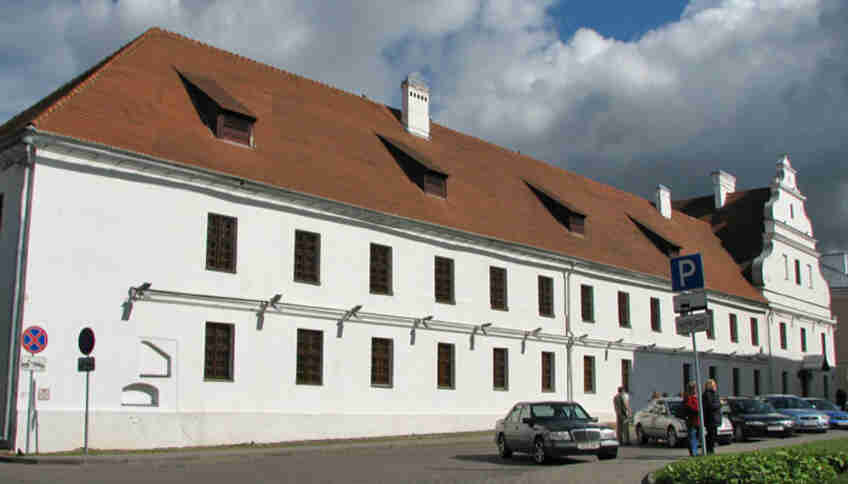
So, on the site of a wooden 16th-century church, at the beginning of the 17th century a stone men's monastery was founded, which received the name of the Holy Spirit Monastery. After that came the turn of building the church, which was replaced by a new stone one. At the same time, a women's monastery was being erected nearby. Together they formed an outstanding architectural ensemble: the men's wing with the church formed its southwestern side, and the women's wing its northeastern side.
The unquestionable jewel of this complex was the church, combining several architectural styles at once: Gothic, Renaissance, and Baroque. But the main artistic feature of this church was the painting of the flat niches on the facade with frescoes depicting saints. The arrangement of the niches and the order in which they were filled with frescoes corresponded to the Orthodox iconostasis. Just imagine - an iconostasis right on the facade, and nothing like that existed anywhere else in Europe!
By the early 1650s, the complex was already ready to receive its first novices, but history decreed otherwise. During the war between Russia and the Polish-Lithuanian Commonwealth, the monastery complex was used as a fortress. Then, after the partition of Poland, Minsk passed to Russia and the monasteries were closed. And after the fire of 1835, the original appearance of the men's monastery and the church was finally lost.
Later, the monastery would be restored in the Classical style and government offices would be placed there. The church would be remade in the Russian style, but in the 1930s, on the wave of atheist sentiment, it was simply blown up.
Today, there are active discussions that it would be a good idea to restore the complex of Basilian monasteries. But only time will show what comes of it.