
In this museum, you can see the artist's earliest works and trace how his own distinctive style was formed.
The collection is uneven: the early period is presented in full, while the others reveal noticeable "gaps." The core of the collection consists of works that were kept by Picasso's parents. He left them in his family home and departed for Paris in 1904. Among them are children's drawings, paintings from the "Blue" period and partly the "Rose" period in the artist's work.
The works that Picasso painted from 1901 to 1904 belong to the "Blue" period. They are dominated mainly by gray-blue, blue, and blue-green shades - the colors of sorrow and sadness. At that time, the artist was deeply affected by the death of his friend Carlos Casagemas. He created a whole series of paintings depicting the poor, the destitute, the blind, and the lonely.
Then came the "Rose" period, when more cheerful tones begin to appear in Picasso's paintings: pink, yellow, and red. At that time, the Medrano Circus stopped at the foot of Montmartre in Paris, where the artist lived. Acrobats and comedians became the heroes of his new canvases. However, the "Rose" period lasted only a very short time, from 1904 to 1906, and then - right up to 1917 - silence. Of course, not in the work of the "prolific" artist; this refers to the museum's collection.
Later Picasso returned to Barcelona with his fiancee, Olga Khokhlova. The paintings he created at that time can also be found in Barcelona's museum collection. However, after that there is silence again - 40 years of the artist's life and work seem to have fallen out of this collection.
To conclude the tour, variations by Picasso on the subject of Velazquez's enigmatic painting "Las Meninas" are presented. The museum's collection also includes the famous "Dove" - a symbol of peace that flew all around the world.
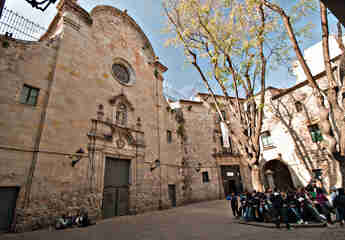
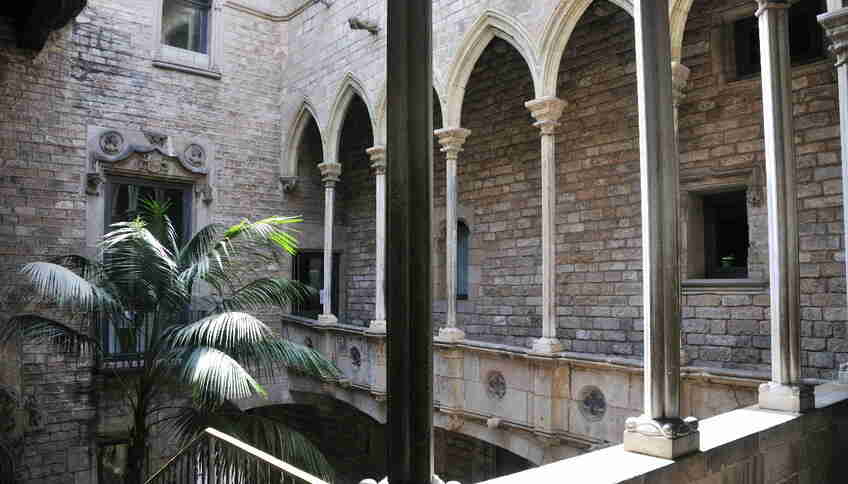
The Picasso Museum in Barcelona is not the artist's only museum; there are two more in France. But in the Catalan capital it is housed in a truly unique building - a 15th-century palace known not only for its exquisite interiors but also for its picturesque inner courtyards. This mansion once belonged to the aristocrat Berenguer d’Aguilar, but in 1963 Pablo Picasso's friend and personal secretary Jaime Sabartes founded a museum in it, donating 574 works by the great artist to the city.
In addition to canvases, the collection includes prints and a collection of ceramics, which was donated to the museum by the artist's widow Jacqueline Roque, who met Picasso in a ceramics shop.