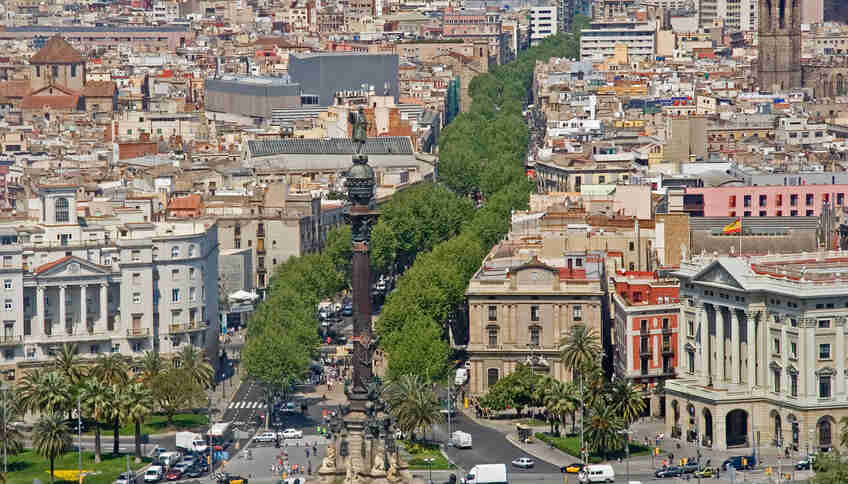

La Rambla is a vibrant and lively boulevard in the very heart of Barcelona, consisting of five sections that flow smoothly from one into another.
If you start your walk from the sea, the first thing you will encounter is Rambla de Mar - a bridge built in 1992 ahead of the Olympic Games. It begins at the Maremagnum shopping center, which stands in the port of Barcelona literally on the water, and leads to Portal de la Pau square, whose name translates as "Gateway of Peace".
Passing through it, it is hard not to notice the 80-meter column - a monument to the famous navigator Christopher Columbus. It has also become one of the symbols of Barcelona, like the architectural masterpieces of Antoni Gaudi or the singing fountain of Montjuic. By the way, it is best to start sightseeing in Barcelona from Rambla boulevard. Just do not forget to keep an eye on your wallets and watch your step. That way you will notice the pavement: the perfectly flat stretch of road seems wavy thanks to the curved lines of the paving tiles.
Learn even more interesting things about the Boqueria market, the Liceu theater, Guell Palace, and many other sights of La Rambla by downloading the audio guide to Barcelona!
Rambla dels Caputxins is famous for the opera house Liceu, as well as the city's first theater, Principal. Here you can also see a monument to the playwright Frederic Soler, who is considered the founder of Spanish theater. It is therefore no surprise that this section of the promenade has so many street performers. They are always dressed in unusual costumes and stand motionless like statues. But as soon as you toss them a few coins, the "sculptures" come to life and even put on a mime show.
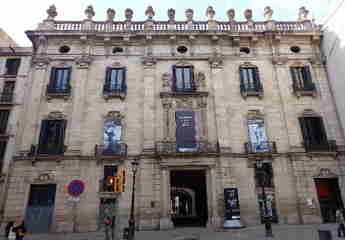
On the flower section of La Rambla, which is also often called Rambla de Sant Josep, there are several more attractions: Virreina Palace, the historic food Boqueria market, as well as Pla de l'Os square, which is famous for the mosaic by the Catalan artist Joan Miro. The multicolored circle, which the artist created at the already quite advanced age of 83, is laid directly on the pavement.
The Rambla dels Estudis boulevard got this name because of the university that was located here until the beginning of the XVIII century, when Philip V closed it. The educational institution was moved to another city, but the name stayed with the street, although a bird market is now located here. Nearby stands the Church of Our Lady of Bethlehem, as well as the Poliorama theater.
As you explore the sights of Rambla boulevard, especially on a hot summer day, you will surely want something to drink. And this is where the drinking fountain in the "Canaletes" section comes in handy. It was installed here back in the XIX century. It is believed that anyone who drinks from it even once will fall in love with Barcelona and will definitely return here again. Want to check?