

Sagrada Familia is a true tourist Mecca of Spain, an unquestionable must see in Barcelona.
It is the most famous and most visited long-term construction project in the world. Its construction began in 1882 and continues to this day. Sagrada Familia is being built thanks to donations, without any permanent funding. At times it seems that the huge tower cranes have already become an integral part of this architectural masterpiece.

At the very beginning of construction, the architect was the little-known Francisco de Villar, who directed the building of the basilica for about 10 years. Then he abandoned this project, and Antoni Gaudi became the chief architect. His works are the calling card of Barcelona. And Sagrada Familia became the architect's posthumous creation. Gaudi devoted 43 years of his life to it, while managing to realize only a third of what he had planned. The author literally lived at his workplace — he occupied one of the cells of the unfinished cathedral.

For several years, Gaudi devoted himself to thinking about the symbolic meaning of the cathedral and searching for architectural forms that would make it possible to increase the height of the building while doing away with buttresses - external supporting semi-arches characteristic of Gothic cathedrals and making the exterior form excessively bulky.
He wanted to build the tallest temple - a Bible in stone. And since the architect believed that nature had already invented the best forms and that his task was to see nature's wisdom and apply it in architecture, he conceived the cathedral as... a spiritual forest, creating an atmosphere for concentrated prayer and contemplation.
Look at the building: its towers symbolize Jesus, the Virgin Mary, the 12 apostles and the 4 evangelists - the entire Holy Family. And the facades were conceived as symbolic milestones in the life of Jesus: the Nativity, the Passion and the Resurrection, and the currently unfinished facade of God's Glory.

Southern Facade of Sagrada Familia
But the first Nativity facade was completed only 6 years after Gaudi's death. He bequeathed the construction of the remaining facades to future generations, believing that the construction of the main cathedral was the life's work of every Catalan.


The Nativity of Christ. Detail of the southern facade.

One of the portals of the southern facade
Northern Facade
The visit to the cathedral begins with the northern facade, where a queue forms at any time of year. But those in the know buy tickets to Sagrada Familia in advance online.

The northern facade, or the Facade of Christ's Passion. Gaudi designed it without excessive decoration. Everything is schematic, angular, tragic. Parts of the figures caught by the light. Every detail tells the story of the most tragic event in the Christian world - the Passion of Christ.

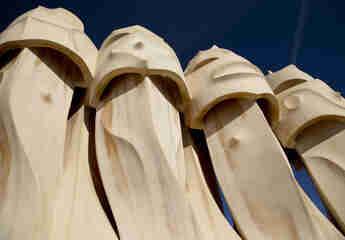
Please note: already on the Passion facade, a warrior appears for the first time, in the format that Gaudi would later use in many of his works.

Fragment of the decor of Casa Mila in Barcelona

The Flagellation. A five-meter sculpture of Jesus tied to the whipping post and abandoned. Detail of the Passion Facade.

Joseph of Arimathea. Passion Facade.

8000 letters were cast in bronze to create the gates. Fragment of the northern facade of Sagrada Familia.


Interior of Sagrada Familia
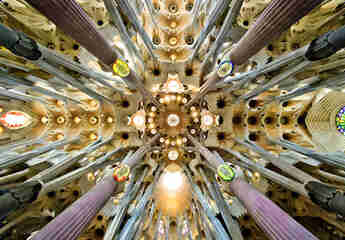
And now let's go inside. Look at the columns, don't they resemble tree trunks and crowns? And the medallions in the vaults - some kind of cosmic inflorescences? The most attentive will surely notice that the trunks of the columns seem to split apart and incline inward toward the central nave. An amazing engineering solution that made it possible to create a light, chaotic, illuminated space and at the same time relieve the heavy vault and avoid using external buttresses, which usually served as a kind of support for medieval cathedrals.

The forest of columns converges above the altar, turning its dome into a lantern of light.


After Antoni Gaudi's death, the authorities did not know for a long time whom to entrust with completing such grand and painstaking work. After all, every detail of the basilica is filled with special meaning, every stone is placed not by chance, and the overall layout is thought out down to the smallest detail. For example, the lighting. Gaudi created many openings in the towers so that light would stream through the stained-glass windows at different levels. And he wanted to place the bells so that they would play in gusts of wind.
The number of details in the decoration and decor of the building is simply astonishing, all the lines and transitions are flawless, the scenes are perfected. It is quite difficult to define any single style, as, however, in Antoni Gaudi's other works. You can feel Art Nouveau with a touch of Gothic, Christian traditions are observed, and at the same time something from the Baroque and a few Eastern motifs have been added. But it does not look like kitsch; rather, it is harmonious eclecticism.


The height of the cathedral's towers takes your breath away. They soar into the air like spikes, and a person next to them feels like a bug. But at the same time, Gaudi did not want their height to exceed Montjuic, believing that man's creation should not be placed above what God created. According to the architect's plan, the tallest tower was supposed to be 170 m, and he wanted to dedicate it to Jesus. However, during Gaudi's lifetime only one 100-meter bell tower, dedicated to Saint Barnabas, was completed.

What was built afterward differs significantly from the Master's work, and this is visible even to the naked eye. After all, Gaudi can only be imitated, but it is impossible to replace him. However, the Spanish government assures that it will still be possible to complete the construction - approximately by 2026.
Photo by Alina Kovalevich