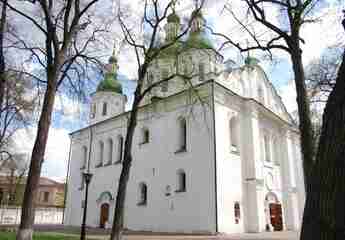

Church of the Nativity of Christ

videnovum.com, Oleg Kupriets
The Church of the Nativity of Christ is an Orthodox stone church built in Kyiv on Poshtova Square in 1809-1814 to the design of architect A. I. Melensky. The church was destroyed by decision of the Soviet authorities in 1935 and restored to its original form in 2003. It is first mentioned in written sources in 1520 as a wooden church of the same name. The new stone Church of the Nativity of Christ was built on the site of the old wooden church, which was dismantled in 1807. The design for the new stone church was developed by architect A. I. Melensky in 1808. Construction of the stone church began in 1809 and ended in 1814. The old wooden church was oriented quite precisely with its apse to the east. The new stone church was oriented along the line of the street. The altar of the church faced southeast. The church stood at the corner of Podil's main street, which was the beginning of the road from Podil to the Lavra.
Monument to Volodymyr the Great

Flickr, akaSeamus
The Monument to Volodymyr the Great is Kyiv's oldest sculptural monument, erected in 1853. It is one of the city's unofficial symbols. It rises on the steep bank of the Dnieper in Volodymyrska Hill Park. The sculptors and architects were Pyotr Klodt (statue of Volodymyr), Alexander Ton (pedestal), and Vasily Demut-Malinovsky (bas-reliefs). Before the monument was installed, the territory was occupied by the vineyards of St. Michael's Golden-Domed Monastery. However, the numerous floods of the Dnieper caused serious subsidence of the soil beneath the vineyards and triggered a series of landslides on Volodymyr Descent. This caused outrage among the local authorities, since a great deal of money had been invested in covering Volodymyr Descent in stone. To prevent this from happening again, it was decided to reinforce the slope by creating a park there. The park was named Volodymyrska Hill because, according to legend, it was here that Prince Volodymyr Sviatoslavich once baptized the people of Kyiv.
Volodymyrska Hill

dt.ua
Volodymyrska Hill (Ukr. Volodymyrska hirka) is a park in Kyiv with an area of 10.6 hectares, laid out in the mid-19th century. The park is located on the upper and middle terraces of Mykhailivska Hill. The upper part of this hill was occupied by the buildings of Iziaslav's city and St. Michael's Golden-Domed Monastery. Development and planning of the slopes began in the 1830s. In 1853, the Monument to Volodymyr the Great was erected on the western part of the hill, and because of it the hill began to be called Volodymyrska. The park laid out there received the same name. Around 1900, the "Golgotha" panorama was built on the hill. It has not survived, having been destroyed in the 1920s. The compositional center of the park is the monument to Prince Volodymyr, toward which the alleys of the middle terrace, the stairways from the upper terrace, and the stairs from Volodymyr Descent all lead. Besides the monument, the park has smaller sculptures, works of Kyiv masters from the 1980s-1990s. In the 1970s-1980s, citywide flower exhibitions were held on Volodymyrska Hill.
Arch of Friendship of Peoples

Flickr, nebarnix
The Arch of Friendship of Peoples is a Kyiv landmark located in Khreshchatyi Park on the high right bank of the Dnieper. It was unveiled in 1982 after four years of construction and was timed to the 60th anniversary of the formation of the USSR. The Arch of Friendship of Peoples consists of three elements: an arch in the form of a huge rainbow, a bronze sculpture of two workers, and a granite sculpture of a scene from the Pereyaslav Rada. The workers' monument is made of metal, granite, and bronze and is a two-figure composition (height 6.2 m) of workers - a Ukrainian and a Russian - jointly lifting a ribbon with the Order of Friendship of Peoples. The horizontally stretched multi-figure composition dedicated to the reunification of Ukraine with Russia, by sculptor Alexander Skoblikov, contains statues of Bohdan Khmelnytsky and boyar Vasily Buturlin, the Russian envoy. The sculptural groups are linked by the rainbow arch, which according to the authors' plan was meant to symbolize the unity of the brotherly peoples: Ukrainians and Russians.
Orlyonok Kindergarten of the Arsenal Plant

artukraine.com.ua
Kindergarten No. 1 "Orlyonok" of the Arsenal Plant is a neoclassical architectural monument built on January Uprising Street (now I. Mazepy Street) in Kyiv to the design of architect Iosif Karakis in the 1930s. The building is located in a picturesque place on the green slopes of the Dnieper and in its style resembles a noble estate or an ancient temple. The strict, laconic, monumental facade and the combination of round and rectangular facade elements reveal features of neoclassicism. The kindergarten is especially interesting because it was not built according to a standard design, and unusually high requirements were imposed on it. The kindergarten was designed for 140 children, and each child was allotted more space than usual[1]. The assembly hall (140 m2) has a height of 6.5 m - above it is a gym covered with a coffered vault. Two ceremonial staircases run around the perimeter of the building[1]. The staircases are located on different levels, which allowed Karakis to increase the height of the halls.
Askold's Grave

Flickr, lights2008
Askold's Grave is a tract on the right bank of the Dnieper in Kyiv where, according to legend, the Kyiv ruler Askold is buried. Today it is part of a park complex laid out in 1934-1936 on the site of the ancient Uhorske tract. According to the Tale of Bygone Years, during their migration from the Volga region to the banks of the Danube at the end of the 9th century, the Magyars (Hungarians) stopped in this tract: "The Hungarians passed by Kyiv, by the hill now called Ugorskoe, and having come to the Dnieper, set up their tents." In memory of this event, a memorial sign designed by Janos Vig was erected in the tract in 1997. Excavations in the tract uncovered traces of 9th-century economic activity, as well as a hoard of dirhams. In 1151, Prince Iziaslav Mstislavich kept his court in the Uhorske suburb.
Park of Eternal Glory

Flickr, atsubor
Park of Eternal Glory (former names: Anosovsky Garden, Commandant's Garden) is a park in Kyiv located on the upper and middle terraces above the Dnieper between Lavrska Street and Dnipro Descent. It is bounded on the south by the ramparts of the Old Kyiv Pechersk Fortress (citadel), and the lower part of the park adjoins the historic area of Askold's Grave. The main entrance is from Glory Square. It includes the Memorial of Eternal Glory with the monument on the grave of the Unknown Soldier, and the Memorial to the Victims of Famines in Ukraine. Area - 18.37 hectares. During the period of Kyivan Rus, the upper part of the park belonged to the grand princely village of Berestovo; in the 16th-17th centuries, it belonged to the Pechersk town that formed around the Lavra. After the earthen fortress (citadel) was built at the beginning of the 18th century, the land was occupied by its glacis and esplanade. At the end of the 19th century, a wasteland on the upper terrace that formed part of the large Esplanade Square (occupying the odd-numbered side of present-day Suvorov Street) was fenced off.
Memorial to the Victims of Famines in Ukraine

Flickr, Anosmia
The Memorial to the Victims of Famines in Ukraine is a memorial complex in Kyiv (in Pechersk, 15a I. Mazepy Street or Lavrska Street) dedicated to the tragedy of the Holodomor of 1932-1933 in Ukraine and the famine of 1921-23, as well as the famine of 1946-47. It is subordinate to the Ministry of Culture of Ukraine. The memorial is open daily from 10 to 18, closed on Mondays. The memorial complex is visited by heads of state and government of foreign countries. The memorial complex includes:
Church of the Savior at Berestove

chnu.edu.ua
Church of the Savior at Berestove (Ukr. Tserkva Spasa na Berestovi) is an ancient church in Kyiv located immediately north of the Kyiv Pechersk Lavra. Although it stands outside the Lavra walls, the Church of the Savior at Berestove is considered part of the entire historic complex included in the World Heritage list. The village of Berestovo was the suburban residence of the great princes of Kyiv. The first mention of it is contained in the Tale of Bygone Years and dates to 980[1]. In 1015, Grand Prince Vladimir Sviatoslavich, the baptizer of Rus, died here[2]. His descendants, Princes Yaroslav Vladimirovich the Wise, Sviatoslav Yaroslavich, Vsevolod Yaroslavich, and Vladimir Monomakh, also lived here and conducted affairs of state[3]. Under the year 1051, the chronicle mentions the Church of the Holy Apostles at Berestove, where the priest Hilarion served; he was the first Rus-born metropolitan of Kyiv[4]. In 1096, the princely palace was burned, but it was restored under Prince Vladimir Monomakh[5].
Kyiv Pechersk Lavra

restinua.com
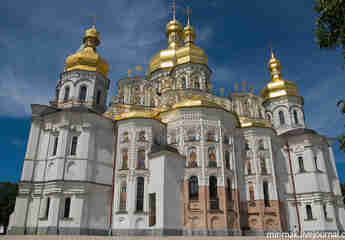
Kyiv Pechersk Lavra (Ukr. Kyiv-Pechersk Lavra) is one of the earliest monasteries founded in the Old Rus state. It was founded in 1051 under Yaroslav the Wise by the monk Anthony, a native of Liubech. One of Anthony's first disciples, Theodosius, became the co-founder of the Monastery of the Caves. Prince Sviatoslav II Yaroslavich gave the monastery the plateau above the caves, where later magnificent stone churches decorated with paintings, monastic cells, fortress towers, and other buildings rose. The monastery is associated with the names of the chronicler Nestor (the author of the Tale of Bygone Years) and the painter Alipius. From 1592 to 1688 it was a stauropegion of the Patriarch of Constantinople; from 1688 the monastery received the status of a lavra[1] and became the "tsar's and patriarchal Moscow stauropegion"; in 1786 the lavra was subordinated to the Metropolitan of Kyiv, who became its sacred archimandrite. In the Near and Far Caves of the Lavra rest the incorrupt relics of God's saints; the Lavra also contains burials of laypeople (for example, the grave of Pyotr Arkadyevich Stolypin).

mydim.ua
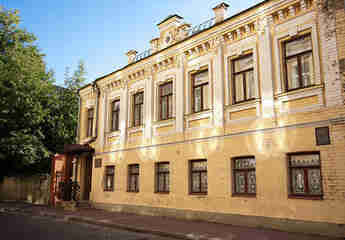
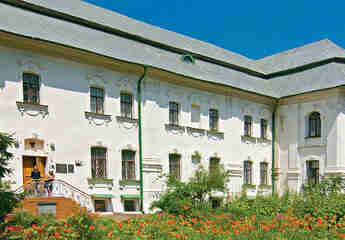
The Ivan Honchar Museum is usually officially designated with the subtitle "Ukrainian Center of Folk Culture." It was opened in Kyiv in 1993 thanks to Ivan Honchar, a well-known artist, sculptor, and public figure. He began collecting works of Ukrainian folk art back in the late 1950s, traveling around the country and seeking out not only the creations of folk masters but also paintings by professional artists that could not be exhibited in state museums.
In 1993, when all the country's exhibition venues focused only on Ukrainian art of the Soviet period, the Ivan Honchar Museum became a unique place where true folk culture could be seen without any restrictions.
The museum's collection numbers more than 15 thousand items. All of them are objects of artistic and ethnographic value - ceramics, paintings (paintings, icons, graphic art), textiles, and folk musical instruments. An equally unique place was chosen for the collection - the museum is housed in a building that is an architectural monument of the 18th century.
Museum of the Great Patriotic War

Flickr, torehau76
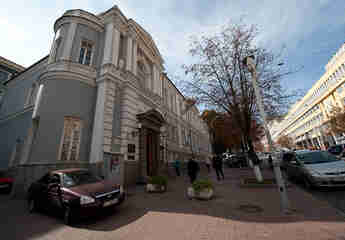
The National Museum of the History of the Great Patriotic War of 1941-1945 (Ukr. Natsionalnyi muzei istorii Velykoi Vitchyznianoi Viiny 1941-1945 rokiv) in Kyiv is a memorial complex located on the slopes of the right bank of the Dnieper on the outskirts of Pechersk, one of the city's historic districts. The authors of the preliminary design were E. Vuchetich and E. Stamo; the authors who realized the complex were V. Elizarov (chief), V. Borodai, I. Ivanov, G. Kislyi, I. Mezentsev, F. Sagoyan, E. Stamo, P. Feshchenko, and V. Shvetsov. It was designed by Giprograd jointly with Ukrproektstalkonstruktsiya. The main contractor was Kyivhorbud-4.[1] The Kyiv Museum of the Great Patriotic War moved twice before it was ceremonially opened at its current site on 9 May (Victory Day) 1981 by Leonid Ilyich Brezhnev, head of the Soviet state. On 21 June 1996, the museum was granted its current status as the National Museum of Ukraine by a decree of President Leonid Danylovych Kuchma.
Motherland

livejournal.com, tov_tob
The "Motherland" monumental sculpture (Ukr. Batkivshchyna-Maty) stands in Kyiv on the high right bank of the Dnieper. It belongs to the "National Museum of the History of the Great Patriotic War of 1941-1945." In 1981, on Victory Day, the complex was opened by CPSU Central Committee General Secretary L. I. Brezhnev. The central figure of the museum is the "Motherland" monument. The sculpture rises above the Dnieper slopes and is visible from distant points of the Ukrainian capital. The museum is located at the foot of the monument.