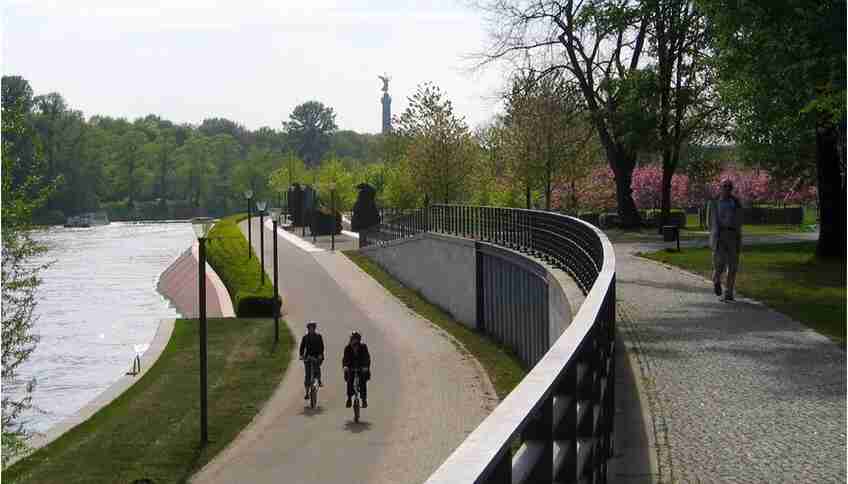
Memorial to Fallen Soviet Soldiers in Tiergarten

Flickr, MadGrin
The Memorial to Fallen Soviet Soldiers in Tiergarten is located in Berlin's Großer Tiergarten (Mitte borough, Tiergarten district), on Straße des 17. Juni. It was erected in 1945 in memory of Soviet soldiers who fell in the battles of World War II. In memory of the 75 thousand Soviet soldiers who died during the Battle of Berlin, three monuments were built in Berlin after the end of World War II. These memorials are not only monuments to the Great Victory on German soil, but also military burial sites. The central memorial is considered to be the Monument to the Liberator Soldier in Berlin's Treptower Park. In addition to the monument in Tiergarten, another memorial to fallen Soviet soldiers is located in Schönholzer Heide in the Pankow district. Every year on May 8, a solemn wreath-laying ceremony is held at the graves of the fallen soldiers.
Großer Tiergarten

Flickr, Jonny_BKirchhain
Großer Tiergarten (German: Großer Tiergarten) is a park in the center of Berlin. The area of Berlin's largest park is 210 hectares. For comparison: Hyde Park in London covers an area of 125 hectares and Central Park in New York — 335 hectares. Several major thoroughfares run through the park, including Straße des 17. Juni. They intersect at Großer Stern, in the middle of which stands Berlin's Victory Column.
Bellevue Palace

Flickr, dasypeltis
Bellevue Palace (German: Schloss Bellevue, bɛlˈvy) is a palace in the northern part of Tiergarten park in Berlin, the residence of the Federal President of Germany. Until the end of 2005, the palace was under reconstruction, and the president used Charlottenburg Palace as his residence. Bellevue Palace, located on the banks of the Spree River, was built in 1786 by architect Michael Philipp Boumann as the summer residence of Prince August Ferdinand, the younger brother of the Prussian King Frederick II. Guests of Bellevue at various times included Friedrich Schiller, the royal couple Friedrich Wilhelm and Louise, Wilhelm von Humboldt, and Napoleon. The interior decor of 1791, after destruction in World War II, was restored from surviving original sketches. Since 1959, the palace has been the location of the institution of the ministers of Germany's federal states.
Victory Column

Flickr, juergenberlin
The Victory Column (German: Siegessäule) is a monument to German history and a landmark of Berlin. The author of the design, architect Johann Heinrich Strack (1805—1880), was a student of Karl Friedrich Schinkel. The author of the figure crowning the column was one of Germany's significant sculptors, Friedrich Drake (1805—1882). The monument is located in the center of Tiergarten park on Großer Stern. The column was built by order of Wilhelm I in honor of Prussia's victories in the Danish War of 1864, the Austro-Prussian War of 1866, and the Franco-Prussian War of 1870—1871. The bronze reliefs on the granite pedestal depict battle scenes telling about the fighting in these wars. The column was unveiled on September 2, 1873, on the third anniversary of the victory in the Battle of Sedan. At the top of the column stands a sculpture of the goddess of victory Victoria, 8.3 meters high and weighing 740 centners[source not specified 1241 days], popularly called "Goldelse" (German: Goldelse).
Berlin Zoo

Flickr, Olivier Bruchez
Berlin Zoo (German: Zoologischer Garten Berlin — Berlin Zoological Garden) covers an area of 35 hectares in Berlin's Tiergarten district and is one of the largest zoos in Germany. No zoo in the world[source not specified 737 days] has such a number of animal species on display (approximately 15 000 animals, 1500 species). Together with the adjoining aquarium, on whose three floors not only fish are presented, but also reptiles, amphibians, insects, and invertebrates, Berlin Zoo is one of Berlin's main attractions. Every year the zoo is visited by about 2.6 million people. Berlin Zoo, the first zoo in Germany and the ninth in the world, opened on August 1, 1844. In 1869, Dr. Heinrich Bodinus became its director. Under him, an antelope enclosure was built which, above all because of its exotic style, quickly became an attraction. Later, enclosures for elephants, ostriches, flamingos, and the famous "Elefantentor" gate were built (German.
Kaiser Wilhelm Memorial Church

Flickr, Noud!
Kaiser Wilhelm Memorial Church (German: Kaiser-Wilhelm-Gedächtniskirche or, briefly, Gedächtniskirche — Gedächtniskirche, among Berlin residents it received the unofficial nickname "Hollow Tooth" (Hohler Zahn)) is a Protestant church in Berlin on Breitscheidplatz, where Kurfürstendamm begins. The memorial church was built according to the design of architect Franz Schwechten in 1891—1895 in honor of the first German Kaiser Wilhelm I, commissioned by his grandson, the last Kaiser of Germany, Wilhelm II. For a long time it was the tallest church in Berlin (its height was 113 m). However, in the middle of the 20th century, the church was destined to become a memorial of destruction and renewal. On November 23, 1943, a sermon on the theme "Everything passes!" was being delivered in the church, and a few hours later the church was destroyed as a result of an Allied bombing raid.
Europa-Center Complex

Flickr, frankeggen
"Europa-Center" is a complex of buildings with a memorable high-rise on Breitscheidplatz in Berlin's Charlottenburg district. In the 1960s, along with the Kaiser Wilhelm Memorial Church, it became a symbol of West Berlin. It is protected by the state as a historical monument. On the site where the "Europa-Center" now stands, the "Romanisches Café" opened in 1916, becoming a legendary meeting place for writers, artists, and theater workers. During the bombings of World War II, in November 1943, the building was destroyed. For several decades, no use was found for the land plot, and the place was considered a "blot on Berlin's calling card." In 1961, soon after the construction of the Berlin Wall that divided the city, the picture changed. New construction was necessary for political purposes as a symbol of the vitality of West Berlin's residents.
Department Store Kaufhaus des Westens

Flickr, Captain Kidd
"Kaufhaus des Westens" (German: Kaufhaus des Westens — "Department Store of the West"), abbreviated Ka-De-We (KaDeWe), is a department store in Berlin's Charlottenburg district (Germany). It was once considered the largest on the European continent and was among the five largest department stores in the world. The department store was founded in 1905 by Adolf Jandorf and designed by architect Emil Schaudt. The store opened in April 1907. 43 thousand square meters of retail space, seven floors, over a quarter of a million product names; the delicatessen department offers about 500 types of bread and almost 1800 types of cheese. Approximately 2400 people work at "KaDeWe".