Spaso-Preobrazhensky Cathedral

panoramio.com, Igor Belov
The Odessa Spaso-Preobrazhensky Cathedral is the largest Orthodox church in Odessa; founded (the original building) in 1794, consecrated in 1808, destroyed in 1936. After being rebuilt on its original site in the early 2000s, it was consecrated (according to the rite of great consecration) on July 21, 2010 by Patriarch Kirill of Moscow and All Rus'.[1][2][3]The cathedral stands in the middle of Sobornaya Square in Odessa; next to the cathedral building there is a fountain-monument in honor of the opening of the city water supply system and a monument to Prince M. S. Vorontsov, Governor-General of Novorossiya and Bessarabia (1823—1844). As it developed architecturally, the cathedral reflected the level of development of Odessa and the entire Novorossiysk region: having been a small religious building at the beginning of the 19th century, it became one of the largest cathedrals of the Russian Empire at the beginning of the 20th century and the main church of Novorossiya.The rector of the cathedral is Metropolitan Agafangel (Savvin).
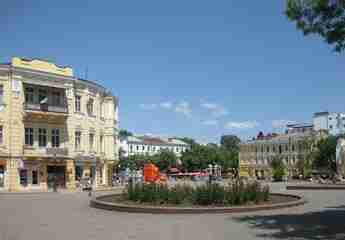
Sobornaya Square

panoramio.com, Igor Belov
Sobornaya Square is one of the main squares of the city of Odessa. It has the shape of an irregular pentagon. It is formed by the intersection of Preobrazhenskaya, Sadovaya, Koblevskaya, and Tolstogo streets.Since 2005, the square has hosted an exhibition-sale of works by Odessa artists and tourist souvenirs. A flower gallery is located nearby.
Monument to Prince Vorontsov

Flickr, andrey panisko
The Monument to Prince Vorontsov is a monument to M. S. Vorontsov, Governor-General of Novorossiya and Bessarabia, erected on Sobornaya Square in Odessa in 1863. Odessa's second monument[1].The monumental bronze figure of His Serene Highness the Prince is depicted wearing a cloak with a field marshal's baton in his hand. The sculpture of the prince is placed on a quadrangular pedestal made of Crimean diorite. On the front side of the monument, the pedestal bears the following inscription: “To His Serene Highness Prince Mikhail Semyonovich Vorontsov from grateful compatriots. 1863.” On the back side: “To the Governor-General of the Novorossiysk Territory and Bessarabia 1823—1854.”, and on the other two sides are bas-relief depictions of the Battle of Craonne and the capture of Varna with the inscriptions “Craonne 1814.” and “Varna 1828.”[1].
Passage

panoramio.com, Ayrup
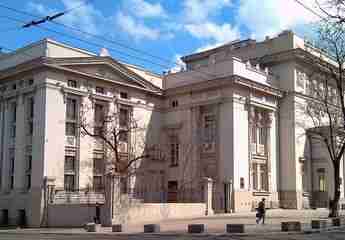
Hotel “Passage” is a hotel and covered shopping arcade, a historical and architectural monument of the late 19th and early 20th century in the city of Odessa, located at 34 Preobrazhenskaya Street (the intersection of Deribasovskaya and Preobrazhenskaya streets, Prymorskyi District).“Passage” was built on a historic site — the original buildings belonged to two Russian officers who received the plot for development at the end of the 18th century, and in 1822 entrepreneur M. A. Kramarev bought it for the construction of an apartment house. The house was built in the 1840s. In Kramarev's house lived the brother of the famous Russian poet Alexander Sergeyevich Pushkin — Lev Sergeyevich, who served as an official at the Odessa customs office. Representatives of the city's intellectual elite and distinguished visitors, including the famous Russian writer Nikolai Vasilyevich Gogol, visited L. S. Pushkin at Kramarev's house.
Monument to the 12th Chair

“Twelve Chairs” is a novel by I. Ilf and E. Petrov. Written in 1927. Genre — a sharply satirical novel-feuilleton. The novel has a sequel — “The Golden Calf”.
City Garden

Flickr, Alisa Volkova
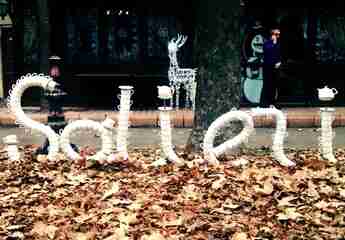
City Garden (Lassalya, City, Deribasa[1]) is a park located in the center of the city of Odessa. The oldest public park in the city.It is located in the city center, on Deribasovskaya Street. The garden was laid out by Felix De Ribas (the brother of Odessa's founder, Iosif De Ribas) in 1803 on his plot of city land right in the center of the young city. Since Felix did not have enough money to keep the garden in order and care for the plants, he decided to donate the garden to the city — this happened on November 10, 1806. The plot of land and the young plantings on it were transferred to city ownership free of charge.The garden contains the Summer Theater of the City Philharmonic (1949), architect R. A. Vladimirskaya, the musical pavilion-rotunda (1943), architect A. A. Gentsler, and a number of sculptural compositions and monuments[1].

Flickr, Epicantus
You can't help exclaiming: what won't they think of next! French perfumer Christophe Lakaren and Honored Artist of Ukraine Alexander Tokarev created a perfume fountain that can… spray fragrances!
This fountain (it is worth noting that it operates only in the warm season) is located in City Garden and appeared there for the 210th anniversary of the founding of Odessa.
The perfume fragrance was chosen by the residents of Odessa themselves. First, they created several scents, from which the townspeople then selected one by voting. Now, in the summer months, this aroma, considered the official scent of Odessa, spreads throughout City Garden once an hour.
Interestingly, Christophe Lakaren was inspired to create such an unusual fountain by Pushkin's poem “The Fountain of Bakhchisarai”.
Monument to Utyosov

panoramio.com, Igor Belov
The Monument to Leonid Utyosov is a bronze sculptural composition installed in Odessa in memory of the Odessan-born Soviet variety performer Leonid Utyosov.The bronze sculptural composition was created by Honored Artist of Ukraine, sculptor A. P. Tokarev, who is the author of a whole series of small sculptural compositions adorning the streets and parks of Odessa. The composition was cast in Kyiv and installed in 2000 during the celebration of City Day, which in Odessa is celebrated on September 2. Utyosov is shown sitting on one end of an ornate bench, the other end of which is empty. Thanks to this idea, and to the fact that the sculpture is made slightly larger than life-size, the figure is brought closer to the viewer and placed on the same level as Utyosov. Residents of Odessa and visitors to the city love taking photographs with this monument, sitting on the bench next to Utyosov[2].
Deribasovskaya Street

mihavxc.ru, Михаил Чухломин
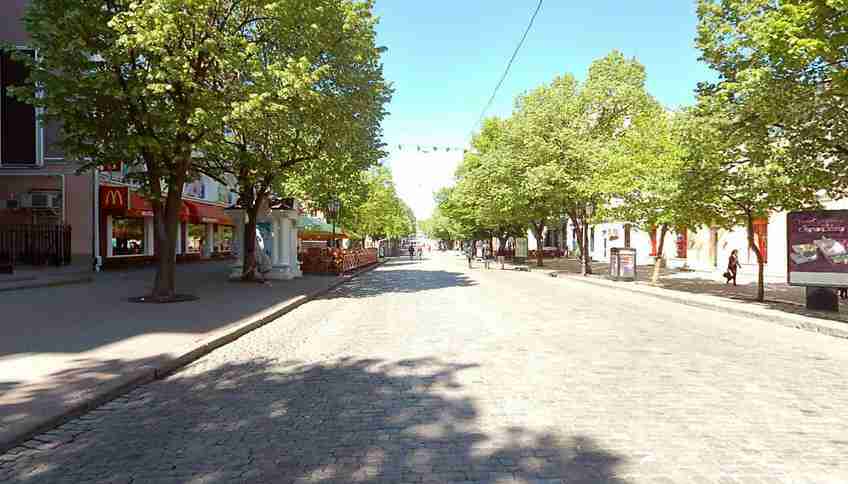
Deribasovskaya Street is one of the central streets of the city of Odessa and one of the city's main attractions. The roadway is paved with cobblestones. At present, most of Deribasovskaya is closed to vehicle traffic and is a pedestrian zone. Deribasovskaya is a popular place for strolling, which is mainly done on City Day and during Odessa's Humorina. Numerous cafes and shops are located on Deribasovskaya. The adjoining City Garden, the first in Odessa, is also popular. Former names: Chkalova Street, Lassalya, Gimnazskaya[1].The street got its name (originally ital. La strata Ribas) in honor of Jose de Ribas, the founder of Odessa and its first mayor, whose house was located on this street. Later his brother, Felix de Ribas, lived here. It is located parallel to Lanzheronovskaya and Grecheskaya streets, between Preobrazhenskaya and Polish streets.The street's original name was Gimnazskaya; the variant Gimnazicheskaya is also sometimes found.
Chocolate Museum

dumskaya.net
Did you know that Odessa has a chocolate museum? These “delicious” sculptures can stand for several years if the temperature conditions are maintained!
It is important to note that chocolate is a very “capricious” material: at too low temperatures it becomes brittle, and at high temperatures it melts. Therefore, for the normal functioning of the “chocolate” museum, the staff must maintain a certain stable temperature. And, of course, after some time has passed since the sculptures were made, depending on the type of chocolate and its shelf life, unfortunately they can no longer be eaten.
The most fantastic exhibits in this museum are paintings made with chocolate. The process of creating such canvases is quite long and labor-intensive. First, a smooth board with raised edges is taken, the height of which determines the thickness of the future canvas. Then the board is filled with white chocolate as a base. The blank canvas is ready. Only after that are masterpieces created on the white chocolate using different types of chocolate with added colorings. The subjects here are incredibly varied: ships, dragons, there is even a Venus de Milo made of white chocolate!

panoramio.com, geo248
On Rishelyevskaya Street in Odessa, at first glance you will see a very unusual scene. Above the entrance to some premises rises a mannequin of a woman dressed in antique clothes. The inscription above her is even stranger: “At Baba Utya's”. Curiosity leads you inside, and there you find yourself in the only permanently operating wax museum in Ukraine. Its founder is the well-known businessman Alexander Pavlovsky.
Interestingly, Baba Utya herself is a very popular person in Odessa. She opened the first public catering establishment in the city, which, incidentally, was often visited by celebrities.
The museum's exposition is presented in four halls: “Hall of the Musketeers”, “Tsar's”, “Children's” and “Hollywood”. Who isn't here! Members of the popular group “Beatles”, Pushkin, Zhukovsky, Gogol, Shrek, Batman, and many, many others.
For those who have seen the entire exposition and want to relax with a cup of tea, a cafe is open, where you will be greeted by the establishment's “regulars” — Leonid Utyosov, Grigory Kotovsky and Anna Akhmatova ;)