
panoramio.com, Vad Ayrup
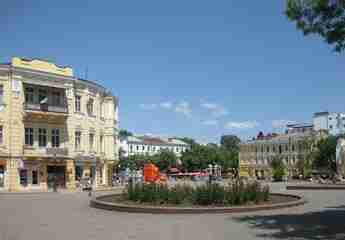
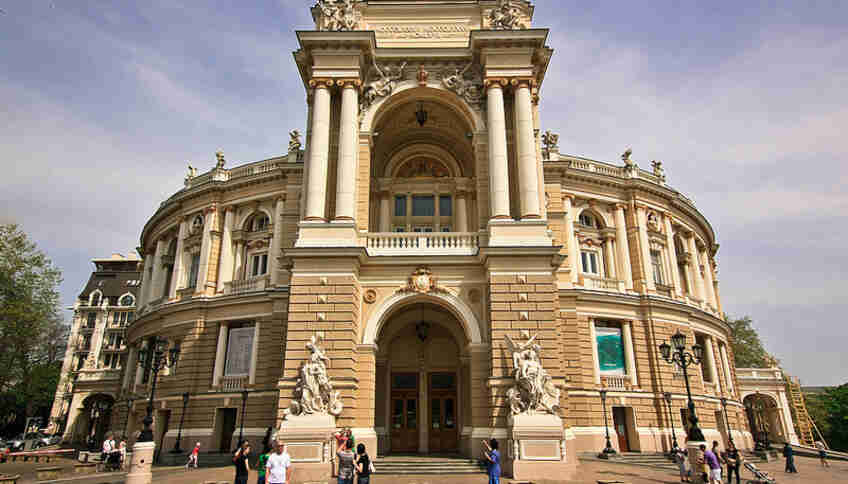
There is a place in Odessa from which a simply stunning view of the Opera and Ballet Theater opens up. It is a square that, in the French manner, is called “Palais-Royal.” And like many other places popular with Odessa residents and visitors to the city, the square with this charming name has its own interesting history.
Two centuries ago, behind the City Theater there was a military ground for drill parades, that is, for marching training. On ordinary days soldiers marched here, and on holidays public festivities were held.
Later, the drill parade ground was moved to Sobornaya Square, and next to the theater they decided to build a Gostiny Dvor — shopping arcades for upscale trade and social amusements. This square was destined to become a place where well-off townspeople could stroll decorously or shop at leisure, avoiding the noise and bustle of the bazaar.
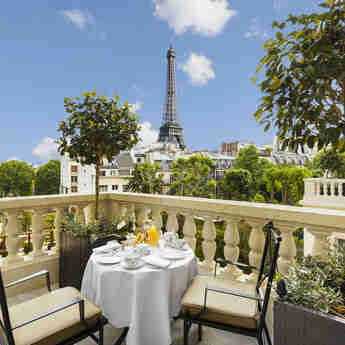
The Gostiny Dvor was given the name “Palais-Royal,” which translated from French means “Royal Palace” — a kind of allusion to the famous Paris residence.
Curiously, the Palais-Royal in the French capital was built for Cardinal Richelieu, a distant relative of Odessa's governor Duke de Richelieu. No, it really was not for nothing that Odessa was called little Paris!
Odessa National Academic Opera and Ballet Theater

bestvisit-ukraine.com
Odessa National Academic Opera and Ballet Theater is the first theater in Odessa and Novorossia in terms of time of construction, significance, and fame[1][2]. The first building was opened in 1810 and burned down in 1873. The modern building was built in 1887 by the architects Fellner and Helmer in the Viennese Baroque style. The architecture of the auditorium is designed in the style of late French Rococo. The unique acoustics of the horseshoe-shaped hall allow even a whisper from the stage to be heard in any corner of the hall. The complete restoration of the theater building was finished in 2007. P. I. Tchaikovsky, N. A. Rimsky-Korsakov, and S. V. Rachmaninoff conducted in the theater, Fyodor Chaliapin, Salomea Krushelnytska, and Leonid Sobinov sang there, and Anna Pavlova and Isadora Duncan danced there. Alexander Pushkin mentions the Odessa theater in the novel “Eugene Onegin.” Forbes magazine included the Odessa theater in the list of the most extraordinary sights of Eastern Europe[3].
Odessa City Council

Flickr, seei
Odessa City Council (Old Exchange) is the building of the Odessa City Council. The building is in the neoclassical style and is located on Duma Square (Primorsky Boulevard). The building was laid on May 23, 1829. Construction was suspended in June 1829 due to the quarantine declared because of a plague epidemic. The quarantine was lifted in December 1829. The structure was erected according to the design of Franz Boffo and Gregorio Torricelli. Construction was planned to be completed in 1834, but because of problems correcting deficiencies, it dragged on until 1837. Originally the facade of the building was decorated with two rows of columns, behind which there was an open courtyard. To increase the area for exchange transactions, the exchange building was rebuilt in 1871-73. The remodeling was carried out under the direction of architect F. I. Morandi. The second row of columns was replaced by a wall with a ceremonial entrance. The covered and rebuilt inner courtyard was named the White Hall.
Sculpture “Laocoön”

Flickr, Alexey Grachev
Sculpture “Laocoön” is a marble sculpture, a copy of the famous sculpture “Laocoön and His Sons,” installed in Odessa in front of the building of the Odessa Archaeological Museum. The sculpture was made by order of the prominent Odessa entrepreneur (later the mayor of Odessa) G. G. Marazli to decorate his dacha, which was located at the end of French Boulevard, on the territories of the Odessa Botanical Garden and the Chkalov Sanatorium. While traveling in Europe, G. G. Marazli saw El Greco's painting “Laocoön” (now in the Washington Museum) and even wished to buy it, but, having visited the Vatican, he was impressed by the ancient Greek sculpture “Laocoön,” a copy of which he ordered for himself[3]. After the October Revolution of 1917, on the basis of Soviet decrees, the sculptural group was nationalized, like other real estate, and was moved from place to place six times. In the mid-1920s, city architects M. V. Zamechek and M. F.
Archaeological Museum

Flickr, dmitriy79
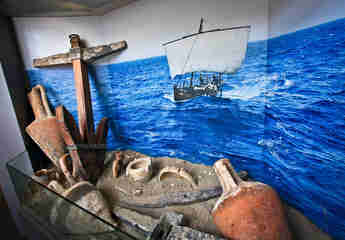
Odessa Archaeological Museum is one of the oldest in Ukraine. It was founded in 1825 by city collector Pyotr Bralamberg, who donated the rare items and books he had collected to create the museum exhibition. At first all this was kept in his own house and regularly replenished by other collectors, but in 1829 a room in a house on Primorsky Boulevard was allocated for the museum, and in 1843 the collections were moved to a bright mansion on Lanzheronovskaya Street.
It is important to note that the museum developed not without the help of members of the Odessa Society of History and Antiquities, who conducted excavations in the southern part of the Russian Empire.
In addition to exhibits from the largest collection in the history of the Northern Black Sea region (there are more than 160 thousand of them in the museum), there are collections of objects from Ancient Rome, Egypt, and Greece — all these rarities, including weapons, household items, jewelry, and money, were found during excavations in the Odessa region.
Particularly interesting is the museum's so-called “Golden Treasury,” where items made of precious metals found in Sarmatian and Scythian burial grounds and in the burial places of nomads are displayed. Numismatists will certainly enjoy the extensive collection of Russian coins.

panoramio.com, Olga Shchedrova
One of the most colorful, recognizable, and to some extent even sacred monuments of Odessa is the monument to Odessa-Mama. This bronze monument depicts a magnificent woman pressing five infants to her breast. These are her beloved children, the founding fathers of the city: Vorontsov, Richelieu, Langeron, Devlan, and Deribas.
The monument was unveiled on April 1, 2000 during the traditional Odessa festival of humor and satire “Humorina.” The ideological inspirer of the monument was Mikhail Zhvanetsky. The famous satirical writer claimed that Odessa rests on four whales: trade, the fleet, art, and medicine.
The author of this original monument was the well-known sculptor Alexander Knyazik. He placed three whales at the feet of Odessa-Mama, and represented the fourth as a headdress billowing like a sail.
Everyone interprets the profound symbolism of the “caring mommy” in their own way, yet one thing remains undeniable: the monument serves as a true adornment of Southern Palmyra.
“Fisherwoman Sonya and Sailor Kostya”

Flickr, Koluchiy
Barges full of mullet… is a famous Soviet song. It was written by composer Nikita Bogoslovsky to lyrics by Vladimir Agatov for Leonid Lukov's film “Two Soldiers” (1943), where it was performed by Mark Bernes, who played the Odessa soldier Arkady Dzyubin. After the film was released, the song became enormously popular. At the same time, officially it was not recommended for performance and was not published, being considered ideologically unsound and almost criminal. In the original version of the film script there were no songs at all. But later director L. Lukov asked N. Bogoslovsky to write a song for the dugout scene — that is how “Dark Night,” brilliantly performed by M. Bernes, appeared in the film. After that, Lukov decided that Arkady Dzyubin should sing one more song, completely contrasting, and instructed the composer to write it “in the style of cheerful Odessa street songs.” An announcement was placed in the newspapers “asking all persons who know Odessa songs to come to the film studio.”
Literary Museum

odespicture.net
Odessa Literary Museum is a literary museum located in Odessa. Founded in 1977 at the initiative of Nikita Brygin, it opened to visitors in 1984. It is one of the largest regional literary museums in Ukraine. The museum building is located in the historic part of the city at 2 Lanzheronovskaya Street. It is the palace of Prince D. I. Gagarin, built to the design of architect L. Otton in the early 1850s. The palace interiors combine various architectural styles: classicism, baroque, and empire. Historians claim that the Hungarian composer and pianist Franz Liszt gave a concert in the ceremonial “Golden Hall.” In 1898 the city duma, which rented the palace from the Gagarins, transferred the building to the Odessa Literary and Artistic Society, which united writers, artists, musicians, and actors. Meetings and evenings of the Society were held until 1903. Outstanding writers Henry Longfellow and Ivan Bunin performed here and read their works.
Museum of Western and Eastern Art

panoramio.com, Vad Ayrup
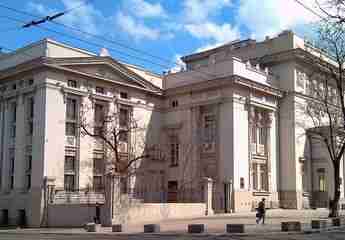
Odessa Museum of Western and Eastern Art is one of the largest art museums in Ukraine, whose collection contains a number of works of high artistic and cultural value. The museum exhibition presents works of Western European art of the 15th-20th centuries, the art of Eastern countries, and ancient art. The museum is located in the palace of Count Alexander Ageyevich Abaza at 9 Pushkinskaya Street. The museum was founded in 1924 on the basis of the collections of the State Art Museum, the Odessa Museum of Red Arts, the art history department of Novorossiysk University, and private collections.
Pushkin Museum

panoramio.com, Vad Ayrup
Odessa A. S. Pushkin Museum (13 Pushkinskaya St.) is a museum located in the building of a former hotel in Odessa, where Alexander Sergeyevich Pushkin lived for a month in 1823. In the 1820s, at 13 Pushkinskaya there was the Hotel du Nord, where there were rooms for visitors and carriage barns with stables. Upon arriving in Odessa on July 3, 1823, Pushkin stayed in this hotel and lived here for a month. Within the walls of this hotel he finished the poem “The Fountain of Bakhchisarai,” wrote the poem “The Gypsies,” wrote thirty lyric poems and two and a half chapters of the novel “Eugene Onegin.” The street on which the great poet lived, formerly called Italian Street, was renamed Pushkinskaya in 1880. Here, for more than 30 years, a museum of the great poet has been operating. In the Odessa A. S.
Hotel “Bristol”

panoramio.com, Igor Belov
Hotel “Bristol” (the original name was “Bristol,” during the USSR it was called “Krasnaya”) is a historic hotel in Odessa located at 15 Pushkinskaya Street (at the intersection with Ivan Bunin Street). The hotel was built in 1898—1899 according to the design of architects Alexander Bernardazzi and Adolf Minkus[2] opposite the building of the New Merchants Exchange and next to the State Bank building, and at that time it was one of the most luxurious hotels in Odessa. It was the first[3] 4-story hotel in Odessa. At present the hotel building has been granted the status of an “architectural monument”[2]. From 2002 until the end of 2010 the hotel was closed for reconstruction. After the reconstruction was completed, the hotel was given 5-star status[4]. Officially, the Bristol Hotel reopened its doors on December 15, 2010[5][6]. As a result of the reconstruction, a spa center with a swimming pool appeared in the hotel [7].
Odessa State Philharmonic

Flickr, Ayrup
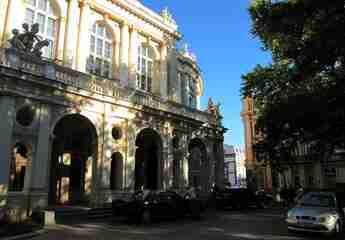
Odessa State Philharmonic (New Exchange) is one of the largest concert organizations in Odessa, founded in 1937. In the same year its symphony orchestra was officially created. The philharmonic has two halls: chamber and concert. The predecessor of this building was the Odessa Philharmonic Society, which was created in 1842. It included both musicians and well-known figures of Odessa, as well as men of letters and military personnel. The Society gave charity concerts and financially supported young artists. In the 1840s the Wieniawski brothers and the composer and pianist Franz Liszt performed on the philharmonic stage. Since 1925 symphonic music concerts began to be held in the building. Professor of the Odessa Conservatory Leonid Mogilevsky became the conductor of the Odessa Philharmonic Symphony Orchestra.

bernardazzi.com
At the very end of the 19th century, a building was erected in the center of Odessa. But even today, many decades later, a person passing by involuntarily stops, struck by the beauty of this structure. On the facade there is a plaque: “Architectural monument, 19th century,” and in the niche at the entrance there is a bust of the architect — Alexander Bernardazzi.
At one time it housed exchange brokers, the philharmonic, Roman Viktyuk's House of the Actor, Oleg Tabakov's theater studio “Experiment”…
And in December 2007 the club-restaurant “Bernardazzi” opened here. A passion for good music, quality sound, magnificent cuisine, and a warm, almost homelike atmosphere became the hallmark of this establishment. Here you can hear a wide variety of musical styles and genres: ethno, cabaret, folk, rock, jazz, lounge, new age, blues, gospel, soul, funk…
In 2012, 'Bernardazzі' became the holder of the elite award “Best of Award of Excellence” from the authoritative wine magazine “Wine Spectator,” and a year later confirmed this high status. In addition, for several years in a row the restaurant “Bernardazzi” has served as the official lounge venue of the Odessa International Film Festival.