Tauride Garden

Panoramio, A Chernenkov
Tauride Garden is a monument of garden and park art in the central part of Saint Petersburg. It is located in the block bounded by Kirochnaya, Potemkinskaya, Shpalernaya and Tavricheskaya streets. The area of Tauride Garden is 21,1 hectares.The garden was laid out in 1783—1800 by the English garden master V. Gould during the construction of Tauride Palace. In place of the small Samoroyka River, a complex hydraulic system of two ponds connected by channels was created. Sterlet were released into the ponds. The ponds were filled with water from the Ligovsky Canal. There are two islands on the large pond. Scenic mounds were made from the soil excavated during the construction of the ponds. In 1866, Tauride Garden was opened to visitors.In the period from 1930 to 1940 the garden was called the Park of Culture and Leisure of the First Five-Year Plan, from 1958 to 1985 — the City Children's Park, and in 1985 its original name, Tauride Garden, was restored.It was badly damaged by the flood of 1924 and during the Siege of Leningrad.
Tauride Palace

Flickr, Where is my spellbook?
Tauride Palace is the Saint Petersburg residence of Prince Grigory Potemkin-Tavrichesky. It was built in the Classical style in the period from 1783 to 1789 according to the design of architect I. E. Starov.The palace is located on Shpalernaya Street, in the block between Potemkinskaya and Tavricheskaya streets. Behind it is Tauride Garden.In the 21st century, the palace is the headquarters of the Interparliamentary Assembly of the Member Nations of the Commonwealth of Independent States. It also houses the Saint Petersburg branch of the Mir TV and radio company.The names of Tauride Garden, Tavricheskaya Street and Tavrichesky Lane derive from Tauride Palace.In the depth of the ceremonial courtyard, separated from the street by a low fence (1792—1793, architect F. I. Volkov), stands the central two-story building with a six-column portico, crowned with a flat dome on a low drum; the smooth wall surfaces are cut through by tall windows and finished with a strictly designed entablature with a frieze of triglyphs.
Museum "Universe of Water"

livejournal.com, project4x4
The museum complex "Universe of Water" is one of Russia's new museums, located in Saint Petersburg, in a water tower. The tower was built in the brick style in 1859—1862, architects E. G. Shubersky and I. A. Merz.The Water Museum is one of the youngest museums of the Northern capital. Its exhibits, models, installations and multimedia expositions tell about the history, current state and prospects of the city's water supply and wastewater disposal, the use of water in everyday life, and the state of water resources. In the museum, visitors learn many new things about the most mysterious substance in nature — Water, in which life originated and without which life is impossible. The relationship between humans and water is presented using extensive historical material, as well as through the example of the development of the water supply and wastewater disposal system of Saint Petersburg. Studying these interconnections is not only interesting, but also useful.
Smolny Cathedral

Flickr, Pola Damonte
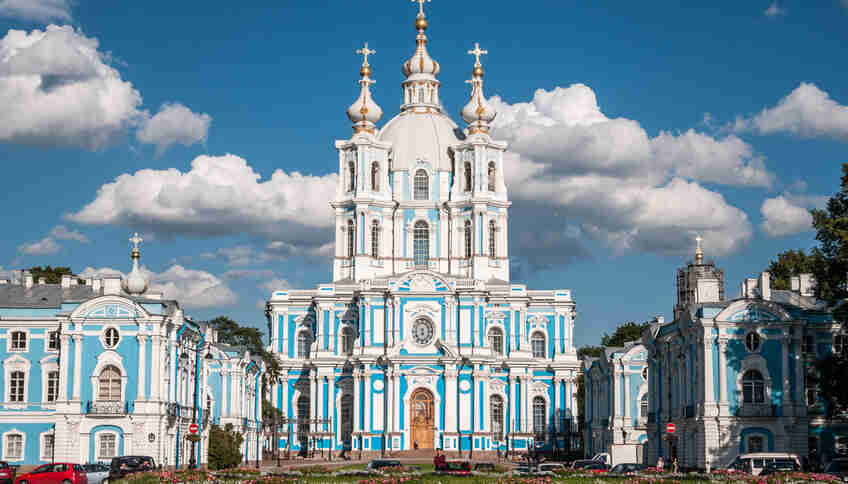
Smolny Cathedral of the Resurrection of Christ (Smolny Cathedral) is part of the architectural ensemble of the Smolny Monastery, which is located in Saint Petersburg on the left bank of the Neva on Smolnaya Embankment. It is also a concert venue for classical music.In the 1740s, the heiress to the royal throne, Elizabeth Petrovna, decided to spend the last years of her life in the silence and peace of a monastery surrounded by one hundred and twenty noble maidens. Already as empress, she ordered a monastery to be built on the site of the "Smolny House" — the palace where she spent her youth. The monastic complex was to include a church with house churches and a bell tower, and an institute for girls from noble families. The architect of the cathedral was Bartolomeo Francesco Rastrelli. The solemn ceremony of laying the foundation stone of the cathedral took place on 30 October 1748. From 1749, the work was supervised by Christian Knobel, an architect who worked together with Rastrelli. By 1751, all preparatory work and all the foundations had been completed.
Smolny Building

Flickr, gracious tiger
Smolny Institute is a building in Saint Petersburg, a monument of history and architecture, the residence of the governor of Saint Petersburg, and a museum. The building was erected in 1806 according to the design of architect Giacomo Quarenghi.In the 19th and early 20th centuries, the Smolny Institute for Noble Maidens was housed in the building.The building is also known for its role in the events of the October Revolution of 1917, after which it housed the Leningrad City Soviet of Workers' Deputies and the city committee of the AUCP(b)/CPSU (until 1991).The building then became the residence of the mayor and, since 1996, the governor of the city.The building houses a number of museum exhibitions reflecting its entire history.