Loft Project Etazhi

Flickr, astramaore
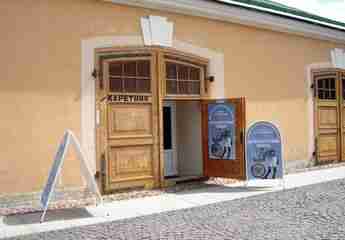
'Etazhi' is a cultural center in St. Petersburg. It is the first and best-known exhibition complex in St. Petersburg operating in a loft, a former factory space[1]. Its self-designation is 'Loft Project Etazhi'. The director and creative force behind 'Etazhi' is Maria Vladimirovna Romashova. It opened in 2007 with an exhibition by Andrew Logan and Irena Kuksenaite in the 'Globus' gallery (5th floor)[2][3] and became the first loft-based exhibition center in St. Petersburg. It occupies five floors of the former Smolninsky Bread Factory building at 74 Ligovsky Prospekt.

kidsreview.ru
'Bread and circuses!' - the famous slogan of Ancient Rome remains extremely relevant even today. In St. Petersburg they know that the public values both bread and spectacles equally, and so they decided to combine them in one place - the State Bread Museum.
This collection opened in 1988, and initially it was an industry museum; only 5 years later was it given state status.
The collection contains everything related to the history of the most important food product. Thousands of different types of bakery products, tools and devices for making bread, and kitchen utensils from different eras reflect the history and regional features of bread baking. There is also an interesting collection of objects directly or indirectly connected with bread - samovars and tableware traditional for Russian kitchens of the past, paintings and figurines associated with bread. This exhibition of more than 15 thousand items gives a complete picture of the everyday and spiritual significance of bread in Russian families.
The most touching and unforgettable exhibit of the Bread Museum is the legendary 125 grams - the daily ration per person in besieged Leningrad. During the war, this small loaf was issued by ration card, and it was baked from oat and rye flour with the addition of oilcake.
Russian Museum of the Arctic and Antarctic

Plus.google, Yuri Sedunov
The Russian State Museum of the Arctic and Antarctic is a museum in St. Petersburg. The museum's goal is to show the historical chapters of scientific research in the Arctic and Antarctic, as well as the Soviet/Russian territories adjacent to the Arctic and the Northern Sea Route. The museum is located in the building of the former Edinoverie St. Nicholas Church, built in 1820—1838 to a design by architect A. I. Melnikov (closed in 1931). In the 1920s, in connection with the active exploration of the Arctic, many prominent polar explorers and scientists proposed organizing a permanent polar museum. In 1930, the Presidium of the Central Executive Committee of the USSR approved the decision to create the All-Union Arctic Institute (VAI), in which a museum of the Arctic was envisaged as a special department. Initially, the museum's exhibits were stored in the basement of the VAI and used only for exhibitions.
Dostoevsky Literary Memorial Museum

Flickr, pablo.sanchez
The State F. M. Dostoevsky Literary Memorial Museum (St. Petersburg, Kuznechny Lane, 5/2) is one of the six Russian museums of the great writer Fyodor Mikhailovich Dostoevsky. The idea of creating the museum was cherished by the writer's widow, Anna Grigoryevna Dostoevskaya. In 1917 she left Petrograd and a year later died in complete solitude in Crimea, far from her children and grandchildren. All the objects that had been in the house where Dostoevsky lived were placed by her in storage in one of the warehouses when she left Petrograd and later disappeared, while the archive materials, with some exceptions, ended up in state archives. In the 1960s, the architect-artist Georgy Vladimirovich Piontek came forward with the initiative to open the museum and with the museum project for Kuznechny Lane, in the house where the writer spent the last years of his life. F. M. Dostoevsky moved into this house with his family in October 1878 and lived there until the day of his death - 28 January (9 February) 1881. The museum was opened for the 150th anniversary of the writer's birth in 1971.
Vladimirsky Cathedral

zerkalotv.ru
The Cathedral of the Vladimir Icon of the Mother of God, or simply Vladimirsky Cathedral, is an active Orthodox church on Vladimirskaya Square in St. Petersburg. It is dedicated to the Vladimir Icon of the Mother of God, one of the most revered icons in Rus'. Vladimirsky Prospekt and Vladimirskaya Square take their names from Vladimir Church. The church belongs to the St. Petersburg diocese of the Russian Orthodox Church and is part of the Central Deanery District. The rector is Metropolitan Vladimir (Kotlyarov), and the cathedral's key keeper is Archpriest Georgy Shmid. Vladimir Church was built on Trade Square between 1761 and 1769, presumably to a design by architect Christian Knobel or according to a plan by architect P. A. Trezzini, on the site of a wooden church of the same name built in 1747. The church was consecrated on 9 April 1783. In 1791 architect G. Quarenghi completed the construction of a freestanding two-tier bell tower. In 1830—1831 a narthex was built by architect A. I. Melnikov.
Beloselsky-Belozersky Palace

worldhouseinfo.com
The Beloselsky-Belozersky Palace; Sergievsky Palace - a palace in St. Petersburg, on Nevsky Prospekt at the point where it crosses the Fontanka River. The author of the project was architect A. I. Stackenschneider, who carried out the construction in the style of the so-called 'second baroque'. In 1797 Princess A. G. Beloselskaya bought from I. A. Naryshkin a small stone house on the corner of Nevsky Prospekt and the Fontanka embankment. The house was demolished, and in its place at the end of the 18th century architects Thomas de Thomon and F. I. Demertsov built the first three-story palace with a modest facade in the classical style. The appearance of this house has been preserved in a drawing by M. N. Vorobyov.[1] In 1847—1848 the palace was rebuilt by architect A. I. Stackenschneider, acquiring its modern appearance. After the reconstruction in the new baroque style, the building came to resemble Rastrelli palaces. Stackenschneider carried out the project by order of Prince K. E. Beloselsky-Belozersky.
Anichkov Bridge

jimohou.diary.ru
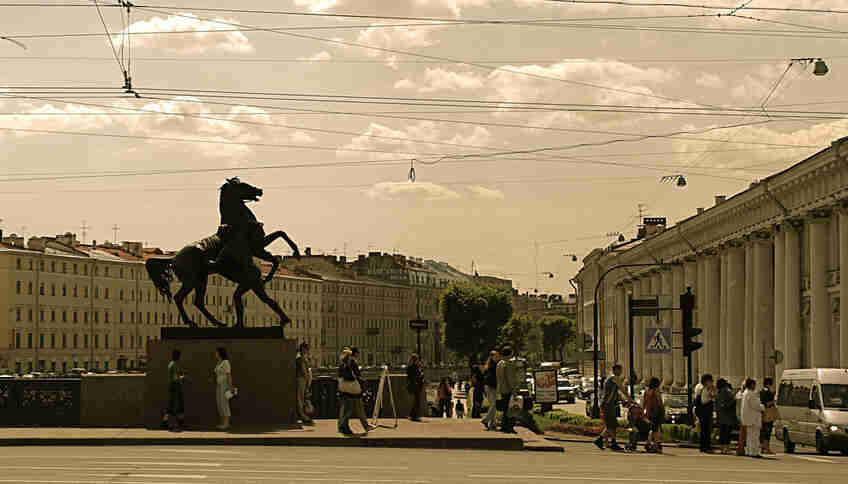
Anichkov Bridge[1] is one of the most famous bridges in St. Petersburg. A permanent stone bridge was thrown across the Fontanka along the line of Nevsky Prospekt in 1785. The bridge owes its name to engineer lieutenant colonel Mikhail Anichkov, whose battalion during the time of Peter the Great was stationed beyond the Fontanka in the so-called Anichkova Sloboda[2]. The 'folk etymology' deriving the name from some Anna, or Anichka, as well as the stress on the first syllable, are incorrect[3][4]. Until 1712–1714 the Fontanka was called Erik or Nameless Erik. The Nevsky Prospekt being laid out was one of the important routes of the new capital, and at the intersection of the two routes it was necessary to establish a permanent crossing. In 1715 Emperor Peter I issued a decree: 'Beyond the Bolshaya Neva on the Fontannaya River along the perspective build a bridge.' By May 1716[5] the work had been completed and a wooden multi-span beam bridge on pile supports had been built across the Fontanka, spanning both the channel itself and the marshy floodplain.
Anichkov Palace

wikia.nocookie.net, Belozerg
Anichkov Palace is one of the imperial palaces of St. Petersburg, by Anichkov Bridge on the Fontanka River Embankment (Nevsky Prospekt, 39). The palace received its name from Anichkov Bridge (see Anichkovs). It is the oldest surviving building on Nevsky Prospekt. Construction began in 1741 by decree of Empress Elizabeth, who had just ascended the throne as a result of yet another coup. The design of the varying-height building in the shape of a stretched-out letter 'N' was created by one of the first architects of the new capital, Mikhail Zemtsov. B. Rastrelli completed the construction in the high baroque style. At that time the Fontanka served as the outskirts of the city, and Nevsky Prospekt was still only a clearing. Thus, the palace was meant to decorate the entrance to the capital. A special canal was dug from the Fontanka to the palace, ending at the entrance in a small harbor. Hence the unusual position of the palace, standing sideways to Nevsky Prospekt.
Alexandrinsky Theatre

saint-petersburg.com, faun070
The Alexandrinsky Theatre (also the A. S. Pushkin Russian State Academic Drama Theatre) is a St. Petersburg theatre, one of the oldest drama theatres in Russia preserved to this day[1]. The first permanent public theatre in Russia was founded by decree of Empress Elizabeth Petrovna on 30 August (10 September) 1756; its original name was 'Russian Theatre for the Performance of Tragedies and Comedies'.[1] The troupe was headed by the 'father of Russian theatre' Fyodor Volkov, and the playwright A. P. Sumarokov became the theatre's director. From 1759 the theatre received court status. From 1763, because of Volkov's death, the oldest Russian actor I. A. Dmitrevsky became head of the troupe. The 'Russian court actors', who performed plays by Sumarokov, Fonvizin, Ya. B. Knyazhnin, V. I. Lukin, P. A. Plavilshchikov, P. Corneille, J. Racine, Voltaire, J. B. Molière, and P. Beaumarchais, performed for a long time in various theatrical venues.
Monument to Catherine II

oboi-812.narod.ru
The Monument to Catherine II is a monument on Ostrovsky Square in St. Petersburg, erected in honor of Empress Catherine II in 1873. At the beginning of the 1860s, the idea arose to erect a monument in the city for the 100th anniversary of Catherine II's accession to the throne. One version of the monument, made at a scale of 1/16 of life size, is located in the 'Grotto' pavilion in Tsarskoye Selo. In the center of the square on Alexandrinskaya Square, the monument to Empress Catherine II was unveiled in 1873. Its author was the artist M. O. Mikeshin. Granite of different types for the monument's pedestal was brought by water from the Karelian Isthmus to the Neva embankment by the Summer Garden, and from there it was delivered to the site by a special portable railway made at the San Galli factory. The cost of erecting the monument was 316 000 rubles, and together with the minting of commemorative medals, the organization of the opening ceremony, and the redevelopment of the square - 456 896 rubles. The monument was built for more than 10 years - from 1862 to 1873.
Gostiny Dvor

Flickr, Maud and John
Bolshoy Gostiny Dvor[1] is an 18th-century monument of history and architecture; in the past it was the central wholesale Gostiny Dvor, and since the beginning of the 20th century, a department store. Architect Jean Baptiste Vallin-Delamot. It is under UNESCO protection. Located in the historic center of St. Petersburg, it occupies the block between Nevsky Prospekt (building number 35), Sadovaya Street, Lomonosov Street, and Perinnaya Line. The vestibule of the Gostiny Dvor metro station opens into the building. The shopping premises of Gostiny Dvor comprise 13 thousand m², while the total area of the department store complex is 78 thousand m².[2] Gostiny Dvors in St. Petersburg have existed almost since the city was founded and played a serious role in sustaining the life of the capital. (For more details, see the St. Petersburg section of the article Gostiny Dvor.) The predecessor of this Gostiny Dvor was the Gostiny Dvor by the Green Bridge. When it burned down in the fire of 1738, it was decided not to restore the old building, but to build a new Gostiny Dvor closer to the city boundary.
Nevsky Prospekt

wikimedia.org
Nevsky Prospekt is the main street of St. Petersburg, stretching for 4.5 km from the Admiralty to the Alexander Nevsky Lavra. It crosses the Moika River (Green Bridge), the Griboedov Canal (Kazan Bridge), and the Fontanka River (Anichkov Bridge). Its greatest width is 60 m (by Gostiny Dvor), and its smallest is 25 m (by the Moika). The facades of 240 buildings face Nevsky Prospekt. The right side (odd-numbered) is unofficially called the 'shady' side, while the even-numbered side is the 'sunny' one (a popular place for walks). The section from Vosstaniya Square to the Alexander Nevsky Lavra is also unofficially called Old Nevsky (partly because in the 1730s an attempt was made to straighten the avenue along what are now Goncharnaya and Telezhnaya Streets). Nevsky Prospekt acquired its modern name in 1781; it came from the name of the Alexander Nevsky Lavra, which bears the name of the national hero, Saint Prince Alexander Nevsky.