Borodino Panorama

Flickr, Bernt Rostad
The museum-panorama “Battle of Borodino” was opened in 1962 on the territory of the former village of Fili (now Kutuzovsky Prospekt). The basis of the memorial complex is the hut of the council at Fili, restored after a fire[1] in 1887, and the panorama of the Battle of Borodino itself, completed by Franz Alekseyevich Roubaud in 1912. For the centenary of the Patriotic War of 1812, commissioned by Emperor Nicholas II of the Russian Empire, the artist Franz Roubaud painted the panorama “Battle of Borodino”. Work on it was carried out with the participation of I. G. Myasoedov and consultant B. M. Kolyubakin. Initially, the panorama was opened in 1912 in a pavilion specially built by architect P. A. Vorontsov-Velyaminov[2] on Chistye Prudy in Moscow (on the site of the present-day building No. 12a on Chistoprudny Boulevard). The lace-like domed structure of the pavilion was designed by engineer E. Izrailovich[3]. In 1918 the panorama was dismantled and, after a lengthy restoration by the artist P. D.
Triumphal Arch

Flickr, batstef2001
The Moscow Triumphal Gates (Triumphal Arch) were erected in 1829—1834 in Moscow to a design by architect O. I. Bove in honor of the victory of the Russian people in the Patriotic War of 1812. They are now located on Victory Square (Kutuzovsky Prospekt) in the area of Poklonnaya Gora. The nearest metro station is “Park Pobedy”. The Triumphal Gates should not be confused with the triumphal arches erected in Moscow from 1721 on the occasion of various significant events on Triumfalnaya Square, which after the construction of the Triumphal Gates on Tverskaya Zastava Square came to be called Old Triumphal Gates Square.[1] On 13 May 1814, Vyazmitinov, acting commander-in-chief in St. Petersburg during the emperor’s absence and head of the Ministry of Police, sent out to all the provinces a decree on the ceremonial reception of troops returning from Paris after the victory over the French troops.
Poklonnaya Gora

photosight.ru
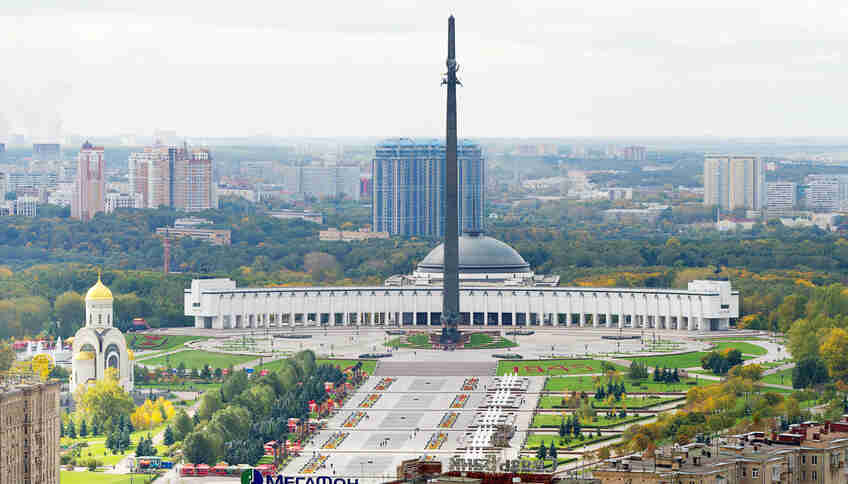
Poklonnaya Gora is a gentle hill to the west of the center of Moscow, between the Setun and Filka rivers. Once Poklonnaya Gora was far beyond the limits of Moscow, and from its summit there was a panorama of the city and its surroundings. Travelers often stopped here to look at Moscow and bow to its churches — this is how the hill got its name. Another Poklonnaya Gora was located in the northeast of Moscow, on the Sergievsky (Yaroslavsky) tract, in the area of the present-day Losinoostrovskaya station. It is shown on topographical maps of Moscow and its surroundings from 1856 and 1878, as well as on the “Geological Map of the Environs of Moscow”, compiled in 1897 by S. Nikitin. This, too, was a gentle hill from which travelers first got a view of Moscow. Now this Poklonnaya Gora is built up with residential buildings. The Losinoostrovskaya station, the complex of buildings of Moscow State University of Civil Engineering (MGSU), and Babushkinskoye Cemetery are also located here.
Church of St. George the Victorious on Poklonnaya Gora
Flickr, eiji kudo1
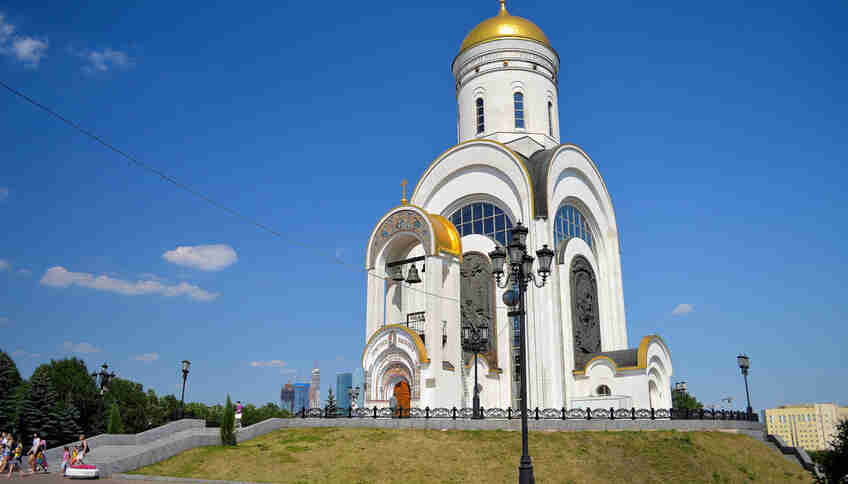
The Church of St. George the Victorious was founded by His Holiness Patriarch Alexy II next to the memorial on 9 December 1993 and was consecrated by him on 6 May 1995. Architect - A. Polyansky. The iconostasis was made by A. Chashkin. The authors of the bronze bas-reliefs are Z. Andzhaparidze and Z. Tsereteli, and of the mosaic icons - E. Klyuchareva. In the whole appearance of the church, one can see that elements of modernism have been added to the Russian style. The shrine of the church is a particle of the relics of the Great Martyr St. George the Victorious, presented by Jerusalem Patriarch Diodor and transferred to the church in 1998. A children's Sunday school operates at the church. The church also educates children from a psychoneurological boarding school. Affiliated with the church is the chapel church of Archangel Michael at the Memorial Museum of the Patriotic War of 1812. Some believe that the location of the church was chosen extremely unsuccessfully – not far from the goddess Nike crowning the tall 140-meter obelisk. The church was consecrated by His Holiness Alexy II, Patriarch of Moscow and All Rus', on 6 May 1995.
Victory Monument

Flickr, JonathanWolfson
The tallest monument in Russia[1] The 141.8-meter obelisk (1 decimeter for each day of the war) has the shape of a three-sided bayonet and is covered over most of its height with bronze bas-reliefs. At a height of 104 meters, a 25-ton bronze sculptural group is attached to the stele, including the goddess of victory Nike carrying a wreath and two cupids trumpeting victory. The monument was unveiled on 9 May 1995 as part of the Victory Memorial Complex.
Central Museum of the Great Patriotic War

Flickr, dfrench3
The Central Museum of the Great Patriotic War of 1941—1945 is a federal state cultural institution of the Russian Federation, the main site of the memorial Park Pobedy on Poklonnaya Gora in Moscow. The Central Museum of the Great Patriotic War of 1941—1945 is a unique memorial complex intended to perpetuate the memory of the heroism and courage shown by our compatriots during the years of the Great Patriotic War. The museum conducts scholarly and cultural-educational work, organizes events for the patriotic education of young people — schoolchildren and students, and provides information assistance to visitors. The galleries and exhibition halls of the Museum regularly host thematic exhibitions (for example, in 2006 the exhibitions “Soviet Small Arms in the Great Patriotic War”, “Dedicated to the Defenders of Moscow”, and others were held).

Flickr, ak_snark
On the territory of Park Pobedy in Moscow there is the Exhibition of Military Equipment and Armaments, a very interesting place where you can study the history of the Great Patriotic War from the point of view of the equipment that took part in it.
As a memorial complex, the park was opened in 1995, for the 50th anniversary of the Great Victory, and it is located in the west of Moscow, on Poklonnaya Gora, not far from the “Park Pobedy” metro station.
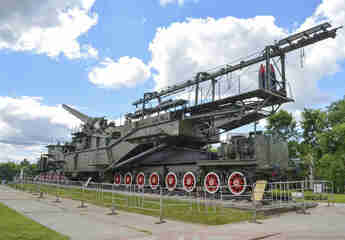
The exhibition of military equipment attracts many visitors. Here you can inspect various equipment that was in service with the Soviet Army. These are airplanes, helicopters, tanks, and other types of armaments. In addition, a great many examples of artillery are presented here — howitzers, cannons, and anti-aircraft guns. In total, the exhibition includes more than 300 types of equipment; you can also see unique exhibits that were once in service with the armies of the Allies, and at the very end — captured equipment.
Not only children and men are delighted by a visit to this exhibition. Wandering among armored trains, peering into dugouts, and admiring the power of warships will be interesting even for those who know the history of the Great Patriotic War only from textbooks.
Park Pobedy

Alena Chudanova
Park Pobedy, or (colloquially) Poklonnaya Gora, is a memorial complex of victory in the Great Patriotic War of 1941—1945 in the west of Moscow. The memorial complex was opened on 9 May 1995 for the 50th anniversary of the Great Victory. In the warm season, it is a place for mass public festivities. Park Pobedy is bounded on the north by Kutuzovsky Prospekt, on the west by Minskaya Street, on the east by General Yermolov Street, and on the south by Brothers Fonchenko Street and residential buildings located not far from Moscow-Sortirovochnaya station of the Kyiv direction of the Moscow Railway. In the eastern part of the memorial complex lies Poklonnaya Gora, and not far from it is the Park Pobedy station of the Moscow Metro.