It is worth noting that we arranged all the sights of Red Square into a specific walking route that you can easily use by downloading the Ever.Travel mobile app for iPhone or Android. In the app you can not only follow this route, but also create your own walks around Moscow and even plan your entire trip.
In the app, just like on this page, all the attractions of Red Square in Moscow are described and arranged into a walking route, and they are also marked on an offline map. So even if you have never been to the very center of the capital, you will easily figure out where to go and which way to walk.
We suggest starting your walk in Alexander Garden and then heading through Manezhnaya Square to Red Square. So, off we go!

photo-moskva.ru
We begin our walk at Alexander Garden – a place well known to every Muscovite and to visitors of the Russian capital. Its convenient location near many landmarks, manicured lawns and lavish flowerbeds, broad paths, and shady trees make it a wonderful place to relax.
The park covers ten hectares – plenty of space to wander among the trees right in the heart of Moscow and take a break from the city noise. There are always lots of people here looking to relax and enjoy themselves. In spring and summer it is lovely to bask in the sun, and in winter people come to sled on hills built here especially for that purpose every year.
As the name suggests, Alexander Garden was laid out by order of Emperor Alexander I in the early nineteenth century, when Moscow was recovering from the devastation left by Napoleon's army. Architect Osip Bove's design called for three sections – the Upper, Lower, and Middle Gardens. Today this division is more conventional than official, although the Lower Garden is closed to visitors.
In the Upper Garden you can see the Ruins Grotto, a reminder of the Patriotic War of 1812. Near the entrance you will also find the Tomb of the Unknown Soldier and the Eternal Flame – a memorial complex honoring those who died in World War II.
Need suggestions for what else to see in Moscow besides Red Square? Use the interactive city map, mark the places you would like to visit, and build walking routes. To learn how it works, read more...

photo-moskva.ru
Our next stop is the Moscow Manege – a historic building that today serves as one of the city's largest museum and exhibition centers. After the major fire of 2004, which destroyed the interiors and damaged the exterior, the Manege was extensively rebuilt. Before that, the largest restoration work here had taken place in the 1930s.
Throughout its history, the Manege – originally conceived as a purely military project where soldiers would drill – actually served the army for only a few years.
From 1831 onward, all kinds of exhibitions were held here – cultural and technical alike. The enormous hall could fit an entire cavalry regiment, so there was room for exhibits of any scale.
After the fall of the tsarist regime, the Soviet authorities continued using the Manege as an exhibition pavilion, and later the Russian Federation did the same. In the first half of the twentieth century, however, the historic building also briefly housed a garage for government cars.
The architecture of the Manege leans toward strict classicism, which in its time stood as a symbolic contrast to the earlier medieval buildings destroyed in the fire of 1812. The project was proposed by architect Agustin de Betancourt, while the Empire-style facades were designed by Osip Bove.
Everything you need to know before a trip to Moscow – tips for independent travelers

Flickr, astikhin
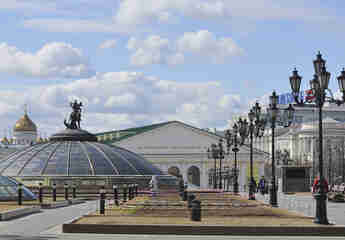
Today, Manezhnaya Square can be seen as a natural continuation of the green space of Alexander Garden. It took shape in the 1930s, when a large group of buildings near the Manege was demolished to make way for the metro.
In 1967 the square received a new name – 50th Anniversary of October – and a monument marking the Revolution's jubilee was planned here, though the idea was never carried out.
The 1990s brought back the square's historic name and ushered in grand reconstruction works under the direction of Zurab Tsereteli. A huge underground Okhotny Ryad complex opened below, while above it a cascade of fountains with sculptures appeared.
The reconstruction timed to Moscow's 850th anniversary effectively turned Manezhnaya Square into a symbol of the new, modern Russia. In 1995, a monument to Georgy Zhukov was installed in the eastern part of the square.
Top 10 attractions in Moscow: the Kremlin, the Tretyakov Gallery, VDNKh...

Flickr, rm996s
The memorial honoring Soviet soldiers who fell in the struggle for victory over Nazi Germany appeared by the Kremlin walls in Alexander Garden in 1966, marking the 25th anniversary of the defense of Moscow. The ashes of an unknown soldier, taken from a mass grave, were buried here.
A year later, the famous architectural ensemble of the Tomb of the Unknown Soldier was unveiled here. The Eternal Flame was lit from the flame at the Field of Mars in Leningrad. Leonid Brezhnev ceremonially lit it after receiving the torch from Hero of the Soviet Union Alexey Maresyev.
Russia's main guard post stands at the Tomb of the Unknown Soldier, known as the Honor Guard or simply Post No. 1. The sentries of the Presidential Regiment change once every hour. They used to guard Lenin's Mausoleum, but in 1997 the post was moved to the memorial by presidential decree.
The memorial's architectural composition is strikingly simple – a battle banner laid down, with a soldier's helmet and a laurel branch upon it. This simplicity and restraint create the strongest emotions, reminding visitors of the sacrifice of Soviet soldiers who gave their lives for peace and their homeland. Beside the Eternal Flame you can read the words: “Your name is unknown, your deed is immortal.”
See also other Moscow guides:

Flickr, thisisbossi
The monument to Marshal of the Soviet Union Georgy Zhukov was originally supposed to stand right on Red Square. That proved impossible, however: the architectural ensemble of Red Square is a UNESCO World Heritage site, and no alterations may be made to it.
So in 1995 the monument to the great Soviet commander was installed on Manezhnaya Square instead. Its creators managed to make it both realistic and deeply symbolic. Experts note the strong portrait likeness and the sculpture's distinctly forceful character.
The monument depicts a specific moment from the Victory Parade held on Red Square on June 22, 1945. Georgy Konstantinovich Zhukov is shown on horseback, rising in the stirrups with his right hand raised. The horse tramples defeated Nazi banners and standards beneath its hooves.
Some critics also believe the monument is not ideally placed, as it gets somewhat lost in the shadow of the History Museum wall.
By the way, the area around Manezhnaya Square and Red Square is home to almost all of Moscow's most expensive and glamorous hotels. Of course, you can stay there during your visit to the capital, but there are also plenty of more affordable and no less interesting options. The easiest way to find a good hotel is on Booking.com, where more than 1,200 places to stay in Moscow are listed.

Flickr, FinsUp0531
Between Manezhnaya Square and Red Square, very close to Resurrection Gate, one of Moscow's sights lies quietly underfoot. At first you may not even notice that the Zero Kilometer marker – from which all the roads of vast Russia are measured – is right beneath your feet.
In fact, the “real” zero kilometer is located near the Central Telegraph building, but documentary precision is not especially important for a symbolic marker.
The Zero Kilometer marker appeared here as a physical landmark in 1995. Created by well-known Moscow sculptor Alexander Rukavishnikov, it is a round metal plaque set into the paving stones and inscribed “Zero Kilometer of the Highways of the Russian Federation.”
Notice that it refers specifically to highways, because there is also a railway Zero Kilometer – it is located on the platform of Yaroslavsky Station.
Four more elements of the composition surround the marker, together forming a square whose corners point toward the four cardinal directions. It features relief images of animals associated with different continents. According to the sculptor's idea, the circle symbolizes harmony, while the square represents paradise.
Tourists rarely dwell on the deeper meaning of the monument, but they happily stand on the plaque and toss a coin over their shoulder in the hope that a wish will come true.

Flickr, Bart's Dad
In the first half of the sixteenth century, a red-brick wall more than two and a half kilometers long was built around Moscow's Kitay-Gorod district. The purpose of this massive fortification was to protect the city from Crimean Tatar raids.
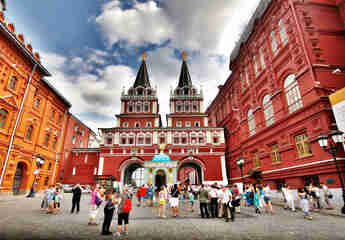
What survives today from the Kitay-Gorod wall is the double-arched Resurrection Gate, which you can see between the History Museum and the State Duma.
Installed in 1535, the gate went by several names over the centuries: first Kuretny, then Neglimensky, and later Lion Gate, because of Ivan the Terrible's menagerie nearby. In 1680, a chamber with two octagonal tent-roofed twin towers was built above the passage.
After an icon of the Resurrection of Christ was placed on the tower in 1689, the name Resurrection Gate came into use. In 1781 the gates also became known as Iversky after the Iver Chapel was added beside them, first in wood and later in stone.
From 1929 to 1931 both the chapel and the gate were demolished, but in the mid-1990s they were rebuilt in their classic form.

moscowviews.ru
It is impossible to imagine the architectural ensemble of central Moscow without the building of the State Historical Museum. Although by historical standards it was built relatively recently – at the end of the nineteenth century – it has long since become one of the calling cards of the Russian capital and a very popular sight.
The museum's story began during the Polytechnic Exhibition of 1872, when several displays – specifically those devoted to the Crimean War – became its first collection. Construction of the new museum building lasted from 1875 to 1881, while the interior decoration of some halls was not completed until the 1910s.
Today, the History Museum offers a magnificent collection of around 22,000 objects. On a visit here, the whole history of Russia – from ancient times to the twenty-first century – unfolds before your eyes. Excellent technical presentation and clear navigation make it easy to explore the museum's 4,000 square meters of exhibition halls.
The fascinating journey begins on the second floor, where you learn about prehistoric societies that once lived on Russian lands, then about Ancient Rus, wars against external and internal enemies, and old cultural traditions. One floor up, you move into the era of Peter the Great and then onward into later periods – all the way to the present day.

Flickr, kukkaibkk
Kazan Cathedral, which adorns Red Square, is one of the most revered Orthodox churches in Russia. It was built in the seventeenth century at the expense of Prince Dmitry Pozharsky and commemorates the liberation of Russian lands from Polish-Lithuanian invaders in 1612.
The cathedral's main shrine is the miracle-working Kazan Icon of the Mother of God, discovered in 1579 and first transferred to the Dormition Cathedral and later to the newly built Kazan Cathedral.
The cathedral building was rebuilt several times at the command of different rulers. Its darkest moment came in 1936, when it was simply demolished to the ground.
Kazan Cathedral was the first of Moscow's lost religious buildings to be restored. The church was rebuilt between 1990 and 1993 mostly with funding from the city government and private donations. The interior wall paintings were created by masters from Palekh and Bryansk.
The appearance of Kazan Cathedral is bright and cheerful. It is crowned by a single dome surrounded by layers of decorative kokoshniks at different levels. The complex architectural composition is executed with impeccable stylistic balance, which makes the cathedral look harmonious and compact.
Beside it stands a tent-roofed bell tower, another fine example of Russian church architecture.

Flickr, ruimsmcarvalho
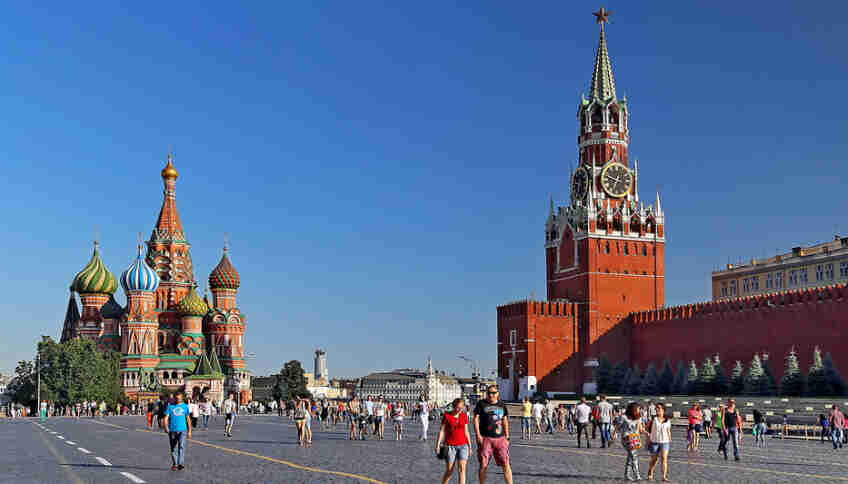
The soul and heart of Moscow is Red Square. This place has witnessed the most fateful events in the country's history: royal decrees were read aloud from Lobnoye Mesto, troops marched out to war through the Spassky Gates, and rulers emerged from the Kremlin here to address the people.
Yet it all began rather prosaically – as a market square laid out beyond the Kremlin walls in the fifteenth century. For several centuries trade thrived here: stone arcades were built for wealthier merchants, while ordinary people sold their goods out in the open air. Great fairs and lively folk festivities were held here as well.
The look and character of the square began to change in 1625, when a Gothic tower was built above the Spassky Gate and transformed the space. The area between the new Spasskaya Tower, St. Basil's Cathedral, and Lobnoye Mesto was so beautiful that people began calling it “red,” meaning “beautiful.” Later the name spread to the entire open space not occupied by the trading rows, and in 1661 Tsar Alexei Mikhailovich officially gave the square the name Red.
Red Square truly is one of the most beautiful squares in the world. Its buildings glow in shades of crimson and are richly decorated in the style of old Russian ornament. Fairytale-like St. Basil's Cathedral resembles a gingerbread palace, while the Kremlin towers and the History Museum, for all their grandeur, look charming – like illustrations from a brightly colored book about an ideal world.

Flickr, Pola Damonte
Moscow's Main Department Store is not just a shopping center where you can buy almost anything. GUM is a true legend.
Everyone born in the USSR knew about this store, even if they lived thousands of kilometers away. In times of shortage, people arriving in the capital headed to GUM first – if not to buy something, then at least to look around.
The current GUM building was erected in 1893 on the site of the outdated Upper Trading Rows. The Moscow merchants' guild announced a competition, which architect Alexander Pomerantsev won with a design in a pseudo-Russian style that harmonized with the other buildings on Red Square. Its decorative details and little towers blend beautifully with the architecture of Moscow's ancient center.
Built with guild money, this grand store remained a point of pride for Russia's merchant class until 1917, when the merchants were driven out, their goods were nationalized, and Soviet offices, agencies, and communal apartments took over the shop spaces until the 1960s. GUM was even slated for demolition, but the war prevented it, and afterward the decision was made to preserve and revive the building.
Today GUM is filled with modern boutiques, yet echoes of the time when it was the USSR's main store still remain: you can hear Soviet hits here, and Gastronom No. 1 still sells classic tea with an elephant on the package and juice in three-liter jars.

Flickr, KanalReise
The resting place of the leader of the world proletariat has become an inseparable part of Red Square's architectural ensemble. The embalmed body of Vladimir Ilyich Lenin lies in a tomb clad in granite, marble, and porphyry that resembles a truncated three-stepped pyramid.
Lenin's first mausoleum was made of wood to a design by Alexey Shchusev and was built in great haste for the leader's funeral. The present mausoleum is actually the third version of the structure, which took shape after World War II.
During the war Lenin's body was moved to Tyumen to protect it from attack and destruction. In 1945 it was returned to the capital, and the mausoleum was updated with tribunes from which the country's leaders delivered many momentous speeches.
Lenin's Mausoleum has repeatedly been targeted by vandalism, and even the honor guard that stood at the entrance until 1993 could not prevent it. Since 1973 Lenin's body has been kept in a bulletproof sarcophagus, and visitors must pass through a metal detector and leave all belongings, including cameras, at the entrance.

Flickr, Olga NZ
The main tower among the twenty towers of the Moscow Kremlin – Spasskaya Tower – is one of the most recognizable symbols of Moscow and of Russia as a whole. For many people across the former USSR, it also symbolizes New Year's Eve, as for decades everyone waited for its chimes on the festive night.
The tower was built in 1491 and was originally half its current height. In 1514, a gate icon of the Savior was installed in honor of the capture of Smolensk, and it soon came to be regarded as miraculous.
From then on, the gates of Spasskaya Tower were revered as sacred. People could pass through them only on foot, men had to remove their hats, and everyone was expected to bow when passing the icon. Even grand princes, tsars, foreigners, and people of other faiths observed this custom, while anyone who broke it had to make fifty bows to the icon as punishment.
The tower acquired its present majestic appearance in 1625, when the English architect Christopher Galloway designed its multi-tiered Gothic-style tent roof. A clock was installed inside the stone upper structure and later replaced several times.
The chimes that mark Moscow time today were installed in 1852. Their melodies, incidentally, were changed even more often – usually to suit the tastes of the rulers of the day.
Above the clock, a scarlet star has glowed on the slender spire for 77 years, replacing the gilded double-headed eagle that adorned the tower from the seventeenth century until 1935.

Flickr, Volodymyr Osypov
The monument to Minin and Pozharsky on Red Square was ceremonially unveiled in 1818 in the presence of Alexander I and a large crowd. It immortalized the feat of two Russian national heroes who played a decisive role in the 1612 victory over the Polish-Lithuanian occupiers.
The sculptural composition by Ivan Martos depicts Kuzma Minin appealing to the wounded Dmitry Pozharsky to lead the Russian forces in defense of the homeland. With one hand, Minin seems to point toward the Kremlin, which is under threat of foreign invasion. The monument is vivid and distinctive: the sculptor worked within the framework of classicism but did not abandon national motifs.
During the Soviet period, the monument to Minin and Pozharsky survived despite the threat of demolition – it was considered an obstacle to festive demonstrations and parades. In 1931 it was moved closer to St. Basil's Cathedral, where it still stands today, which means Minin now points not toward the Kremlin but somewhere in the direction of GUM.

Panoramio, Kirill Vyacheslavovich
Perhaps the most recognizable architectural landmark in Moscow after the Kremlin's Spasskaya Tower is St. Basil's Cathedral, also known as the Cathedral of the Intercession of the Most Holy Theotokos on the Moat.
It is a symbol not only of Moscow but of nearly all Russia. As part of the Red Square ensemble, the cathedral has been on the UNESCO World Heritage List since 1990.
The cathedral's architecture is wonderfully expressive: the composition consists of several churches crowned with vividly painted domes set at different heights.
The cathedral was built from 1555 to 1561 by order of Ivan the Terrible to commemorate the victory over the powerful Kazan Khanate, which is why each altar was dedicated to a feast day that coincided with one of the major battles. Kazan fell on the Feast of the Intercession of the Mother of God – and that is how the cathedral received its original name.
The chapel of St. Basil was added much later, in 1588. It received the relics of the local holy fool Basil, who died in the 1550s and was said to be feared even by Ivan the Terrible himself. Since then, the cathedral has also been dedicated in St. Basil's name.
When the Soviet authorities came to power, the cathedral was not demolished – it was simply too beautiful and unique. For a long time it functioned as a museum. In 1991 it returned to the Russian Orthodox Church, and services are held here once again today.
Tip! This is where our Red Square tour comes to an end. We have told you about Moscow's most popular sights, but the city has plenty more interesting places to discover. Many of them are marked on the Ever.Travel interactive map. Pick where you would like to go next, build your routes, and sync your plans with our free mobile app. Happy walking!
See also other Moscow guides and routes: