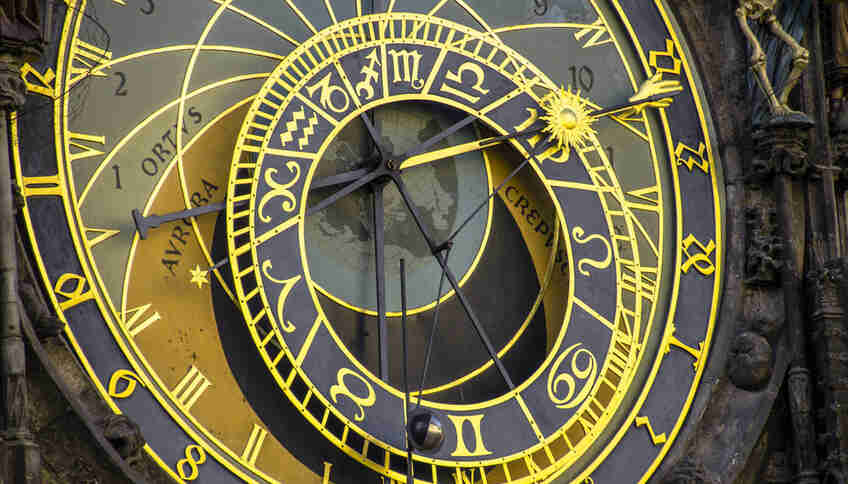

The Prague astronomical clock - one of the city's great medieval showpieces. It tracks several kinds of time, along with the movement of the Sun, Moon, and zodiac signs.
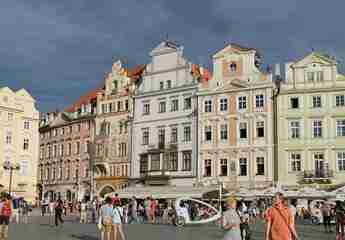
Updated for 2026: Old Town Square is as busy as ever, especially right before the hourly show. Arrive a few minutes early for a better view, and pay attention to the details around the dial - that is where the Orloj really rewards a closer look.
At a glance, the clock has three main parts. The upper section holds the figures of the apostles, who appear in the windows on the left and right. Each carries an object linked to Christian tradition. Peter holds the key to the Kingdom of Heaven, while Andrew appears with a cross. Between the windows stands an angel - God's messenger. Here, the angel also serves as a guardian against evil. It is one of the oldest figures on the Orloj. Above the angel is another protective symbol: a rooster. It greets the first light of day and, in traditional belief, drives dark forces away with its crowing. It was added later than the other figures, but it occupies the highest point of the ensemble.
Trying to read all this while standing under the clock and matching each detail to the dials is not exactly easy. That's why we created a mobile audio guide to Prague! Press play and hear the story of the Orloj, along with dozens of other sights in the Czech capital.
The middle section of the Prague Orloj is the astronomical dial. Earth sits at the center, surrounded by the Zodiac Ring, which shows the Sun's place in the zodiac. Around it are the scales and markings that let you read the clock in several different ways. The gilded hand with the sun tracks the Sun, while the darker hand with the sphere marks the Moon.
Another hand on the astronomical dial shows Old Czech time. In that system, the day began at nightfall rather than at midnight. Roman numerals mark Central European time, while Arabic numerals indicate the daylight hours.
The outer ring around the dial is decorated with animal figures, including a lion, dog, and cat. They were believed to protect the clock, which stood exposed on the outside of the tower and was therefore thought to be vulnerable to supernatural forces. There are imaginary creatures here too, including serpent-like beasts and mascarons - grimacing masks meant to frighten evil away.
On either side of the middle section are figures whose meaning is still interpreted in different ways. The man with the mirror is sometimes read as a symbol of vanity, sometimes as a magician, and sometimes as someone defending himself against a basilisk. Nearby are a skeleton with an hourglass, a figure with a money bag, and a Turk.
The lower dial is the calendar dial. It shows the months and days. On either side stand symbolic figures of a philosopher, the Archangel Michael, an astronomer, and a chronicler.