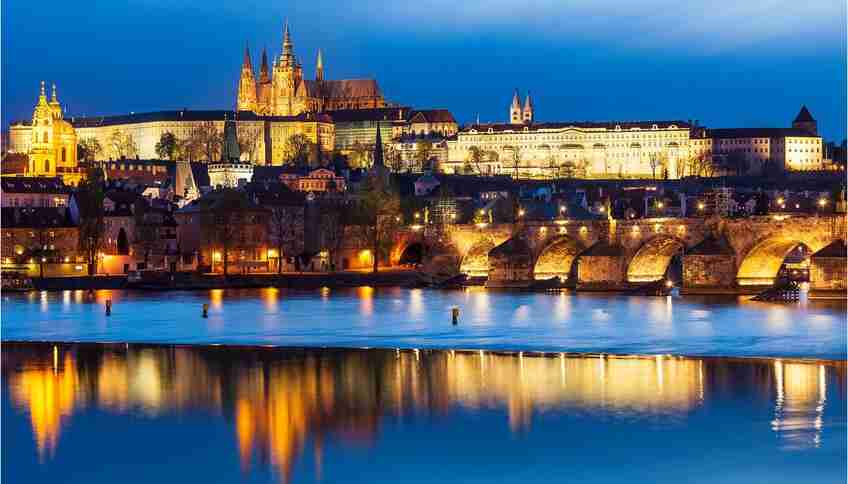

One of the oldest and largest fortresses in the world is located in the capital of the Czech Republic. This is Prague Castle.
Its history begins in the 9th century and is inseparably linked with the emergence of Prague itself. In those distant times, according to archaeologists, there were not one but two fortresses located on opposite banks of the river. One of them was called Grad, and the other Vysehrad. But centuries later, Vysehrad fell into decline, and now the National Cemetery is located there. And Prague Castle is still the most visited place in the Czech Republic. Many architectural monuments, artistic masterpieces, and historical treasures have been preserved here, which are a must-see when in Prague.
For many centuries, the ancient fortress served as a royal residence and still remains the president's office. Early in the morning, he comes here and calmly walks past the first, still sleepy, tourists. Many do not even realize that this is the head of state — no pomp and no long motorcades.
At the entrance to Prague Castle there are guards — this is a special guards unit. Hundreds of onlookers gather every day to watch the changing of the ceremonial guard. And those who miss the solemn spectacle try to make up for it with photos of the guards on duty. Passing through the central gate, visitors find themselves in the first courtyard. There they are greeted by the Theresian Palace — строгий и лаконичный, built in the spirit of classicism. Then, through the Matthias Gate, you can reach the second courtyard, where the Chapel of the Holy Cross is located. This chapel is a true treasury, where you can see the authentic relics of King Charles, as well as all the regalia necessary for the coronation.
But the main attraction of the Prague fortress is the St. Vitus Cathedral. It is located in the third courtyard. Its construction began in the 14th century and was completed only in the 20th century. Inside the church, it takes your breath away — the size of the Cathedral is truly impressive. When the first impression settles, you can begin to examine the details: magnificent stained-glass windows, ancient frescoes, sculptural tombs of kings, and much more. Visitors also have the opportunity to climb to the top of the Cathedral's main tower, but to do this they will have to overcome 287 steps.
From April to October, the Royal Garden is open to visitors, where you can see valuable tree species such as plane tree, sycamore, hornbeam, and beech. In addition, various ornamental plants and flowers are grown here. The Summer Palace, built in the 16th century for Queen Anne, is also located here, and next to it is the bronze “Singing” Fountain.