
All the sights of Prague are shrouded in legends and mystical stories. Charles Bridge is no exception.
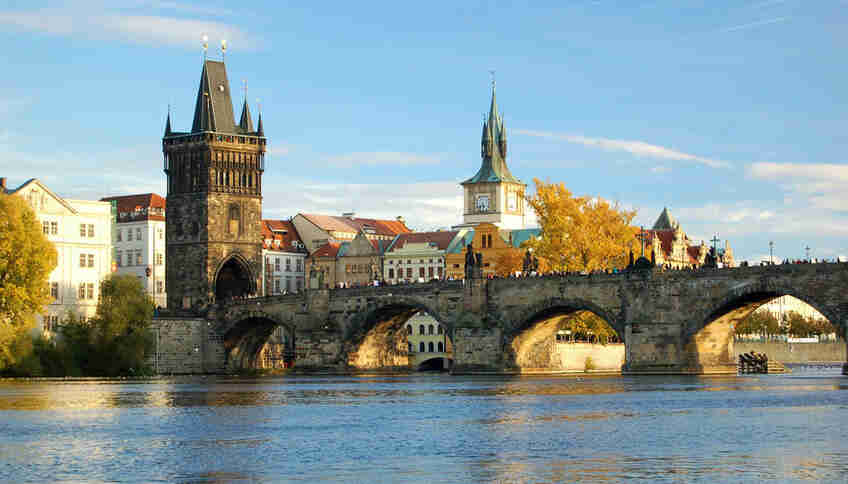
It was built back in the Middle Ages to connect the city's historic districts: Mala Strana and Stare Mesto. The Royal Road ran across this bridge, and it was this bridge that allowed the Hussites to cross into Mala Strana in 1420.
Charles Bridge was built for more than 100 years, beginning in 1357. Before it, another bridge stood on this site - Judith Bridge, but in 1342 it was badly damaged by flooding. And since a crossing over the river was urgently needed, construction of a new one began.
Charles Bridge became much wider than its predecessor - 9.5 m, and its length was 520 m. Powerful arches faced with sandstone blocks were used as supports. By the way, the bridge was first called the Prague Bridge, but in the 19th century it was decided to rename it Charles Bridge to immortalize the name of Charles IV, who ordered it to be built.
The bridge is adorned with thirty sculptures, mostly on religious themes. Most of them are exact copies, while the originals are kept in the National Museum. The most beautiful sculptural composition is considered to be Matthias Braun's work “The Vision of Saint Luitgard.” And the most popular with tourists is Jan Brokoff's sculpture depicting a Turk guarding Christians taken prisoner. “The Crucifixion” is the oldest sculpture; it bears an inscription in ancient Hebrew containing the Tetragrammaton - the unpronounceable Name of the Lord, consisting of four letters.
There is a beautiful legend that the first stone of Charles Bridge was laid in 1357 on the 9th day of the 7th month at 5:31 a.m. If you arrange all the numbers in a row, you get 135797531 - that is, first the digits increase and then decrease. The date and time were meticulously calculated by the Czech historian and astronomer Zdenek Horsky. He was sure that this would help the bridge stand for centuries. In essence, his words are hard to refute now. More than 600 years have passed, and the bridge still stands today.
According to another legend, the Czech saint Jan Nepomuk was thrown from Charles Bridge into the Vltava. They say that when the sack with his body fell into the water, five stars appeared above it, which later began to be depicted on all icons bearing the saint's likeness. On the bridge itself there is a place where a cross and two copper nails are embedded in the railing - this is the marker by which you can understand exactly where Jan Nepomuk was thrown from.
There is also a belief that lovers who kiss on Charles Bridge can make any wish, and it is sure to come true. Just like the thoughts that will be in your head when you touch any of the bridge's sculptures. A beautiful belief, isn't it?