Rembrandt House Museum

Flickr, spinphase
Before we begin our bike ride, we'd like to remind you that this route is part of our mobile app – the Travel Planner for iPhone and Android. After downloading it, you can use not only this tour, offline maps, and GPS, but also plan your entire trip to Amsterdam. Let's get started!
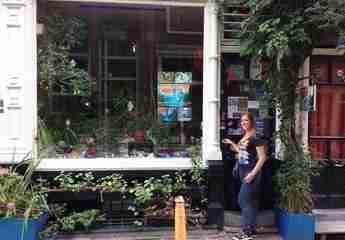
We begin our route at the Rembrandt House Museum. Surely it would be almost unforgivable to visit Amsterdam and not stop here. In this house on Jodenbreestraat, the great painter spent 17 years creating his immortal masterpieces. He sold the house and its contents in 1656 after running into financial trouble. In 1911, it was decided to restore Rembrandt's original home to the way it once looked. That was possible in part because meticulous Dutch archivists had preserved, since the 17th century, the detailed inventory drawn up by a notary when the building was sold.
The heart of the Rembrandt House Museum collection is the artist's print collection – the most complete one known today. It houses 260 of the 290 surviving etchings. Seeing these works up close is a wonderful way to appreciate Rembrandt's mastery.
Beyond the artworks, the museum is treasured for its atmosphere. The interiors have been recreated as they were when the house was Rembrandt's own home. You can even visit the holy of holies – the studio where the master worked wonders with his brush.
Temporary exhibitions connected directly or indirectly with Rembrandt's work are also held here from time to time.
Thank you! Every time you book hotels on Booking.com through our site, you help us describe one more place, create one more route, or develop one more city. We truly appreciate it!
banner booking

Flickr, mikejharrington
The Waterlooplein flea market is located not far from the Red Light District, right by Rembrandt's house. This open-air market, with more than three hundred stalls, is the perfect stop if you decide to hunt for vintage treasures during your visit to Amsterdam. You can find everything here – from worn clothing, old books, military uniforms, DVDs, videotapes, and vintage electronics to truly unusual finds like a hemp-cloth bag, a collection of porcelain dogs, or ice skates with wooden bindings. Prices vary, but overall they are quite reasonable.
There are always plenty of tourists here, which also means pickpockets and scammers, so keep an eye on your belongings. Besides casual sightseers and curious visitors, the Waterlooplein flea market also draws local eccentrics and fashion lovers, serious collectors, and theater artists – the things sold here appeal to just about everyone.
And now we continue to the next stop on our Amsterdam walk – the Blue Bridge.
The Blue Bridge, or Blauwbrug

Flickr, copetan
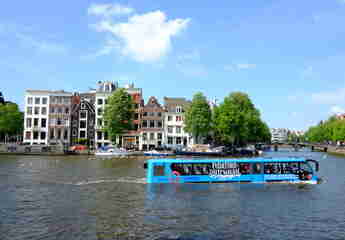
Who would have thought that a bridge with the rather boring number “236” would hide such a story? At first glance it may seem like just another crossing over the Amstel, of which Amsterdam has many. But this bridge has more than a number – it also has a name, the Blue Bridge. The nickname was inherited from an earlier bridge built here at the start of the 17th century. It was called blue for the simple reason that it was painted in one of the colors of the Dutch national flag – blue, of course.
The old bridge was wooden, while the new one was built of stone. It was constructed in 1883 to a design by Bastiaan de Greef and Willem Springer. The two architects had a fondness for Parisian architecture, especially the bridges spanning the Seine, so a little piece of France appeared in the capital of the Netherlands. The bridge turned out stately and elegant, with three passages for small boats, lamp posts shaped like columns topped with crowns of the Austrian Empire, supports resembling stone ship prows, and many other rich decorative details.
Technically, the Blue Bridge is still fully functional and reliable, and it should keep delighting visitors with its beautiful appearance for a long time. Traffic crosses it, including trams. Once you have crossed this historic bridge, you will find yourself going from Waterlooplein to Rembrandtplein – or the other way around, depending on your route.
Other routes and walks around the city, or what else to see in Amsterdam:
Hermitage Amsterdam

Flickr, Tanzeus
In Amsterdam you can, of course, visit plenty of exhibition halls and museums – this city is famous for its artistic traditions. But what about the Hermitage? Amsterdam has one too. It is directly connected to the world-famous Russian art museum of the same name in St. Petersburg, as it is one of its branches. Its name is simple and clear – Hermitage Amsterdam.
The museum stands on the banks of the Amstel in a historic 1681 building known as the Amstelhof. It is even possible that Peter the Great once passed through these parts while visiting the Netherlands to study shipbuilding and navigation. In any case, the building, originally constructed as a retirement home, was converted into a museum between 2007 and 2009, and its elderly residents moved to a newer, more comfortable home.
Hermitage Amsterdam officially opened to visitors in the summer of 2009 with Dmitry Medvedev and Queen Beatrix taking part in the ceremony.
The museum's spacious, bright, and beautifully equipped halls regularly host themed temporary exhibitions that attract both visitors and Amsterdam locals. Until September 2014, for example, there was an exhibition called “Russia Before Peter the Great,” followed by shows such as “250 Years of the Hermitage,” “Tsar Alexander I and Napoleon,” and others.
For fans of self-guided routes, here is our travel planner for iPhone and Android. Create your own routes or choose ready-made ones, with offline maps, GPS, and everything completely free.
Magere Brug

Flickr, wally nelemans
Amsterdam is a city of canals, so the sheer number and variety of its bridges should come as no surprise. You could explore Amsterdam's bridges for ages, but some stand out thanks to their historical importance and distinctive appearance.
One of the most interesting bridges across the Amstel stands in the city center, linking Kerkstraat and Nieuwe Kerkstraat. It is called Magere Brug and is considered by many to be one of the most beautiful bridges in Amsterdam. It was built in 1934 to a design by architect Piet Kramer. The first bridge here appeared in 1691 and was officially named Kerkstraatbrug, but because of its narrow proportions it picked up the nickname Magere Brug – the Skinny Bridge – and that name has survived to this day.
The first bridge was wooden and had 13 spans. In 1871 it was replaced by a 9-span structure, also made of wood. Then in 1934 the graceful white bridge we see today was built. Over the decades it has been renovated a couple of times, including in 1994, when an automatic system was installed to open the central section for passing boats.
One of Magere Brug's most charming features is its illumination. It is decorated with 1,800 lights that glow in the evening and give the whole neighborhood a festive mood.
On Victory in Europe Day, celebrated on May 8, the bridge becomes the venue for a concert traditionally attended by Queen Beatrix of the Netherlands.
Magere Brug is also something of a movie star and appears in films quite often. Its most famous role is in the James Bond film “Diamonds Are Forever.”

Flickr, peterpj
In Amsterdam's quiet center, near Keizersgracht, a charming canal-side house museum awaits. Built in 1672, it belongs to the Van Loon family, descendants of the founders of the Dutch East India Company.
Rembrandt's student, the painter Ferdinand Bol, once lived here, and the house later passed into the possession of the Van Loon family. For a time, Thora van Loon-Egidius, lady-in-waiting to Queen Wilhelmina of the Netherlands, also lived here. Each resident left behind artworks and interior pieces that later became part of the museum's collection.
The architecture is typical of a classic Dutch canal house. At the top of the facade you can see four figures – Mars, Minerva, Vulcan, and Ceres – symbolizing war, justice, fire, and fertility, the four sources of the family's prosperity.
There is plenty to see in the museum, although the collection is quite eclectic because it was assembled by different owners over several centuries. Look out for antique furniture, porcelain, silverware, valuable figurines, and family paintings. Behind the museum lies a wonderful garden that feels like a direct step from the street into the 17th century.
Interestingly, descendants of the aristocratic Van Loon family still live in the building, so some parts of the house are closed to visitors. As you walk through the rooms, you might even unexpectedly run into members of the family.
banner booking

Flickr, JCBphoto
Not far from Rembrandtplein, on the bank of a quiet Amsterdam canal, stands an impressive house museum. It was built in 1678 for the newlyweds Albert Geelvinck, from an old and noble seafaring family, and Sara Hinlopen, whose family was famous for trading in goods from exotic lands.
As part of her dowry, Sara brought many curiosities collected by her family, who stood at the origins of the Dutch East India Company. Among those valuables were paintings by Rembrandt and Gabriel Metsu, inherited from her father.
The refined approach to interior design and landscaping was continued by Albert and Sara's descendants, and thanks to this family's love of decorating their home, visitors today can see examples of the mansion's interiors from different eras along with genuine antiques and household items from past centuries.
The Blue Room is decorated in the Louis XVI style and adorned with five panels painted by Egbert van Drielst.
The Red Room reflects the neo-Rococo style, with its high ceiling and mirrors providing a perfect frame for six 17th-century paintings.
In the hall you will find a tapestry woven in Brussels in 1600 depicting the confrontation between Kings Croesus and Cyrus II.
The Chinese Room features eight wall panels with fantastical birds and flowers painted on canvas in the chinoiserie style, dating from the late 18th century.
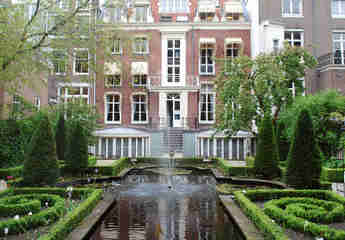
And of course, do not miss a stroll through the delightful Renaissance-style garden with its ponds and fountains, cozy benches, and splendid roses of unique varieties.
What Else to See in Amsterdam:

Flickr, clareandben
Back at the start of the 20th century, this neighborhood was popularly known as the “Devil's Corner.” Very poor residents lived here, and the buildings looked more like half-ruined shacks. Today, this is where you will find Amsterdam's most famous cinema, Tuschinski Theatre, built between 1918 and 1921 by the Polish Jewish entrepreneur Abraham Icek Tuschinski. Incidentally, the surname “Tuschinski” is pronounced with the stress on the “i.”
Abraham fled the pogroms as early as 1904 and settled in Rotterdam, where he built his fortune after starting out as a tailor. His business grew, and in time Tuschinski bought a hotel for Jewish migrants heading to America. Later, together with partners, he became the owner of four cinemas in Rotterdam.
All that time, he never gave up his dream of building his own cinema – an “oasis of luxury and pleasure” that ordinary people could also enjoy. He found the right place here, in the “Devil's Corner,” right in the city center and at an affordable price.
The cinema opened in 1921 and immediately caused outrage among some locals. Many considered the extravagant facade tasteless, and the two towers decorating it were seen as spoiling the cityscape. For anyone interested in architecture, the theater was built in the Art Deco style with Art Nouveau elements.
At the time, the building was not only the most “luxurious” in the city in terms of design and interior decoration, but also a marvel of modern engineering: its power supply, heating, and ventilation systems kept the temperature steady throughout the building. The owner paid an astonishing sum for those days – four million guilders – to build the cinema.
Marble, expensive woods, bronze, copper, silk, woven carpets… Every hall and every foyer had its own style. The cinema was also unique for its organ, which could imitate all kinds of sounds for silent films, including car horns, sirens, and rain.
Rumor had it that during World War II the cinema was confiscated by the German occupiers and renamed “Tivoli.” During the war, only German films were shown here. Abraham and his family were deported in 1942 to a Dutch concentration camp and then to Auschwitz, where he died at the age of 55.
After the war, Marlene Dietrich, Edith Piaf, and Judy Garland performed here. In 2002, the theater was restored with the aim of bringing back its original interiors and exterior.
Munttoren

Flickr, François Collard
Not far from Dam Square in Amsterdam you can see a tall and elegant tower that seems to be made of two different halves. This is the Munttoren, and its mixed architectural look comes from the fact that it was rebuilt, or more precisely, extended upward with a new section. Originally, from the 15th to the 17th century, the tower served as a guard structure and formed part of the medieval wall with a gate known as Regulierspoort.
A fire in 1618 destroyed almost all of the fortifications, but the tower survived in part. Restored in 1619-1620, it acquired Renaissance features thanks to architect Hendrick de Keyser. An elegant spire and a clock with four faces were added. The tower received its current name, the Mint Tower, because coins were struck here for some time. Today, money is made here in a different way – by selling beautiful and original Delftware.
The tower's main attraction, besides the building itself, is the carillon created by Pieter Hemony and installed in 1668. Some of its bells were originally intended for the Amsterdam Stock Exchange tower, but plans changed and they found a new home here.
The bells ring every fifteen minutes. On Saturdays, from 2 to 3 p.m., Amsterdam carillonneur Gideon Bodden gives concerts on this unusual instrument.
Floating Flower Market

Flickr, Guilleont
In the capital of the land of tulips, a visit to the flower market is a must – afterward you will be able to rave about how many shades, shapes, and varieties of tulips you saw. The best place to discover the full richness of Dutch floristry is the floating flower market. The first and only flower market on the water lies along the picturesque Singel canal.
The story of tulip trading on Amsterdam's canals goes back to the 17th century, when flower sellers offered their goods straight from boats. The business proved popular, and a special place was set aside for it: at first the market occupied a canal that had once formed part of the city's moat. When that canal was filled in, the floating flower market moved to its current location near Dam Square. It has been moored here since 1862, although today the vendors no longer bob in boats – the stalls are firmly attached to the quay.
Finding the flower market is easy – just follow the wonderful scent that reaches you from blocks away. Thousands of tulips, roses, hydrangeas, and hyacinths fill the air with fragrance and delight the eye. Along with flowers grown in Holland, you will also find unusual exotic plants for sale here.
The floating flower market is also a great place to buy souvenirs. For gardeners and flower lovers, Dutch tulip bulbs make the perfect gift, while those less interested in gardening can pick up magnets, mugs, or traditional wooden clogs.

Flickr, Rafael Chu
While strolling around Amsterdam, be sure to stop at Café 'Luxemburg'. It stands in a lively business district yet feels like a true island of calm and comfort amid the capital's bustle.
Café 'Luxemburg' belongs to the kind of establishment known as a brasserie, a format that originated in France and still feels slightly uncommon to us. A brasserie is a cafe with its own personality. What sets it apart is that the interior, rhythm of service, and especially the menu are kept unchanged for as long as possible, staying faithful to time-tested classics whose main virtues are reliability and simplicity. The menu and daily specials are usually written in chalk on a slate board, which gives the place extra charm.
Another hallmark of a brasserie is the summer terrace or a long bar by the window, where you can ponder the meaning of life over a slice of strudel while watching the hurried flow of pedestrians outside. Classic cafe brasseries have always been a haven for the creative elite – artists, writers, and philosophers.
Café Luxemburg has been welcoming guests for more than a quarter of a century. Here you can try some of the city's best veal and shrimp croquettes, delicious homemade bread, a wide selection of Dutch cheeses, and of course excellent beer, along with fresh newspapers in languages from all over the world.
This cafe has deservedly earned glowing reviews in publications such as the “New York Times,” “Le Figaro,” and “The Independent.”
Spui Square

Flickr, brand_eye
One of Amsterdam's central squares is called Spui, a name that roughly translates as “sluice.” It is a reminder of the time when there really was a small body of water here, which was filled in at the end of the 19th century to create the square.
It is often crowded here, because the University of Amsterdam is nearby – and that naturally means lively crowds of Dutch students. By the way, this university is one of the largest and most respected in Europe. Close by stands the Old Lutheran Church, where new university professors are traditionally welcomed.
Even more people gather here on Fridays, when secondhand book sellers take over the square. On Sundays, local artists set up here instead.
Do not miss the chance to drop in, even briefly, for a cup of coffee at Café Luxemburg, a stylish and popular spot known even beyond the Netherlands.
There are also a couple of other places here where you can grab a bite – they may not be as famous as Café Luxemburg, but they are pleasant in their own way and offer traditional, simple, affordable menus, which is exactly what local students need. One example is the Swiss cafe “Espirit.”
The center of Spui Square is decorated with a statue of a little boy. Not a peeing one like in Brussels – just a boy standing there and smiling at passersby. It is called “The Little Darling” and captures all the carefree fun of Amsterdam.

Flickr, Abariltur
Westerkerk, built in the first half of the 17th century, is the largest church in Amsterdam and probably its most historically significant. Many people even consider the Westerkerk Tower one of the city's symbols.
This church stands not far from the Jordaan district, but on Tuesdays the sound of its 48 bells can be heard far beyond the neighborhood. And it is not just ringing – they play melodies from popular songs, another example of the Dutch ability to approach even ordinary things in an unexpected way. You might even hear a Beatles tune from these bells!
The church is worth visiting at the very least because only inside can you fully appreciate the grandeur of Amsterdam's largest Protestant church. It also houses an organ painted in the 18th century by the Flemish artist Gerard de Lairesse. Thanks to the excellent acoustics, classical music concerts are often held here.
It is here, by the way, that Rembrandt, the famous Dutch painter, was laid to rest. Sadly, the exact location of his grave is unknown – because of his poverty, the artist was buried in an unmarked grave. A memorial was later built to mark Rembrandt's symbolic burial place.
Begijnhof

Flickr, lev.glick
The Begijnhof architectural complex, made up of several idyllic old houses built around a garden, is a peaceful and quiet place that sharply contrasts with the busy streets of central Amsterdam. For many centuries it offered refuge to the beguines – women who lived a way of life close to monasticism, though less strict. The beguine movement existed from the 12th century right up to modern times, and these small communities, also known as beguinages, were once widespread across Belgium and the Netherlands.
Amsterdam's Begijnhof is one of the oldest in Europe. The exact date of its foundation is unknown, though it is thought to date back to the 14th century. Stylistically, the buildings belong to the 17th and 18th centuries, but they were constructed on earlier Gothic frameworks.
You can enter Begijnhof from Kalverstraat or via Spui Square. Step into the courtyard and you are immediately surrounded by an atmosphere of calm and peace.
Look out for house No. 34 – you can recognize it by its strict shape and almost black walls. This wooden house is called Houten Huys, was built in 1420, and is considered the oldest surviving building in Amsterdam today.

Flickr, Nige B
As you stroll through Amsterdam's streets, admiring its unique canals and buildings, you will almost certainly want to learn more about the history of this remarkable city. For example, how it grew from a small fishing village on the Amstel into one of Europe's most important capitals over the course of a few centuries. Amsterdam Museum, located in the city center between Kalverstraat and Nieuwezijds Voorburgwal – streets with their own fascinating past – will help you do exactly that.
The location of the collection is no less remarkable than the exhibits themselves. This history museum first opened in 1926 in the Waag, one of Amsterdam's oldest architectural monuments. Later, in 1975, it moved to a building that had served as an orphanage since 1580 and was remodeled in 1634 by the great Dutch architect Jacob van Campen.
The museum's collection includes more than 70,000 objects and covers Amsterdam's history from the early Middle Ages to the present day. It includes paintings, models, installations, and photographs, with special attention given to archaeological finds.
Although around 25,000 objects can be viewed online, the real impression only comes from seeing the museum's collection in person. After all, no photograph can fully capture the atmosphere of Amsterdam's centuries of history coming alive before your eyes.
See Also Other Guides to Amsterdam: