Central Station

Flickr, Jim Nix / Nomadic Pursuits
Amsterdam Central Station (Dutch: Station Amsterdam Centraal) is the main railway station of the Dutch capital. It was built in 1881—1889 by architect Pierre Cuypers with the participation of Adolf Leonard van Gendt. In 1885, Cuypers also designed the Rijksmuseum building in Amsterdam, which outwardly resembles Central Station. It is the first station in the Netherlands to have been designed by a famous architect. The station separates the city from the port, and many railway tracks were laid through the city. The station has six platforms and 15 railway tracks. Coordinates: 52°22′44.7″ N 4°53′57.33″ E / 52.379083° N 4.899258° E (G) (O)52.379083, 4.899258
Schreierstoren Tower

Flickr, PeterBeresford
Schreierstoren Tower (Dutch: Schreierstoren) is a former defensive tower in Amsterdam. It was built in 1487 and was given the name Schrayershoucktoren (from the word schray - sharp), because the city wall at this point turned at an acute angle. Over time, a legend arose that the tower's name comes from schreien — to cry — and means the "tower of tears," because this was the place where women said goodbye to their husbands leaving on ships of the East India Company. The tower was restored in 1966, and after the restoration it housed a cafe. On the north-eastern wall of the tower, a memorial plaque was installed in September 1927 stating that from here, on April 4, 1609, Henry Hudson set out for America on an expedition commissioned by the East India Company to find a western route to India. The result of the expedition was the description of the Atlantic coast of North America from Newfoundland to New York, the discovery of Manhattan Island, and the river now known as the Hudson.
St. Nicholas Church

Flickr, Jaume CP BCN
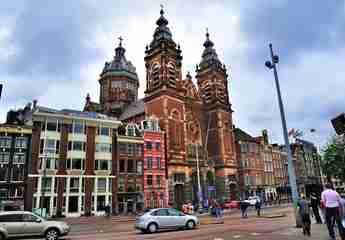
St. Nicholas Church is located in the very center of Amsterdam. According to architect Bleijs's design, it was built from 1885 to 1887. Today it is the largest Roman Catholic church in the capital of the Netherlands.
The architectural appearance of St. Nicholas Church combines the most popular styles of those times — from Neo-Renaissance to Neo-Baroque. The facade of the church is crowned by two towers, with a rose window between them. In the round stained-glass window you can see a bas-relief of Christ and the four Evangelists. In the upper part of the pediment, in a niche, stands a sculpture of St. Nicholas. At the intersection of the two main lines of the church building there is a large octagonal tower with a dome topped by a cross.
Not long ago, St. Nicholas Church was restored. Inside the building there is a functioning 19th-century organ. Concerts with organ accompaniment are sometimes held here.
The church took its name from the hidden Church of St. Nicholas, which the Catholics of Amsterdam, persecuted as enemies of the people, used for their services after independence was proclaimed in the country. To this day, the people of the Netherlands revere St. Nicholas as the patron saint of the capital.
Damrak

Flickr, Suburban_Guard
Damrak (Dutch: Damrak) is a street in central Amsterdam, a former canal filled in in 1845-1883, running between the Central railway station and Dam Square, from north to south.[1] This is the main street by which people get from the railway station to the center of Amsterdam. It is home to cultural centers, many cafes, craft workshops, and museums. At the intersection of Damrak and Rokin Street is the historic Dam Square.[2] Due to the fact that this street is home to the Berlage Exchange building[3], the first stock exchange in Europe, as well as several other buildings associated with financial activity that were erected there at the beginning of the 20th century, the term 'Damrak' became synonymous with the Amsterdam Stock Exchange in the same way that Wall Street is synonymous with the New York Stock Exchange and NASDAQ[4].

Flickr, Abariltur
Berlage Exchange is the most significant architectural structure in the Netherlands from the century before last. This long red-brick building is easy to find if you walk from the central railway station.
The construction of the exchange, designed by architect Hendrik Petrus Berlage, lasted five years — from 1898 to 1903.
It was intended that the building would stand by the Amstel River — on reclaimed land where merchant ships moored. For many years, freight, grain, stock, currency, and commodity exchanges coexisted in this building. The heroes of the Dutch capital also found their home here — at three different corners of Berlage Exchange stand the famous 17th-century conqueror and admiral Jan Pieterszoon Coen, Amsterdam's founder knight Gijsbrecht van Aemstel, and the jurist Hugo Grotius.
In addition, the building delights visitors with Jan Toorop's mosaic paintings in the exchange vestibule and a museum opened on the centenary of the laying of the first stone of Berlage Exchange.

Flickr, elsa11
De Bijenkorf is a chain of 12 department stores located in different cities of the Netherlands. The main shopping center is in the heart of Amsterdam — on Dam Square. This store was founded back in 1870 — at that time it was only an ordinary haberdashery, though trade there was quite brisk. In 1889, the owner of the haberdashery, Simon Goudsmit, passed away, and his wife took the business into her own hands, acquiring neighboring premises to expand it.
The building on Dam Square is built in a slightly pretentious aristocratic style. De Bijenkorf, which, by the way, is translated from Dutch as "the beehive," has 6 floors that you can wander through endlessly without noticing how time flies. The shopping center features a wide variety of luxury clothing, footwear, perfume, and cosmetics brands, and on the fifth floor there is a restaurant with an amazing view of the city.
National Monument

Flickr, wally nelemans
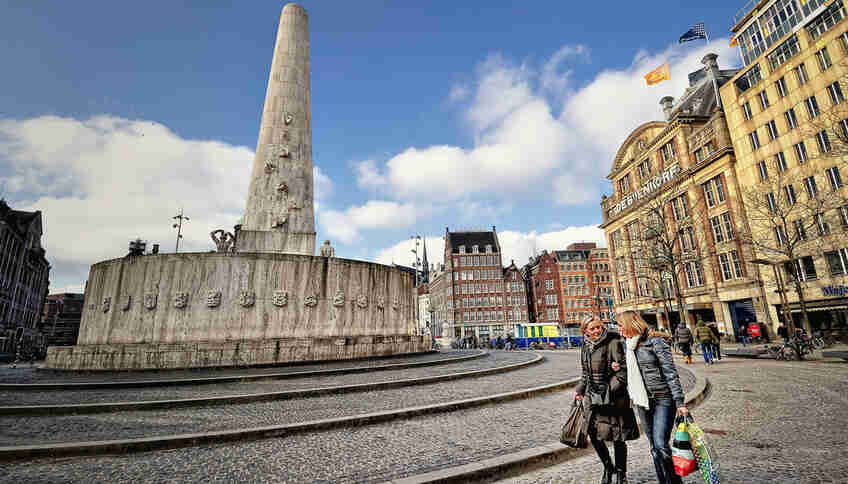
The National Monument (Dutch: Nationaal Monument or Nationaal Monument op de Dam) is a memorial on Dam Square in Amsterdam in memory of the victims of World War II. Every year on May 4, a national ceremony commemorating the victims of World War II and subsequent armed conflicts is held at this monument.[1] The monument was designed by Dutch architect Jacobus Oud, the sculptures were created by John Rädecker and his sons, and the author of the bas-reliefs was sculptor Paul Grégoire. The central element of the monument is a 22 m concrete conical column completely covered in white travertine. On the front side of the column is the bas-relief De Vrede (Peace), consisting of four chained male figures symbolizing suffering during the war. On either side of these central figures are two male sculptures representing the Dutch resistance, on the left — a symbol of the intelligentsia and on the right — a symbol of the working class. The howling dogs at their feet symbolize suffering and loyalty.
Dam Square

AMSTERDAM.DANCE-LOCATION.RU
Dam Square (Dutch: de Dam) is the central square of Amsterdam, the capital of the Netherlands, where famous buildings are located and numerous events are held, making it one of the best-known and most important places in the city. The name of the square, like that of the entire city, is connected with the dam that was built on the Amstel River in the XIII century. The dam was gradually reinforced and eventually became wide enough for a city square to arise, later becoming the center of the city that formed around it. Dam Square was formed from two squares — Middeldam and Platse. Gradually, this area became the center of commercial and political life.
Madame Tussauds Museum

Flickr, Abariltur
Madame Tussauds Museum (Fr. Madame Tussauds) is a wax museum in London's Marylebone district, with branches in 14 cities (as of 2013): Amsterdam, Las Vegas, New York, Los Angeles, Hong Kong, Shanghai, Washington, Vienna, and Berlin. It was founded by sculptor Marie Tussaud. Marie Tussaud (1761—1850), née Grosholtz (Grosholts), was born in Strasbourg; her mother worked as a housekeeper for Dr. Philippe Curtius, who made wax models. He taught Marie Tussaud the art of working with wax. In 1765 she made a wax figure of Marie Jeanne du Barry, the mistress of Louis XV. The first exhibition of Philippe Curtius's wax works took place in 1770 and was very successful. In 1776 the exhibition was held at the Palais-Royal in Paris. The next exhibition on Boulevard du Temple in 1782 became the precursor of the Chamber of Horrors. In 1777 Marie Tussaud created her first wax figure (Voltaire), followed by Jean-Jacques Rousseau and Benjamin Franklin.
Royal Palace

Flickr, Sara Jimeno
The Royal Palace (Dutch: Koninklijk Paleis) is the former Amsterdam city hall, now one of the three palaces in the Netherlands that are at the monarch's disposal. The building was constructed in 1655 according to the design of Jacob van Campen, inspired by Roman architecture (Dutch Classicism). The classical forms and luxurious interiors were intended by the creators to emphasize the grandeur of Amsterdam. The palace is located on Dam Square. For the construction of the palace, a powerful foundation of 13.659 wooden piles was laid, and the walls were erected from yellow sandstone brought from Germany. The three floors are crowned by a dome with a weather vane in the shape of a sea vessel. The interior decoration is made with marble. The central hall measures 36×18 m and has a height of 27,5 m; the hemispheres of the Earth are depicted on the floor. The palace was built during the Golden Age and was used as the city hall until 1808, after which it housed the residence of Louis Bonaparte.
New Church

Flickr, Lars Rollberg
Nieuwe Kerk[1] (Dutch: Nieuwe Kerk, IPA: [ˈniwə ˈkɛrk] — New Church) is a 15th-century Calvinist church in Amsterdam. It is located on Dam Square, next to the Royal Palace. In 1408, the Archbishop of Utrecht granted permission to build a new parish church in Amsterdam because St. Nicholas Church could not accommodate all the faithful. Initially the church was dedicated to Saints Mary and Catherine. In 1421, 1452, and 1645 the church burned in city fires. After 1645 it was rebuilt in the Gothic style. In 1892—1914 the church underwent a major renovation, as a result of which many Neo-Gothic details were added. Another reconstruction of the church took place in 1959—1980. The church was used for royal coronations and inaugurations, most recently during the accession of Queen Beatrix, as well as weddings, most recently during the wedding of Prince Willem-Alexander and Maxima Zorreguieta in 2002.

Flickr, Abariltur
Magna Plaza is one of the best shopping centers in the Netherlands, featuring boutiques of many world brands, as well as designer home goods stores, souvenir shops with national goods, cafes, restaurants, and beauty salons. Fashionistas and shopaholics will be able to indulge themselves in the departments of Mango, Lacoste, America Today, Energie, and other clothing brands. But that is not the main reason why you should visit Magna Plaza Shopping Center.
The reason is that the building that now houses modern shops ranks among the ten most valuable historic buildings in Amsterdam and amazes with the beauty of its many airy turrets, exterior decoration, and interior design.
Built in 1899 to a design by the famous architect Cornelis Hendrik Peters, this palace-like Neo-Gothic structure originally served as the main post office of the Dutch capital. In 1990 it was decided to renovate the building and open a shopping center here. To do this, many walls inside the premises were removed, which made it possible to create an empty space in the center of each floor, surrounded by an elegant balustrade, behind which rows of boutiques are located. In the hall on the 1st floor there is a grand piano that greets Magna Plaza visitors with beautiful music on weekends, and if you lift your head, above the fourth floor you will see a 19th-century glass dome.