Notre-Dame de Paris

Flickr, Moyan_Brenn
The Cathedral of Notre-Dame de Paris (Notre-Dame-de-Paris; fr. Notre Dame de Paris) is a Catholic cathedral in the center of Paris, the geographical and spiritual heart of the French capital, located in the eastern part of the Île de la Cité, on the site of Paris's first Christian church — the Basilica of Saint Stephen, which itself was built on the site of the Gallo-Roman Temple of Jupiter. It was built from 1163 to 1345. The height of the cathedral is 35 m, length — 130 m, width — 48 m, the height of the bell towers — 69 m, the weight of the Emmanuel bell in the eastern tower — 13 tons, and its clapper — 500 kg. The architecture of the cathedral shows a duality of stylistic influences: on the one hand, there are echoes of the Romanesque style of Normandy with its characteristic powerful and dense unity, and on the other hand, innovative architectural achievements of the Gothic style are used, which give the building lightness and create an impression of the simplicity of the vertical structure.
If this is your first time in Paris, know that it is very convenient to see its sights by downloading a mobile audio guide, which will take you through the city's most interesting and significant places: the Eiffel Tower, Notre-Dame de Paris, Montmartre...
Sainte-Chapelle

Flickr, Luxie P.
The Holy Chapel (Sainte-Chapelle) (fr. Sainte Chapelle) is a Gothic reliquary chapel on the grounds of the former Royal Palace (later the Conciergerie) on the Île de la Cité in Paris. It was built by Louis IX in 1242—1248. It has the most complete ensemble of 13th-century stained-glass art and is considered one of the most beautiful small Gothic churches. The chapel was conceived by Louis IX as a place to store sacred relics brought by the crusaders from Constantinople, which had been plundered during the Crusade. Chief among them was the Crown of Thorns stained with the blood of Christ, possession of which was meant to strengthen the influence of the French kingdom in the Christian world. In 1239, Louis acquired the crown, according to some reports, for the enormous sum of 135 thousand livres from the Latin Emperor Baldwin II. More precisely, Baldwin II had pawned the Crown of Thorns to the Venetians, from whom it was redeemed by Louis IX.
Louvre Pyramid

lolapi.ru, Лола Пидлуская
Two hundred years after the French Revolution, President François Mitterrand proposed the Grand Louvre project. Mitterrand wanted to turn the royal palace into the largest museum in the world. His idea also included extending the historical axis of Paris — a nine-kilometer perspective running along the Champs-Élysées. Now the so-called Triumphal Way begins near the Louvre — in the Cour Napoléon by the pyramid and the equestrian statue of Louis XIV, passes through the Arc de Triomphe du Carrousel, the Arc de Triomphe on Place de l'Étoile (Charles de Gaulle), and ends at the Grande Arche in La Défense. After the completion of construction, the pyramid became the main entrance to the Louvre. Around the large pyramid are three smaller pyramids, which serve only as skylights.
Place de la Concorde

Flickr, French Moments
Place de la Concorde (fr. Place de la Concorde) is the central square of Paris and an outstanding monument of urban planning from the age of Classicism. It is the second largest in France (after Place des Quinconces in Bordeaux). Place Louis XV was laid out between the Champs-Élysées (to the west) and the garden of the Tuileries Palace (to the east) by order of the king himself by his chief architect Gabriel in 1755. Originally, it was an octagon surrounded by a moat, at the corners of which stood eight allegorical statues symbolizing the main cities of France. In the middle of the square, an equestrian statue of Louis XV by Bouchardon and Pigalle was installed. On the north side, the elegant buildings of the Naval Ministry and the Hôtel de Crillon were erected. In 1787-90, the Concorde Bridge was built across the Seine, and on the opposite bank it leads to the building of the National Assembly (formerly the Bourbon Palace).
Grand Palais

wikimedia, sanchezn
The Grand Palais (fr. Grand Palais) is a majestic Beaux-Arts architectural structure located to the left of the Champs-Élysées in Paris's 8th arrondissement. It is known as a major cultural and exhibition center. The Great Palace of Fine Arts was erected in Paris in 1897 for the World Exposition held from 15 April to 12 November 1900, on the site of the dismantled Palace of Industry. A building dedicated by the Republic to the glory of French art, as can be read on one of its pediments, was originally intended to host the capital's official cultural events. In 1925, the Grand Palais was one of the venues of the International Exhibition of Modern Decorative and Industrial Arts.
Les Invalides

lolapi.ru, Лола Пидлуская
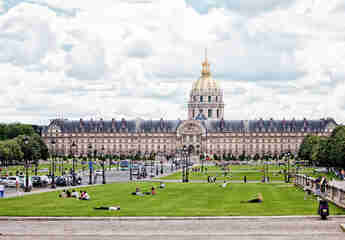
Les Invalides or the National Residence of the Invalids (fr. L'hôtel national des Invalides), or simply the Invalides (Les Invalides), in Paris, is an architectural monument whose construction was begun by order of Louis XIV on 24 February 1670 as a home for distinguished army veterans disabled in war. It was one of the first, if not the first, homes for disabled veterans in Europe. Today it still houses disabled veterans, and it also contains several museums and a military necropolis. In 1670, King Louis XIV of France decided to build an almshouse for wounded and aged soldiers. Supervision of the work in the Paris suburb of Grenelle was entrusted to the court architect Libéral Bruant, who designed five courtyards, the largest of which, in the center, was the royal one. Work was carried out from March 1671 to February 1677, quite rapidly, and the first residents moved in in October 1674.
Eiffel Tower

Flickr, Antonio Torres Ochoa
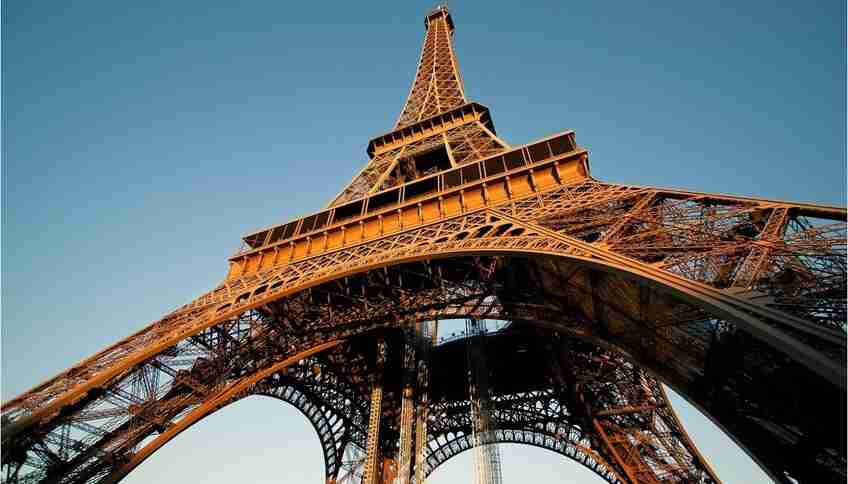
The Eiffel Tower is a metal tower in the center of Paris, its most recognizable architectural landmark; it is also world-famous as a symbol of France. This later symbol of Paris was built in 1889 and was originally conceived as a temporary structure — the tower served as the entrance arch to the Paris World's Fair of 1889. The tower was saved from planned demolition (20 years after the exhibition) by the radio antennas installed at its very top — the era of radio had arrived. It is named after its designer Gustave Eiffel; Eiffel himself called it simply the 300-meter tower (tour de 300 mètres). In 2006, 6 719 200 people visited the tower, and over its entire history, through 31 December 2007, 236 445 812 people. Thus, the tower is the most visited and most photographed attraction in the world.
Palais de Chaillot

Flickr, bobmorton
Palais de Chaillot (fr. Palais de Chaillot) was built according to the design of L. Boileau, J. Carlu, and L. Azéma for the 1937 World Exposition on the site of the former Palais du Trocadéro. Several museums were housed in Palais de Chaillot: the Musée de l'Homme, the Naval Museum, and the Museum of Architecture. Palais de Chaillot is located in Paris's 16th arrondissement opposite the Eiffel Tower (on the opposite bank of the Seine) and consists of two enormous pavilions curving away in both directions. Between the pavilions is an esplanade that offers the best view of the Eiffel Tower. In addition, this is where the Trocadéro garden complex begins, with staircases and the largest fountains in Paris.
Arc de Triomphe

lolapi.ru, Лола Пидлуская
The Arc de Triomphe (fr. arc de triomphe de l’Étoile) is a monument in Paris's 8th arrondissement on Place Charles de Gaulle (Place de l'Étoile), erected in 1806—1836 by the architect Jean Chalgrin on Napoleon's orders to commemorate the victories of his Grande Armée. Executed in the antique style, the Arc de Triomphe has imposing dimensions: height 49.51 m, width 44.82 m, vault height 29.19 m. In the corners above the archway are bas-reliefs by the sculptor Jean-Jacques Pradier depicting winged maidens blowing fanfares — allegories of glory. The arch is adorned with four sculptural groups. Six bas-reliefs on the four sides of the arch depict scenes of the Revolution and the Empire, and are located above the sculptural groups as well as on the sides of the arch. On the walls of the arch are engraved the names of 128 battles won by the republican and imperial armies, as well as the names of 558 French military leaders. In honor of the Hundred Days of Napoleon's rule, the arch is surrounded by 100 granite bollards connected to each other by cast-iron chains.
Champs-Élysées

Flickr, La Pom
The Champs-Élysées (fr. avenue des Champs-Élysées or les Champs-Élysées, or simply les Champs) is one of the main avenues in Paris's 8th arrondissement. The Champs-Élysées stretch from Place de la Concorde to the Arc de Triomphe. Length 1915 m, width 71 m. The name comes from Elysium in Greek mythology. The Champs-Élysées are the beautiful fields of the blessed in the afterlife on the banks of the River Ocean, where heroes loved by the gods arrive at the end of mortal life. On the Islands of the Blessed, eternal spring reigns, and there is neither illness nor suffering.