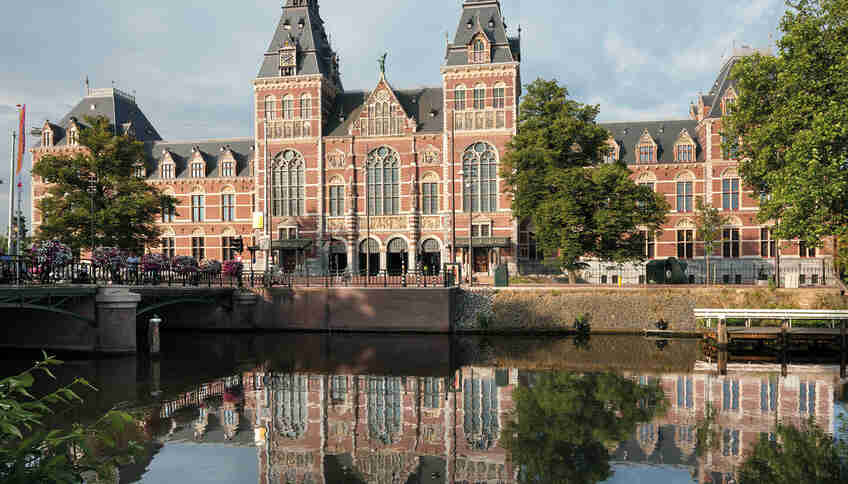
Rijksmuseum

Flickr, Jim Nix / Nomadic Pursuits
The State Museum, Rijksmuseum (Dutch: Rijksmuseum, IPA: [ˈrɛi̯ksmyˌzeːjʏm]) is an art museum in Amsterdam (the Netherlands).The museum was founded in 1808 by Napoleon I's brother, Louis Bonaparte, King of Holland. It opened to the public in 1815. The new building was constructed in 1877—1885 by architect Pierre Cuypers.The museum has an art collection (paintings, sculptures, decorative arts, and Asian art), a historical collection (archaeological artifacts, paintings, sculptures, clothing), and a collection of drawings, prints, and photographs.The core of the art collection consists of numerous works by Dutch masters of the 15th—19th centuries; in particular, famous 17th-century masters are represented, first and foremost Rembrandt, Vermeer, and Hals, as well as de Hooch, Steen, Ruisdael, van der Helst, van Scorel, and others.The main place in the exhibition is given to Rembrandt’s “The Night Watch” (the painting belongs to the city of Amsterdam and is held by the museum on temporary loan).

Flickr, costerdiamonds
The “Coster Diamonds” diamond factory is famous all over the world. Masterpieces of jewelry art are created here, and some of them have long since become legendary. Like, for example, the Kohinoor diamond, belonging to the Crown of the United Kingdom, or the famous Dresden Green Diamond, the treasure of Saxony. Founded in 1840, the factory quite quickly turned from a small workshop into one of the world leaders in diamond cutting.
When you visit, you will be offered a tour of the workshops, where you will be able to see how rough diamonds, with the help of skilled craftsmen, turn into magnificent cut gems worthy of shining in the most expensive jewelry. You will become acquainted with the technologies used for diamond cutting and see samples of products of many different types and sizes. If you wish, you can even buy the jewelry pieces you like. In fact, that is what they are made for!
But be careful: the enchanting sparkle of diamonds is not only mesmerizing, it can also magically and imperceptibly empty even the thickest wallet. It is hard to resist such splendor, but sometimes aesthetic pleasure alone is enough, because diamonds are works of art no less valuable than painting or architecture.

google, shaggyandolive
In Amsterdam, on Museumplein, not far from the State Museum and the Van Gogh Museum, there is another fascinating museum whose collection is every bit as good as those of its illustrious neighbors. This is the Diamond Museum, founded by the famous Dutch company “Coster Diamonds,” which has been processing diamonds since 1840.
The museum building is a beautiful large villa, which is exactly what one would expect from an exhibition associated with brilliance and luxury.
In the museum, you can learn about the history of diamond mining and the technologies used to process precious stones. Then, of course, you will see the diamonds themselves—the finest examples of the work of Dutch masters. The most valuable specimens are copies, but they are made so skillfully that even a specialist would find it difficult to determine where the original is and where the copy is.
Since the museum is located in the same building as the “Coster Diamonds” factory, visitors can watch first-class jewelers at work, creating true masterpieces. Here, if you wish, you can also arrange the purchase of an item you like: directly from the manufacturer, with all possible guarantees and certificates, and even saving a little on taxes.
Van Gogh Museum

Flickr, [alfred bosker] photography
The Vincent van Gogh Museum (Dutch: Van Gogh Museum) is an art museum in Amsterdam housing the largest collection in the world of paintings and drawings by Vincent van Gogh, as well as works by his contemporaries, including Paul Gauguin, Georges Seurat, Paul Signac, Claude Monet, Henri de Toulouse-Lautrec, and Pablo Picasso.The museum’s permanent exhibition tells about Vincent van Gogh’s life and work and also features many of his famous canvases, including “The Potato Eaters,” “Bedroom in Arles,” and one of the three versions of “Sunflowers.” The museum also organizes exhibitions on the history of 19th-century art.
Stedelijk Museum

Flickr, kashun369
The Amsterdam City Museum (Dutch: Stedelijk Museum, IPA: [ˈsteːdələk myˈzeːjʏm]), the Stedelijk Museum, or Stedelijk Museum—is an art museum in Amsterdam. The Vincent van Gogh Museum and the Rijksmuseum are also located in its immediate vicinity.The City Museum was founded in Amsterdam in 1895 as a museum of the city’s history. In the building, constructed in the Neo-Renaissance style, furniture, coins, silverware, jewelry, and furnishings from old Amsterdam houses were originally displayed; in addition, visitors could familiarize themselves with a collection of weapons and an exhibition of an old pharmacy. In 1920—1940, part of the museum’s holdings was transferred to other museum institutions. At the same time, a collection of modern Dutch and French art was created. From 1930, the museum housed an extensive collection of works by van Gogh, which moved to its own building in 1972.
Vondelpark

Flickr, Toni Escuder
Vondelpark (Dutch: Vondelpark) is a public urban park of 47 hectares (120 acres) in Amsterdam, the Netherlands. The park opened in 1865 and was originally called Nieuwe Park, but was later renamed Vondelpark in honor of the 17th-century playwright Joost van den Vondel. About 10 million people visit the park every year. The park has a film museum, an open-air theater, and a playground.In 1864, a group of citizens created the “Association for the Construction of a Park for Riding and Walking.” They bought several hectares of land on the edge of Amsterdam. In 1865, Het Nieuwe Park (“New Park”) was opened to members of the association and, for a fee, to other citizens. In 1867, a statue of the writer and playwright Joost van den Vondel was installed in the park. The pedestal of the sculpture was created by Pierre Cuypers. As a result, people began to call the park Vondelspark (Vondel Park). In 1873, a bandstand was built.