
The highest point in Paris, a place where Zola lived, Picasso painted, and Amelie worked. A district with the most romantic and creative flair in the entire city.
Montmartre is one of the districts of Paris, located on the slopes of the hill of the same name. According to one version, it got its name from the Mountain of Mars (Lat. "Mons Martis"), according to another, from the Mountain of the Holy Martyr (Lat. "Mons Martyrium").
In ancient times, when Gallo-Romans still lived here, gypsum deposits were discovered in Montmartre. This material began to be actively used for the construction of houses, temples, and other structures. Soon the district became the wealthiest in the entire area.
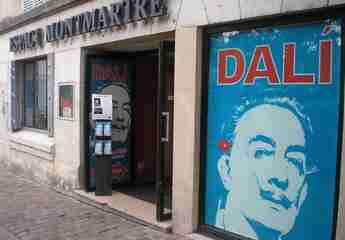
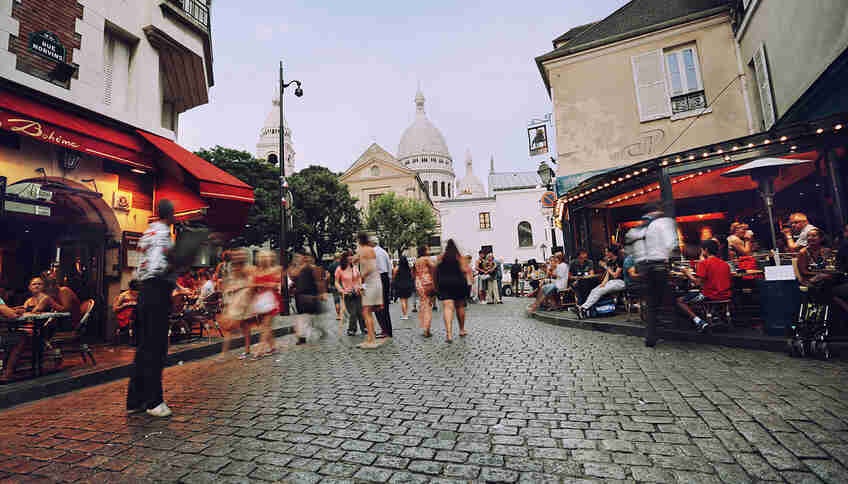
Today Montmartre remains one of the most expensive districts in Paris. Apartment prices here are off the charts. No wonder, because famous people lived here everywhere you look. At the beginning of the 20th century, Montmartre was considered the cradle of bohemia. Renoir, Casas, Van Gogh, Toulouse-Lautrec, Picasso, and many other artists captured the beauty of this cozy district on their canvases. Their success still gives street portrait artists and musicians no peace. For a modest 15-20 euros, an artist from Montmartre (usually wearing a scarf and a cap) will easily portray you against the backdrop of the famous Moulin Rouge cabaret.
Learn more — see the guide to Montmartre!
In some places, the climb up Montmartre is quite steep, but the landscapes that open up from above are incomparable. However, the wine and champagne sold here at every turn are best enjoyed at the top or on the way down, otherwise the way up will seem overwhelming. Looking at the local gray-haired old men who briskly climb the steps, it even feels a little awkward that your feet naturally lead you toward the funicular. In addition, you can reach the top of the hill by minibus, making stops to see the main sights of Montmartre.
The film "Amelie," released in 2001, brought unprecedented popularity to this district. Many of its scenes were filmed in this very area of Paris. The Cafe des Deux Moulins, where Amelie worked in the story, really exists. As do the greengrocer's shop, the railway station, and the cozy streets of Montmartre. True, they had to be thoroughly cleaned of dirt and numerous graffiti. But the number of tourists wanting to see these places with their own eyes increased many times over. The above-mentioned cafe even started baking special buns called "Amelie."
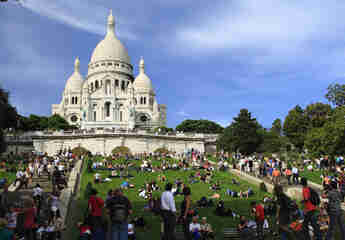
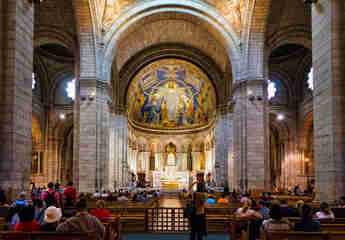
There are three churches on the hill: the Sacre-Coeur Basilica, the Church of Saint-Jean-de-Montmartre, and the Church of Saint-Pierre-de-Montmartre. Sacre-Coeur, or, as it is also called, the "Basilica of the Sacred Heart," is located at the very top of the hill, at an altitude of 130 m. Inside, it is decorated with mosaics and multicolored stained-glass windows. The wide staircase that worshippers descend when leaving the church opens onto a magnificent panoramic view of the whole city. Couples in love like to come here, and tourists also wander here by the hundreds.
You can hear more about all the most remarkable places of Montmartre by downloading the Paris audio guide in the Ever.Travel mobile app.