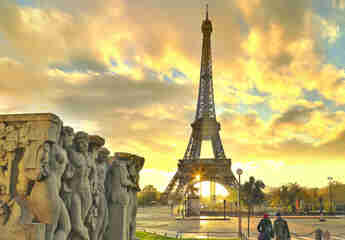
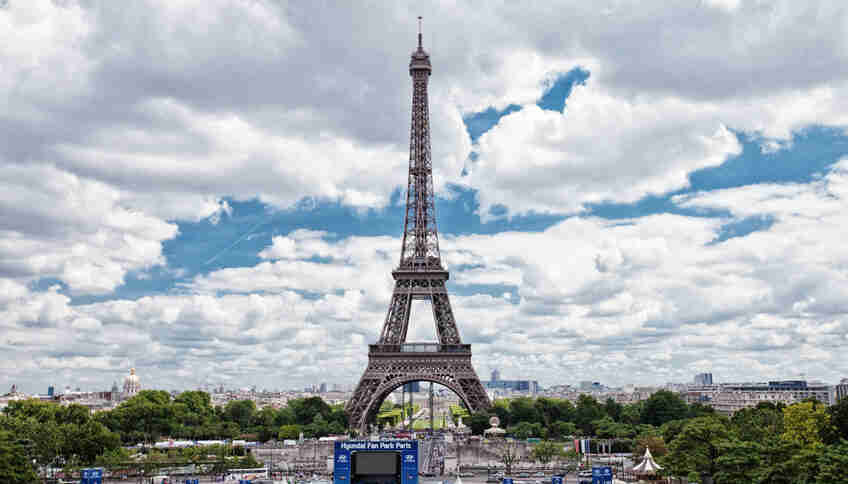

Paris's most famous symbol—the Eiffel Tower—was built in 1889 specifically for the World's Fair. A monumental structure was needed to frame the entrance to the exhibition grounds, one that would emphasize the beauty and grandeur of France. Incidentally, the exhibition itself was held in honor of the 100th anniversary of the Great French Revolution. Since the occasion was so significant, the project preparation was taken very seriously as well, and a competition was announced.
Of course, you can read this story while standing next to the Eiffel Tower. But it's much nicer to listen! By downloading the Paris audio guide in the Ever.Travel mobile app. It's convenient, easy, and much cheaper than the official audio guide to Paris's main landmark ;)
Can you imagine now that instead of the Eiffel Tower, a giant guillotine, a stone tower, or any other structure of stone and metal might have appeared in Paris? Hardly! But those were exactly the kinds of proposals submitted by the competition participants. In the end, Gustave Eiffel's project won. He promised that he would build the tallest tower in the world in just two years.
That is more or less what happened: two years and two months later, the “iron lady” was already gleaming in the center of Paris with fresh paint. It was assumed that the Eiffel Tower was a temporary structure that would be demolished 20 years after the exhibition. But 125 years have already passed, and it still stands in the same place! Moreover, every year thousands of tourists and Parisians themselves flock to it. Naturally, no one would dare demolish it now, but why was it left standing when the first 20 years had expired? After all, the entire creative intelligentsia, including Alexandre Dumas, Guy de Maupassant, Charles Gounod, and many others, was categorically opposed to the “ridiculous tower.”
First, money. It turned out that in just one year after the tower opened, visitor revenue had already covered almost all the construction costs. And the stream of people wanting to visit has not stopped to this day. Second, military purposes - telegraph communications were being rapidly developed. And third, radio and television broadcasting followed: in 1921 the first radio broadcast from the tower took place, and just 4 years later they tried to send a television signal from here.
Today the Eiffel Tower is Paris's main attraction. It has restaurants, observation decks, an ice rink, and a unique weather station. Paris television programs are broadcast from here. The tower houses a transmitter used for communication by the city's police and fire service, as well as a giant beacon at the very top. Its light can be seen 70 km around!
There is even a special patented shade of paint used to paint the Eiffel Tower, and it is simply called “Eiffel brown.” It takes 60 tons of paint to refresh the appearance of “la tour Eiffel”. That is why the procedure is carried out infrequently—once every 7 years. The bottom of the tower is painted in darker shades, and toward the top they become lighter and lighter.
As with all the world's most famous attractions, the Eiffel Tower is illuminated from within at night. Usually it is a steady golden glow with sparkling silvery lights (at the beginning of each hour), but on especially festive occasions the tower is lit in red, blue, or several colors at once (for example, the colors of the French flag).