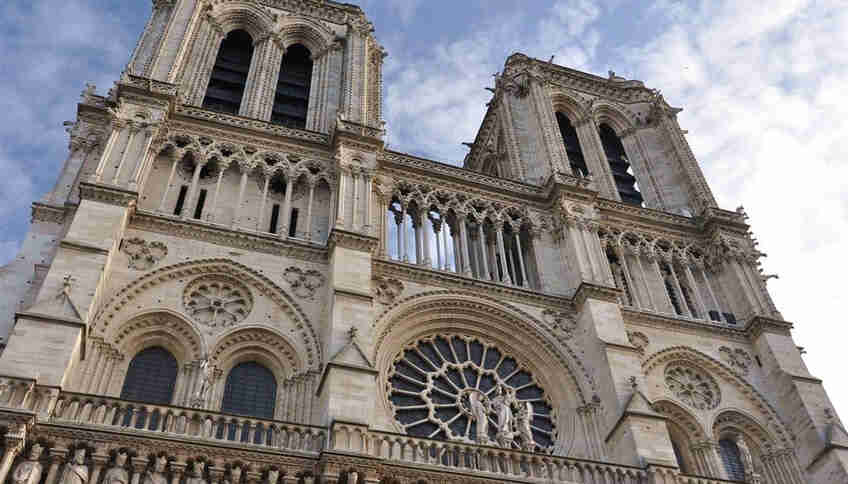

No list of Paris attractions can be considered complete if it does not include Notre-Dame Cathedral.
It is not only the architectural jewel of the French capital, but also the “heart” of its spiritual life. The Catholic cathedral Notre Dame de Paris was built on the very spot where the first Christian church of Paris once stood – the Basilica of St. Stephen, and before it there was a Temple of Jupiter here, erected by the Romans. Therefore, this place is not merely sacred, but hallowed by thousands of generations.
Before visiting Notre-Dame de Paris, don't forget to download the audio guide to the famous cathedral in the Ever.Travel mobile app.
The construction of Notre-Dame de Paris lasted almost 200 years (from 1163 to 1345). The height of the cathedral reaches 35 m, and the length is 130 m. According to some estimates, it is large enough to fit a twelve-story building inside. Initially, it was assumed that the Cathedral should be of such dimensions that, in the event of danger, all the inhabitants of Paris (then around 10,000 people) could take shelter in it.
Architecturally, Notre-Dame de Paris is a successful combination of the Romanesque style and the Gothic style that replaced it. Inside the Cathedral there is not a single load-bearing wall. The building stands on columns that are connected to each other by arches. The absence of paintings on the walls is more than compensated for by stained-glass windows and graceful sculptures. In the 17th century many of them were badly damaged, but were later reconstructed.
The Cathedral houses unique relics that believers can see on the first Friday of every month, as well as on Good Friday during Lent for Catholics. During the service they display the Crown of Thorns of Jesus, a fragment of the Cross that he carried, and even a nail taken from his hand. But usually so many people gather that not everyone gets to see it with their own eyes.
It is better to come here on any Sunday and listen to the organ, which is considered the largest in France. This is absolutely free, as is the pleasure of hearing the giant bell near which the famous hunchback Quasimodo suffered in Victor Hugo's novel.
The eerie creatures – gargoyles – did not appear on the walls of the Cathedral immediately. They were installed during the reconstruction in the 13th century. They are not merely decorative elements, but also help channel rainwater away. The word “gargouille” itself translates as “gutter,” so during downpours streams of water pour from their mouths and are diverted away from the walls and foundation of the Cathedral to protect them from destruction.
And the sculptures at the base of the towers of Notre-Dame de Paris are called chimeras. These are ugly fantastical creatures that embody the forces of evil and human sins. They have no function other than decorative. Although some parents also scare their children with them so that they behave a little more calmly.