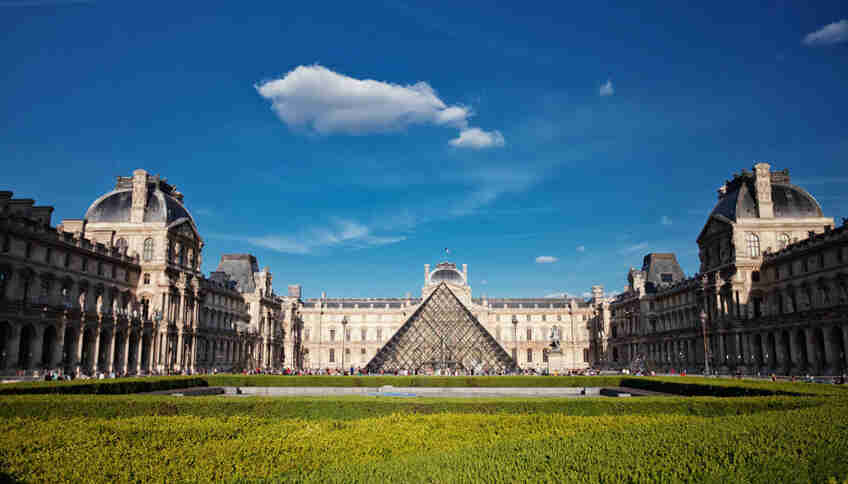

The Louvre in Paris is one of the largest and most visited museums in the world. It is located in the very heart of the French capital and covers more than 160,000 square meters. The Louvre became a museum in 1793; before that, the palace served as a royal residence (from the 16th century), and even earlier, as a fortified castle (from the 12th century). Incidentally, the remains of the ancient fortress can still be seen today—a wooden walkway runs along them, so you can stroll beside the base of the walls, which are already about 900 years old. It is hard even to imagine how much these stones have "seen" over their many centuries of history!
The grounds of the Louvre are enormous—with numerous buildings, all kinds of entrances, exits, and passageways. It is very easy to get lost here. But the main masterpieces of art are marked in different colors on the maps that are handed out when you buy your ticket. First and foremost, everyone wants to see Leonardo da Vinci's Mona Lisa, the statues of Venus de Milo and the Winged Victory of Samothrace. Tourists always crowd around them. And so that a distracted visitor does not hold up everyone else, guards are always posted here to make sure the line keeps moving. So stories about someone standing in front of the painting for half an hour, mesmerized by Mona Lisa's smile, are, to put it mildly, exaggerated.
Learn more about which exhibits at the Louvre deserve special attention by downloading the Paris audio guide in the Ever.Travel mobile app.
Of course, it is impossible to see the entire Louvre in one day. Especially if you have simply decided to drop in here to tick it off while seeing Paris's main sights. The museum contains more than 400,000 exhibits, and there are both permanent and temporary exhibitions. To avoid the feeling of rushing through everything, it is better to plan your route in advance and identify the works of art that interest you most.
After the release of The Da Vinci Code, visitors have become interested not only in the Louvre's collections, but also in the glass pyramid located in the Napoleon Courtyard. It was built in 1989, when there was an urgent need to increase the capacity of the Louvre's main entrance. At the same time, natural light had to be brought into the underground halls where the ticket offices are located. The project was led by I. M. Pei, an American of Chinese descent. His creation was subjected to unprecedented criticism from the public. Pretty much everyone had something to say then on the subject of "How badly this awful pyramid spoils the overall appearance of the building." It was much the same with the world-famous Eiffel Tower, which many people initially called a "giant lightning rod." But in both cases, people gradually accepted it, and now the glass pyramid is perceived as an integral part of the Louvre. Incidentally, there is not just one pyramid: there are three smaller ones next to it, which serve as a kind of portholes for the interior spaces.