Updated for 2026: Passeig de Gràcia is still one of Barcelona's busiest and most elegant avenues, so expect crowds, book popular interiors ahead when you can, and come early if you want quieter photos.
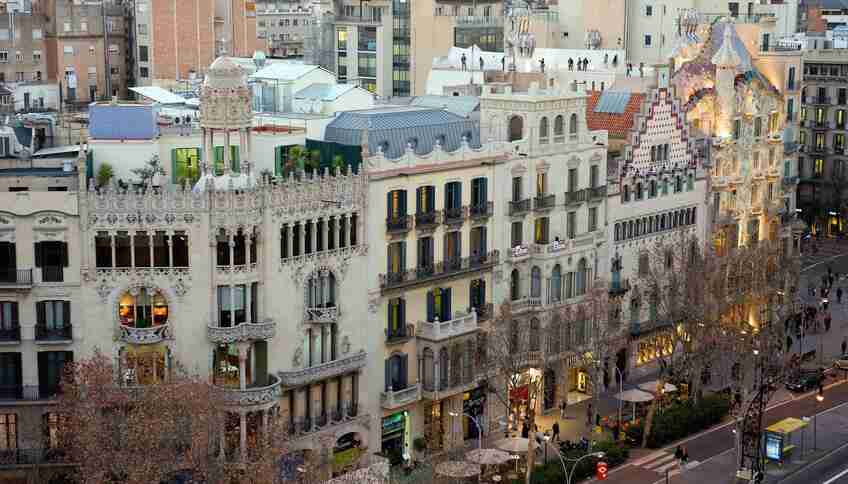
The name of this famous block in Barcelona's Eixample district is a nod to the myth of the apple of discord. On one short stretch of Passeig de Gràcia, some of the biggest names in Catalan modernisme—Lluís Domènech i Montaner, Josep Puig i Cadafalch, Enric Sagnier, and, of course, Antoni Gaudí—seem to be competing to see who could create the most memorable facade.
If you walk up Passeig de Gràcia from Plaça de Catalunya on the left-hand side, by the third intersection you will already spot Casa Lleó Morera, easy to recognize by the turreted rotunda on its roof. It was completed in 1906 to a design by Domènech i Montaner. Sadly, not all of the original sculpture that once decorated the facade has survived.

Flickr, Khraym The Cheetah
Next door is Casa Mulleras, designed by Enric Sagnier and completed in 1905. It is a fine example of classicism meeting modernisme, even if its facade is far more restrained than its neighbors.

Wikimedia, Pere López
A little farther along stands Casa Amatller, built by Puig i Cadafalch in 1900, with its stepped gable, carved details, and wrought-iron balcony railings.

Flickr, Rajan Raju
Just a few steps away is the extraordinary Casa Batlló, originally built in 1877 and dramatically reworked by Gaudí in the early 20th century. The whole building feels fluid and organic. The facade is partly covered in broken-ceramic mosaic, and its colors shift from gold to greenish blue. The carved stone details were made from stone quarried on Montjuïc. Some people see knights' helmet visors in the balconies; others see skulls.

Photo by Alina Kovalevich
That is exactly why this stretch earned such a memorable name: beautiful buildings, standing shoulder to shoulder, yet each with a completely different personality.
If you continue another three blocks north along Passeig de Gràcia, you will come to another of Gaudí's Barcelona landmarks: Casa Milà, famous for its rippling facade and spectacular roof terrace. If you are a real admirer of this brilliant Catalan architect, explore Barcelona with our Gaudí guide. You can also check out other self-guided walks around the city:
Or browse the interactive map of Barcelona attractions. It is a handy way to keep the places you want to see together, especially alongside the free Ever.Travel mobile app. That way, information about the Block of Discord, Casa Batlló, and other Barcelona sights is easy to pull up while you are out exploring. Read more about it here.