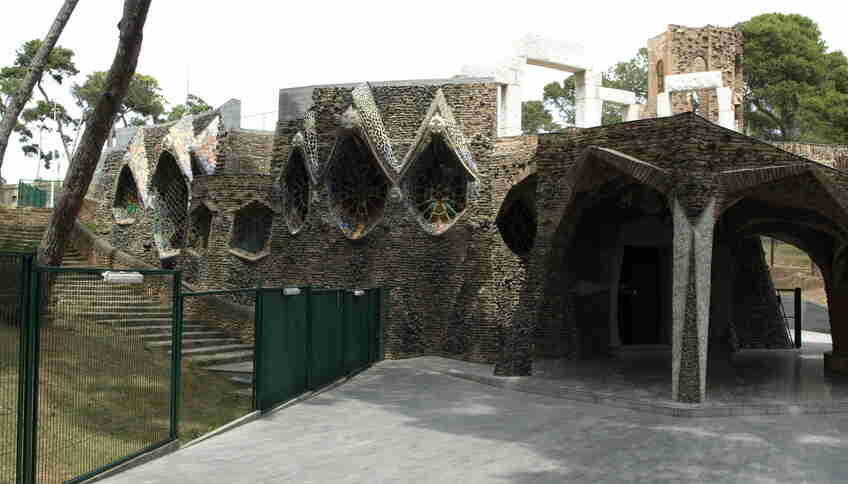
Half an hour from Barcelona, in the town of Santa Coloma de Cervelló, there is one of Antonio Gaudí's creations, not the most famous, but no less original and significant.
Strictly speaking, this outstanding architectural monument is not a church. Due to funding problems, the great architect's plan could not be fully realized: only the lower part of the building — the crypt — was built. The spacious bright room fits so well into the surrounding space that it resembles a natural cave rather than a work of human hands.
The stone vault is supported by basalt columns, each unlike the others and arranged in a chaotic order. The angles and arches of the ceiling structures were calculated using a unique technology far ahead of its time: Gaudí hung bags of shot on chains and, based on their tension, determined what, where, and how to build. Today such models are created with the help of a computer, but at the time this was a real technological breakthrough.
The place where the crypt is located is also interesting. At the end of the 19th century, Spanish manufacturers began moving their production facilities outside the city. This was partly dictated by economic benefits, partly by ideas popular at the time about the possibility of creating an urban environment of a fundamentally new type. Around factories and manufactories, "colonies" appeared — autonomous settlements for workers, which, in addition to residential houses, had schools, shops and churches — all the social infrastructure relevant at that time. One of them was built for the employees of his textile factory by industrialist Eusebi Güell, a well-known patron and supporter of Antonio Gaudí. The main work on designing and planning the colony was undertaken by Gaudí's student and assistant, the talented modernist architect Francesc Berenguer.